


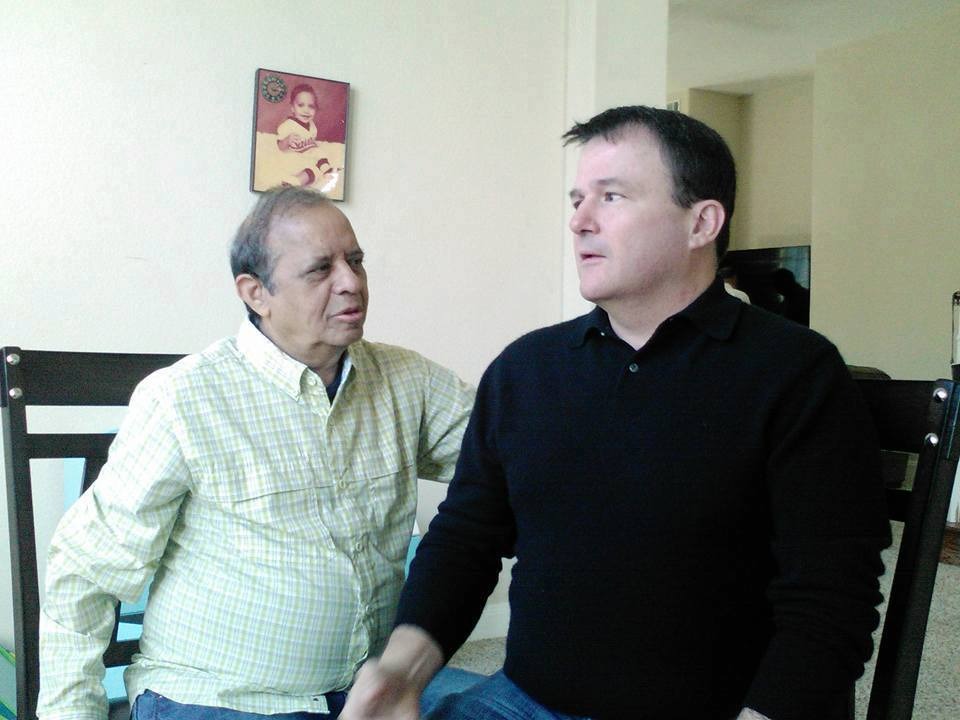
Growing up in a conventional environment in India where healing was regarded more as a pastime than a respectable vocation, as a young man, Mohan Sadashiv Joshi chose the security and respectability of a conventional career, joining the State Bank of India. Little did he know that this very job would lead to an unexpected experiment that would change the course of his life, leading him down an entirely unexplored path.
What makes his journey particularly remarkable is that he built his career as a healer without formal training and earned a reputation in the 1980s—the pre-digital era—without social media, online promotion, or organized publicity. His success rested entirely on word of mouth, his growing list of people seeking his help eventually including politicians, bankers, industrialists, businessmen, and other prominent personalities.
“I sometimes wonder whether I was destined to become a healer. Surprisingly, I never intended to practice healing or imagined that it would become my life’s mission,” says Joshi.
Recalling his unexpected career transition, he says that at 17, he began studying astrology and became proficient within a few years. While working at the State Bank of India, he offered astrological guidance to people in his spare time. It was during this period that an unexpected encounter changed the course of his life.
Dr Ramakant Keni of Bombay Hospital, who headed its Department of Parapsychology, approached him for astrological guidance. To Joshi’s astonishment, Dr. Keni predicted that he would become a good healer.
“Initially, I could not believe him. The idea that someone could be healed through touch seemed almost unthinkable to me,” he says, adding: “I must make one thing clear: Dr. Keni was not my guru, nor did anyone formally teach me healing.”
Curiosity, however, prompted Joshi to experiment. He decided to try his hands on his own boss at the SBI Woodhouse Road Branch in Mumbai’s Colaba, who was suffering from pain associated with a ganglion.
“To my surprise, his pain subsided within a day or two, and the swelling disappeared over approximately 45 days. This unexpected experience changed my outlook and inspired me to explore healing seriously.”
What began as a simple experiment gradually became a lifelong dedication. He says he can’t say whether it was destiny or divine grace: “I only know that I never planned to become a healer; life led me to this path.”
“For me, healing has become more than a practice—it is a mission of compassion, service, and gratitude,” Joshi says.
After that experiment, he began reading books on healing to understand the possibilities of a practice that was still unfamiliar to him.
A different understanding of healing
Joshi began his healing journey in 1980, when healing systems such as Reiki and Pranic Healing were not widely known in India. His approach evolved independently.
“I did not learn healing from books, follow a prescribed technique, or rely on elaborate procedures. My approach developed through personal experience, observation, and years of serving people who came to me seeking relief.”
His method is remarkably simple. He gently places one hand on a person’s head and the other on the spine or back for a few minutes, sincerely wishing for their well-being. He then remains still for a few moments. For him, the essence of healing lies in the intention to help, followed by quietness and stillness.
“I simply offer my presence with compassion and leave the mystery of healing unexplained.”
Joshi describes his approach as blessings of a mother or the compassionate touch of a saint. “I believe healing, at its heart, is a simple act of love and compassion for someone who is suffering.” He adds that a healer must learn to become a medium rather than attempt to bring about healing through personal effort.
To explain this, he offers the analogy of an electric wire.
“Let us consider an electric wire. It allows electricity to pass through it without claiming ownership of the energy. Similarly, a healer, in my understanding, should become a humble channel rather than constantly trying to make healing happen through personal effort, techniques, or mental activity.”
For Joshi, knowing that a healer is merely a channel and actually becoming one are two different things. Degrees, certificates, and knowledge of elaborate techniques may demonstrate learning, but they do not necessarily teach a person how to surrender the mind, become still, and serve without personal interference.
He is equally uncomfortable with healing becoming a commercial enterprise.
“When helping the suffering becomes merely a business, the spirit of unconditional love and compassion can be overshadowed by financial considerations.”
Beyond techniques: The question of healing
Joshi’s philosophy raises a larger question about the relationship between healing, medical science, and the numerous unconventional healing systems that have emerged over the years.
He observes that millions of people worldwide have acquired healing qualifications and learned different modalities. Yet, healing has not proven reliable enough to replace conventional medicine.
“Perhaps this explains why healing has yet to demonstrate a reliable ability to replace conventional medicine. I believe its greatest potential should be explored where medical science has limited answers, always as a complement to appropriate medical care.”
He does not claim to understand the ultimate mechanism behind healing. Instead, he believes that scientists and researchers should investigate it.
Say Joshi: “My role is not to claim that I understand the mechanism but to continue serving those who seek my help with humility, sincerity, and compassion.
“I do not wish to make extraordinary claims or challenge the medical profession. I would simply like an opportunity to demonstrate, through a transparent and independently observed session, what may be possible through the simple touch of a healer.”
He hopes to explore whether people experiencing pain, migraine, insomnia, and certain functional disorders may experience relief through his approach, sometimes within minutes or over a few days. He wants to observe and investigate these experiences independently rather than accept them on faith.
“I do not ask anyone to believe me; I only request an opportunity to witness, observe, and investigate.”
His intention, he says, is to bring the worlds of healing and medical science closer through open-minded observation, mutual respect, and a shared desire to reduce human suffering.

Serving the ordinary person
While his philosophy may be rooted in meditation and surrender, his work has always been grounded in the everyday struggles of ordinary people.
Joshi expanded his healing work around 1982, treating 30–40 people daily, many of them poor textile workers unable to afford medical care. He estimates having helped over 100,000 people across social backgrounds. His work attracted newspaper and magazine coverage and took him to several Indian cities through healing camps. His clientele included over 100 distinguished personalities, among them industrialist Dhirubhai Ambani, the late politician Balram Jakhar, writer Suresh Khare, actors, chartered accountants, and advocates. Yet, he never allowed social standing or influence to determine his approach to healing.
“I never approached a dignitary seeking an opportunity to treat them. They approached me.”
Sometimes, a car driver’s experience would prompt the owner of the vehicle to seek his help. This was how word of his work spread across different social and economic groups.
His healing service, he says, was always free and unconditional. He never measured a person’s worth by wealth, position, influence, or social standing.
“If I have any achievement to cherish, it is not the over 100 dignitaries I had the privilege of treating, but the more than 100,000 ordinary people who came to me with hope.”
His healing sessions were open to all, often drawing dozens of people. Though journalists from many publications reported on his prominent clients, he never publicized their names. For him, serving ordinary people and earning their trust mattered most.
A family connection
His daughter, Rashmi Deshpande, assisted him in healing sessions until her marriage in 2003. Joshi believes she has healing abilities of her own, though her practice paused after marriage and subsequent relocations to Delhi, Thane, and eventually the Midwestern United States.

Taking healing across borders
Joshi’s association with the United States began in 1998, when his son moved there. He subsequently visited the country many times before eventually making it his permanent home in 2021. Today, he lives in Sunnyvale, California.
“It was a major change in my life, but I carried something far more important than belongings or possessions—my lifelong commitment to healing and serving people who suffer.”
Joshi has been inspired by well-known healers Edgar Cayce, Harry Edwards, and José Arigó. “Their accounts encouraged me to explore the possibility of serving suffering humanity through healing. At the same time, the teachings of Patanjali’s Yoga Sutras helped me understand the importance of controlling the fluctuations of the mind and cultivating inner stillness,” he says.
He conducted healing camps in Dallas (2016) and Herndon, Virginia (2017–18). In 2017, he was invited to teach his approach at a Brazilian spiritual healing center, a humbling opportunity for a self-taught healer.
Forty-four years, one unchanged approach
Looking back on his over four decades of healing, Joshi says that his approach and basic understanding of healing have remained the same. “ I have never felt the need to surround my practice with elaborate techniques or complicated procedures,” he says.
He places his hands on a person’s head and back for a few minutes. The process may be repeated once a week for several weeks, depending on the individual’s circumstances and response.
“Yes, one thing has certainly grown over the years—my confidence. This has come naturally through the experiences, observations, and feedback of thousands of people who have approached me seeking help.”
The experiences of those who have approached him have taught him much, but he does not believe he has mastered the mystery of healing.
Perhaps that is what distinguishes his understanding of the practice. Despite the passage of time, he continues to approach each person with the same simplicity and sincerity with which he began.
His service remains open to everyone, irrespective of wealth, status, or position. Although some people voluntarily offer payment out of gratitude, he says it is never a condition for receiving healing.
Whether by destiny, divine grace, or chance, Joshi never planned to become a healer. Life led him there, and after four decades, he remains a humble instrument committed to serving those who suffer.
And perhaps that is the most enduring conviction behind his journey: “Healing is not about performing a technique; it is about becoming a humble instrument of compassion. The healer must learn not to do it but simply to allow it.”
For more on Mohan Sadashiv Joshi, visit his website: https://www.healmohan.org/

Leave a Reply