


What if a prayer could become more than words?

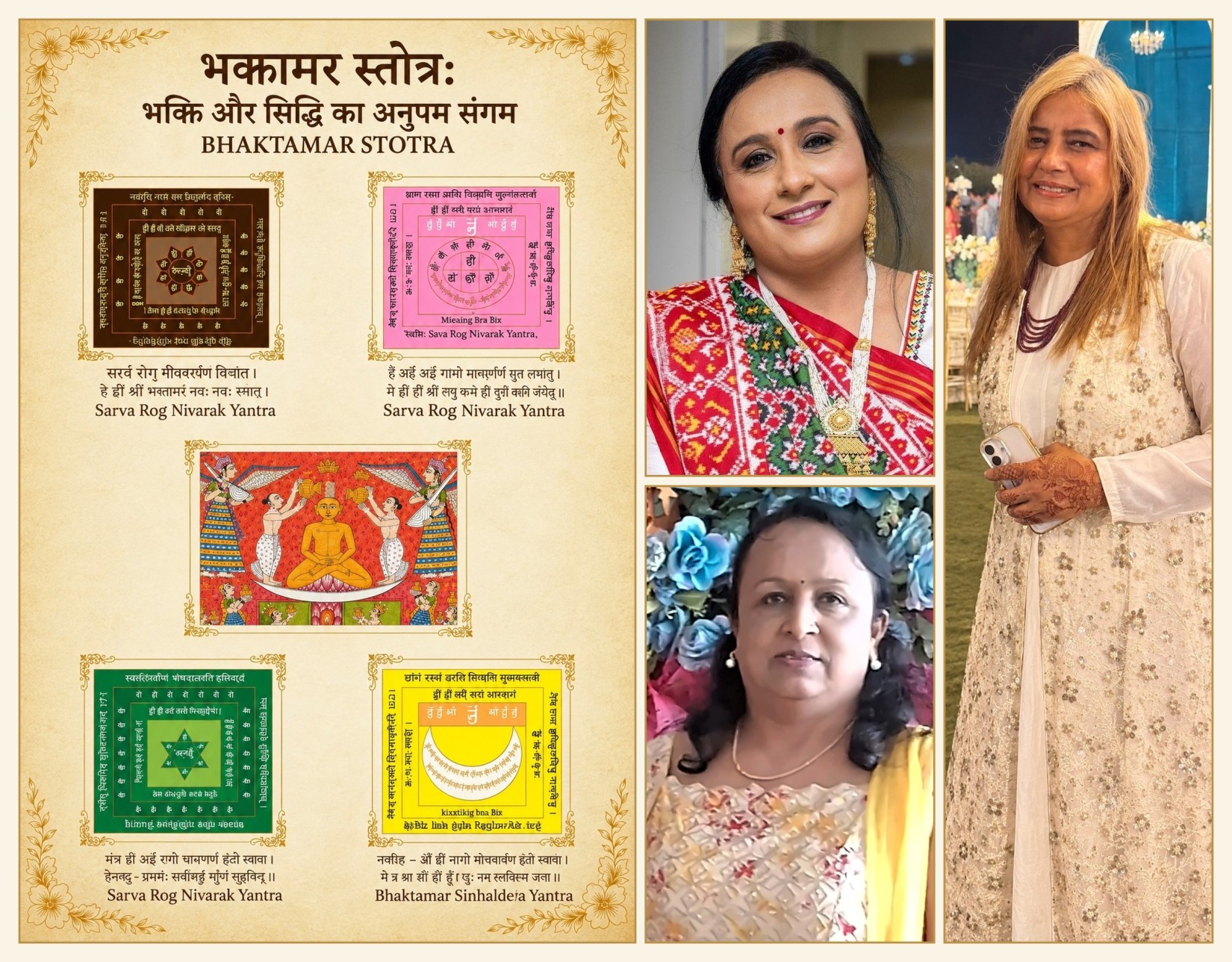
For centuries, the Bhaktamar Stotra has been recited within the Jain tradition as an offering of devotion to Lord Adinath – the first Jain Tirthankar named Rishabhdeva. Composed in Sanskrit and comprising 48 verses, Bhaktamar Stotra (The Hymn of the Immortal Devotee) invokes surrender, reverence and spiritual contemplation. Its authorship is ascribed to a Jain monk, Acharya Mantungasuri, in the 7th century. For those who practice it deeply today, Bhaktamar is not simply something to be recited. It is something to be experienced, something to be explored for healing and personal growth.
The stotra’s enduring appeal lies perhaps in this very possibility – that an ancient prayer can continue to reveal different dimensions to those who approach it with faith. Jainism is an ancient Indian religion that focuses on spiritual purity and liberation of the soul through a strict path of nonviolence (ahimsa) toward all living creatures
Made aware of Bhaktamar, a less known Jain system of healing, by Neil Doshi, a friend in New Jersey, we spoke to two practitioners whose journeys with the stotra offer two complementary perspectives. Sejal Dipan Mehta, a Bhaktamar teacher based in Mumbai, explores its dimensions through sound, mantra, meditation and what she describes as energetic and healing applications. Hetal Kothari, an expert in occult sciences and numerology based in Rajkot, Gujarat, brings a more personal and devotional perspective, rooted in a lifelong connection with the stotra and its ability to foster inner strength and transformation.
While researching the topic, we came to know the Bhaktamar pioneer, Dr Manju Sandeep Jain, who is behind the resurgence of the stotra. Based in Nagpur, she has devoted over two decades to researching and teaching Bhaktamar and its healing potential. Her work brings together the stotra’s 48 verses with their meanings, chanting, meditation, mantras and yantras.
Dr Manju Jain spoke to A Lotus in the Mud editor Parveen Chopra.

Dr Manju Jain: Childhood memory to a global Bhaktamar mission
Dr. Manju Jain’s relationship with Bhaktamar began in childhood, watching her mother recite the stotra for people and even for Jain monks who had fallen sick. In her own family, Bhaktamar was recited whenever someone fell ill, and the recoveries she witnessed left a lasting impression on her.
Years later, those memories led her to a more systematic exploration of the stotra’s healing powers. “I thought, let me take up this research myself. And if I find it works, then I will take it to the medical fraternity,” Dr Manju says.
In 2007, she began working with patients at a hospice in Nagpur in Indian state of Maharashtra, where many were considered beyond curative treatment. For some, she would chant Bhaktamar shlokas and observed unexpected improvements, including patients living considerably longer than anticipated. These initial findings led her towards academic research, culminating in a PhD focused on the 45th Bhaktamar shloka, which is associated with incurable diseases. Her father, a radiologist, supported her research. Zoroastrian College, affiliated with the Open International University for Complementary Medicines in Sri Lanka, granted her the Ph.D.
The 45th verse in original Sanskrit is:
उद्भूत-भीषण-जलोदर-भार-भुग्नाः, शोच्यां दशा-मुपगताश्-च्युत-जीविताशाः ।
त्वत्पाद-पंकज-रजोमृतदिग्ध-देहाः, मर्त्या भवन्ति मकर-ध्वज-तुल्य-रूपाः ॥ ४५॥
It highlights that true spiritual surrender and meditation on the pure attributes of the Tirthankara (Lord Rishabhadeva) can transform intense physical and mental suffering into health and joy.
Since formally beginning to teach in 2011, Dr Jain says she has trained thousands of people in Bhaktamar chanting and healing under the aegis of Global Centre for Bhaktamar. Her approach combines the 48 shlokas with their meanings, meditation, mantras and yantras, with an emphasis on their practical applications. She believes different shlokas can be applied to different areas of life, including health, academic achievement and other challenges.
Before devoting herself fully to Bhaktamar, Dr Manju spent 15 years in her family’s windmill-tower manufacturing business. She has studied systems including Reiki and Pranic Healing, but her focus has remained Bhaktamar.
Her international outreach has included teaching in the United States, programs with the Jain community there and presentations at conferences. She has presented her work at the Psycho-Oncology World Congress in in Lisbon in 2014, and in Washington, D.C., in 2015, and has worked with students at Loyola Marymount University in Los Angeles.
Dr Manju’s mission to promote Bhaktamar has evolved into a larger vision to make its practices accessible to people beyond traditional Jain settings. She has worked with children, trained practitioners internationally and developed a network of teachers and healers. She also envisions a Bhaktamar Divine Shrine centered around the 48 shlokas, with each represented by a separate dome and yantra. She has organized a Bhaktamar Healing conference on September 30, 2026 in Nashik, Maharashtra.

Sejal Mehta: Deepened relationship with Bhaktamar during Covid
Sejal Mehta has spent many years studying, practising and teaching the Bhaktamar Stotra. For her, the name Bhaktamar (literally, immortal devotee) carries its essence. For her, the stotra is more than a hymn, it is an important part of the Jain spiritual tradition.
Her appreciation for Bhaktamar deepened during Covid. “I learnt Bhaktamar during the pandemic and it helped me tremendously,” she recalls. When she began applying the system to others, she claims to have witnessed people recovering from serious illnesses, some returning home from hospitals. These experiences inspired her to explore Bhaktamar further as a system of sound, vibration and spiritual healing. She went on to receive a PhD for her Bhaktamar work from The Thames International University in Paris.
At her Shree Rushabh Bhaktamar Healing Centre in Mumbai, Sejal teaches what she calls the “nanotechnology” of Bhaktamar and “drugless therapy.” By these terms, she means a framework of distilling the stotra into increasingly subtler forms of sound and practice – not nanotechnology as known in science and engineering.
Sejal explains that she progressively compresses the stotra’s verses into sentences, beej aksharas, swaras, mantras, and ultimately individual beej sounds. She also works with the musical dimension of Bhaktamar, including its rendition in Kangra Raga, and has developed what she calls “frequency codes,” “switch codes” and “beej-mantra words” for the stotra to be more effective when used.
According to Sejal, each particular verse is associated with a specific concern, so a Bhaktamar practitioner need to work with one particular verse or its distilled form rather than undertaking all 48 verses every time. She believes this makes the practice more accessible, especially to children, elderly people or those who are ill. “Even someone in a hospital who cannot do a long practice can simply work with a beej word,” she says. She sometimes recommends the most distilled form of the stotra: writing a frequency number on the wrist or meditating on a Bhaktamar symbol at the Ajna chakra in the middle of the forehead. She claims that specific verses have been successfully used for concerns ranging from serious illnesses and conception-related difficulties to digestive problems, and educational challenges.
For Sejal, the Bhaktamar practice requires discipline and intention. She encourages those beginning to use it to abstain from meat and alcohol and to approach it with innocence and purity. “It is magical,” she says, but your consciousness is as important as the technique.
Her mission is to make this ancient knowledge accessible to contemporary audiences. She has taught aspects of Bhaktamar even to Jain sadhus and wants younger generations to engage with the stotra no matter that it is in Sanskrit.
Through her Mumbai center, she teaches the complete 48 verses in an intensive format, along with their associated practices, and offers group and individual sessions. She also initiates those who wish to become healers.
She has won many awards for her pro bono Bhaktamar work and has traveled to Dubai in that connection.

Hetal Kothari: The inner transformation with devotion
For Hetal Kothari, Bhaktamar is rooted in devotion. It began in her childhood when the religious atmosphere at home and the melodious chanting of the stotra drew her in. “Initially, it felt like a beautiful and calming recitation. But as time passed, I began to experience the profound devotion and faith of its author, Acharya Mantungasuri,” she recalls.
With a background in occult sciences and numerology, Hetal has long been interested in the deeper patterns underlying spiritual traditions. Yet her connection with Bhaktamar remains intensely personal. During difficult periods in her life, the stotra became a source of mental strength and positive energy. She says, “Through its regular recitation, my patience, inner peace and mental stability have grown. I remain calm even during times of stress and anxiety.”
For her, the transformation is primarily inward. She believes Bhaktamar can cultivate faith, courage and resilience while helping quieten fear and negative thoughts. The first verse, expressing devotion and surrender to Lord Adinath, and the sixth hold particular significance for her. “These verses teach us to let go of ego and embrace humility,” she says.
In Hetal’s view, “Bhaktamar is not merely the chanting of words; it is the voice of the soul.” She believes its deeper value lies in allowing the verses’ meaning to influence how one meets life’s challenges.
That is why she advises newcomers to approach the stotra with understanding and sincerity. “When you understand the meaning, your devotion deepens.” Above all, “Chant with a pure mind and complete devotion, free from ostentation. The feeling in your heart matters far more than mere pronunciation.”
Like Sejal, Hetal too has traveled to Dubai to do a presentation on Bhakatamar.
Where Sejal Mehta explores Bhaktamar through its structures, sounds and healing applications, Hetal returns to its devotional core and awakening within the person – the possibility of becoming calmer, more humble and more resilient through devotion. Dr Manju Sandeep Jain is, of course the Global Mother Bhaktamar.
Contacts:
Dr. Manju Jain can be contacted through her website: www.drmanjujain25.com
Sejal Mehta Ph: +91 91670 09224; https://www.instagram.com/shreerushabhbhaktamarhealing/
Hetal Kothari: +91 9173021513
Resources:
Bhaktamar Stotra with meaning in Hindi:
https://jaingyandarshan.wordpress.com/2016/01/05/1492/
Bhaktamar Stora recited by Anuradha Paudwal: https://www.youtube.com/watch?v=RZY6kVsNwSQ
Healing stories from Dr Manju Jain’s practice

Dr Manju Jain’s files have quite a few cases of miraculous Bhaktamar healing. One woman in America, she narrates, had almost lost her voice. After practising a particular shloka, the woman regained around 75% of her voice. She and her husband later travelled to India, where Dr Manju and her assistants worked with her for seven days and she subsequently recovered her voice almost completely.
Another case Dr Manju recounts involved a man from Sacramento in California, who was critically ill with cancer of the blood and bone marrow. He undertook a 21-day Bhaktamar practice along with his wife that included chanting and dietary restrictions. Dr Manju claims his reported cancer-cell count fell dramatically.
Working with children
Dr Manju has also experimented with Bhaktamar-based practices in educational settings. Working with groups of young children, she introduced chanting, stories, meditation and “healing charging of water”. This led to improvements in concentration, behavior and academic engagement. One program involved academically weak children whose psychometric scores reportedly improved after a 21-day Bhaktamar intervention.
These accounts are her own recollections and should not be seen as independent medical evidence.
The role of yantras
Yantras occupy an important place in Jain’s system. She describes them as symbolic and energetic representations of the shlokas, mantras and associated practices rather than simply as tantric objects. She has created a collection of all 48 Bhaktamar yantras in gold, each corresponding to one shloka, and has incorporated them into her meditation centre at home.


Leave a Reply