

In the middle of a city built on diversity, Dr. Mohan Bhagwat, Sarsanghchalak (Supreme Leader) of RSS or Rashtriya Swayamsevak Sangh, placed before his audience an idea that belongs to neither one country nor one community: the possibility that beneath the immense diversity of human life lies a fundamental unity of existence.
At the Universal Oneness Celebration at Madison Square Garden on August 29, Bhagwat spoke to some 5,000 members of the Indian diaspora and guests about a philosophy deeply rooted in India’s civilizational thought. His central proposition was both simple and profound: “We are one, and due to diversity, that oneness is decorated.” He argued that diversity should be celebrated, respected and accepted while the underlying feeling of oneness must never be forgotten.
It was an especially fitting message for New York.
Few places on Earth demonstrate the reality of diversity more vividly. People from different nations, religions, languages and cultural traditions have made this city their home. New York does not derive its character from everyone being alike; its character emerges from millions of differences existing within one shared civic space.
The mystery of the One and the many
Indian philosophy has spent centuries asking a question that remains remarkably contemporary: if everything appears different, what is it that ultimately connects us?
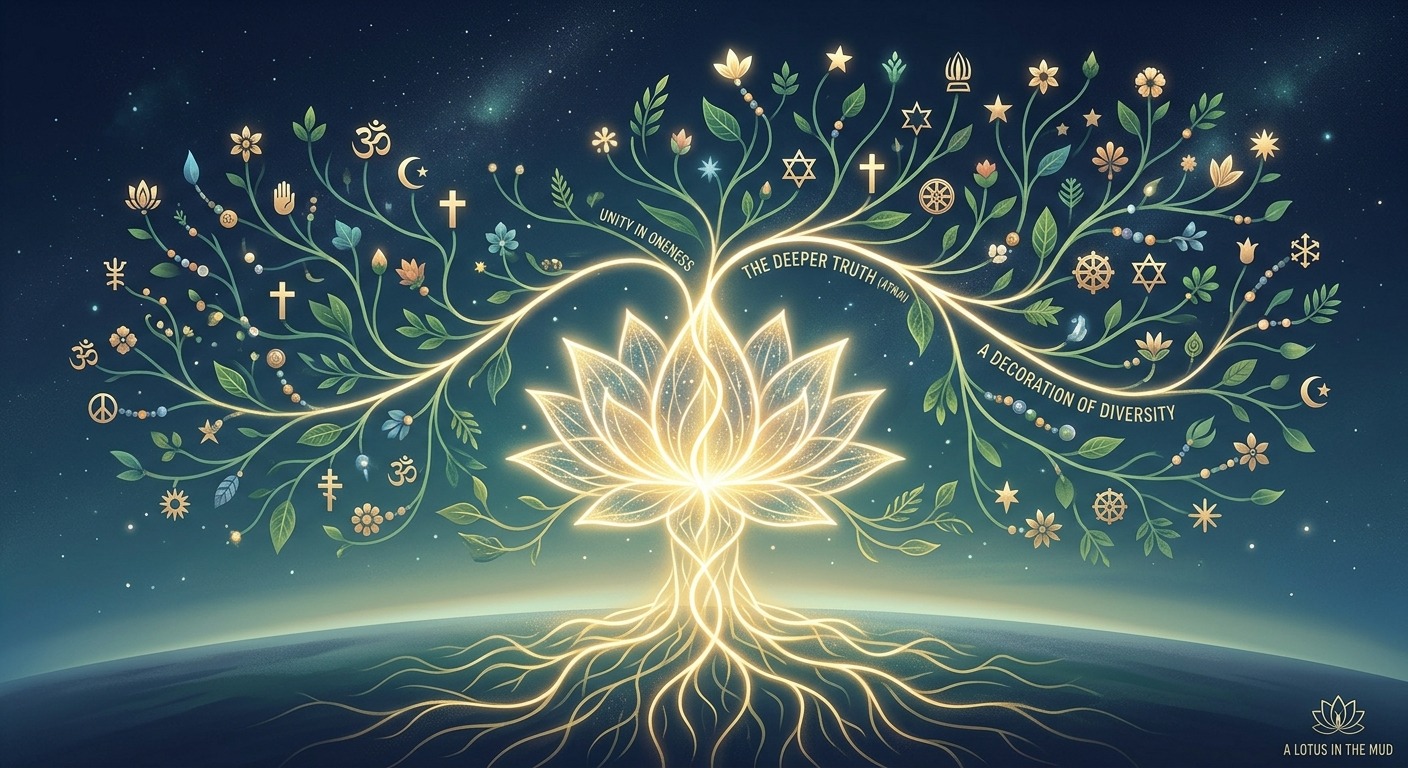
Human beings have different bodies, clothing, languages, customs, beliefs and ways of worship. Yet, Bhagwat said, the Atman is the deeper truth that connects them. He compared humanity to beads in a necklace: the beads are separate and different, but a single thread runs through them all.
The metaphor offers an accessible way to understand a profound philosophical principle.
We see the beads.
We do not ordinarily see the thread.
We notice nationality, religion, profession, wealth, social identity and appearance. But beneath these visible distinctions is the human experience itself—the desire to live, to love, to belong, to find meaning, to protect those we care for and to be treated with dignity.
The diversity is visible. The connection is deeper.
This is where the idea of oneness becomes more than a spiritual abstraction. It becomes a way of looking at another person.
Humanism begins when the other stops being a stranger
The word humanism is often associated with placing human dignity and welfare at the centre of social life. Bhagwat’s philosophy of oneness adds another dimension: perhaps genuine humanism begins when we stop seeing another person’s life as completely separate from our own.
He pointed to the enormous network of relationships behind everyday life.
The food on our table depends upon farmers.
The clothes we wear depend upon workers and industries.
The buildings in which we live and work depend upon thousands of unseen hands.
Modern life itself is an extraordinary demonstration of interdependence.
No individual is completely self-made.
We owe something to someone.
And if our lives are sustained by the contributions of others, then gratitude naturally leads to responsibility. Bhagwat’s message therefore moved from the philosophical idea of oneness towards the practical obligation to give back.
This is perhaps where spirituality meets humanism.
It is not enough to know that we are connected.
We must behave as though that connection matters.
We are one, and due to diversity, that oneness is decorated. Bhagwat’s formulation that diversity “decorates” oneness offers perhaps the most beautiful way to understand pluralism.
The disappearance of enmity
One of the most striking elements of Bhagwat’s address was his reflection on enemies.
He suggested that even when evil or wrongdoing exists, the answer should not be a desire for the destruction of the person. Instead, the wish should be that the person’s “evil buddhi”—wrong thinking—disappears. He described enmity itself as something that can arise from circumstances and human actions rather than being a permanent truth about two people.
There is a powerful psychological insight in this.
Human beings frequently turn temporary disagreements into permanent identities.
Someone disagrees with us, and they become an enemy.
A community behaves differently from ours, and suspicion develops.
A political disagreement becomes personal hostility.
A difference in belief becomes a reason for exclusion.
The philosophy of oneness asks us to interrupt that process.
Reject the wrongdoing, but do not surrender the humanity of the wrongdoer.
That distinction is difficult—but potentially transformative.
It allows justice without hatred, disagreement without dehumanisation and social responsibility without permanent hostility.

Mohan Bhagwat spoke about the need for individual progress, social development and environmental well-being to move together rather than one being sacrificed for another.
Diversity is the decoration of unity
Bhagwat’s formulation that diversity “decorates” oneness offers perhaps the most beautiful way to understand pluralism.
A garden is not beautiful because every flower is identical.
A symphony does not become music because every instrument produces the same sound.
A city does not become vibrant because every neighbourhood looks alike.
Beauty emerges through relationship between differences.
In the same way, unity becomes richer when different cultures, traditions and communities retain their distinctive character while recognising a common human foundation.
This is particularly significant for the Indian diaspora in America.
Indian-Americans do not have to choose between cultural heritage and American belonging.
They can celebrate Diwali and Thanksgiving.
They can speak English and an Indian language.
They can carry stories from grandparents while building careers in Silicon Valley, New York, Houston, Chicago or Boston.
Their identity can be expansive rather than divided.
Janmabhoomi and Karmabhoomi
Bhagwat’s message to the diaspora also carried a strong emphasis on responsibility towards one’s Karmabhoomi—the land where one lives and works.
He urged Indian-Americans to be loyal to America and fulfil their responsibilities towards the country in which they live, work and earn, while recognising Bharat as their janmabhoomi. Contributions to Bharat, he suggested, can follow the fulfilment of one’s responsibilities to the Karmabhoomi.
There is something deeply relevant to the modern diaspora in this idea.
Roots need not compete with belonging.
A person can remember where they came from while sincerely serving the place where they are.
The diaspora can therefore become a bridge between cultures—not because it belongs incompletely to either, but because it understands both.
For America, this means an Indian heritage that contributes to the American story.
For Bharat, it means a diaspora that carries its civilisational values into the wider world.
And for the next generation, it means that identity does not have to be a choice between “here” and “there.”
Beyond wealth: the human purpose of prosperity
The Madison Square Garden address also questioned the idea that material abundance alone can provide lasting happiness.
Bhagwat used the example of a doughnut to explain how even something pleasurable can lose its appeal when consumed excessively. His broader argument was that material happiness is temporary and that human beings require a deeper sense of purpose.
This is particularly interesting in a society as ambitious as America.
Success is important.
Prosperity is important.
Innovation is important.
But what happens when achievement becomes the only measure of a life?
Bhagwat offered another measure: what we distribute may matter more than what we accumulate.
His observation that the important question is not simply how much we earn but how much we distribute reframes prosperity as responsibility.
A successful person can create opportunities.
A wealthy person can create institutions.
A knowledgeable person can educate.
A powerful person can protect.
In this vision, the highest form of achievement is not merely rising above others—it is helping others rise with you.
Oneness does not end with humanity
The philosophy of interconnectedness also extends to the natural world.
Bhagwat spoke about the need for individual progress, social development and environmental well-being to move together rather than one being sacrificed for another.
This idea has an unmistakably modern relevance.
Humanity cannot live independently of nature.
The air we breathe, the water we drink, the food we grow and the ecosystems that sustain life are part of one larger relationship.
The environmental crisis can therefore also be understood as a crisis of consciousness.
When humanity imagines itself as separate from nature, exploitation becomes easier.
When humanity recognises itself as part of nature, responsibility becomes natural.
Oneness with humanity and oneness with nature ultimately emerge from the same realisation: we are not isolated.
Humanity begins when we stop seeing another person’s life as completely separate from our own.
A humanism for an interconnected century
The greatest contribution of Bhagwat’s New York message may therefore be its attempt to connect several ideas that are often discussed separately: spirituality, human dignity, social responsibility, diversity, service, diaspora identity and environmental harmony.
Together they form a larger philosophy.
The individual is connected to society.
Society is connected to nature.
The diaspora is connected to its heritage.
Diversity is connected to unity.
And humanity is connected to humanity.
That is the deeper meaning of Vasudhaiva Kutumbakam—the world as one family.
It does not mean that everyone must think alike.
It does not mean that cultures must disappear.
It does not mean that differences should be ignored.
It means that difference should not prevent belonging.
The real test begins after the applause
The significance of a message about oneness cannot ultimately be measured by the size of the gathering or the applause that follows.
It is measured in ordinary life.
When we meet someone whose religion is different.
When we disagree politically.
When we encounter another culture.
When someone weaker needs our help.
When our success gives us the ability to help another person.
When we choose to protect nature even when exploitation would be more profitable.
When we teach our children that being proud of one’s heritage does not require looking down upon another.
That is where oneness becomes real.
Perhaps the enduring image from Madison Square Garden is therefore not the stage itself, but the invisible thread.
Thousands of people may appear different.
Millions of people across America may live different lives.
Billions of people across the planet may speak different languages and follow different paths.
Yet beneath the visible diversity is something remarkably simple.
We are human.
And perhaps the most beautiful expression of Bhagwat’s message is this:
Unity is not the disappearance of diversity.
Unity is what gives diversity a relationship.
Diversity is not the enemy of oneness.
Diversity is the decoration of oneness.
In an age searching for connection, that is not merely an Indian message.
It is a human one.
Many cultures. Many faiths. Many journeys.
One humanity. One Earth. One shared existence.
And perhaps the future of human civilization depends on learning to live as though that ancient truth were already known to us.
Read a report on Mohan Bhagwat’s speeches in New York and Toronto: https://alotusinthemud.com/mohan-bhagwat-rss-universal-oneness-north-america/


Leave a Reply