
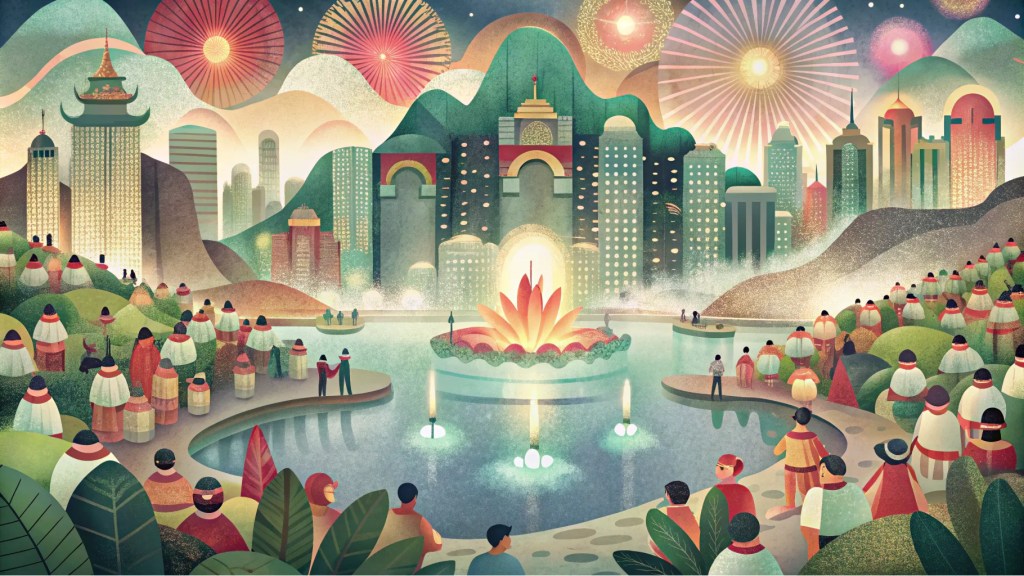


At a time when wars, social divisions, and global uncertainty continue to test the idea of peaceful coexistence, the message of unity offers a renewed sense of hope. Delivering a talk on the topic of ‘Unity in Diversity: A Path to Peace’ on July 19, Dr. Gnanvatsal Swamiji urged people to see differences not as barriers but as the foundation of harmony.
Different colors, one beautiful picture
Drawing a simple yet powerful analogy, the eminent spiritual leader, motivational speaker and author from the BAPS Swaminarayan Sanstha pointed out that “Different-colored crayons come together to create a beautiful picture. Different-colored threads come together to create a beautiful tapestry. Different instruments come together to create a musical masterpiece.” So, diversity does not diminish beauty—it creates it. When differences unite with harmony, they produce something far greater than what any one element could achieve alone, he said.
Gnanvatsal Swami left a successful career as a mechanical engineer in 1992 to embrace monastic life under the guidance of Pramukh Swami Maharaj, the previous spiritual head of BAPS. Today, he is widely respected for his teachings on purposeful, value-based living and has received several honors, including two honorary D.Litt. degrees.
Speaking to an appreciative group of about 75 people at eminent pediatrician Dr Hari Shukla’s house in Jamaica Estates in Queens, New York, Dr Gnanvatsal Swami explained that harmony requires the right balance. He juxtaposed the contrasting qualities of tea and sugar.
“One of the simplest examples of unity in diversity is a cup of tea. Sugar is sweet, while tea granules are bitter—opposites in taste. Yet, when they come together in the right proportion, guided by a skilled hand, they create something delightful that refreshes and energizes us for the day. Alone, they are incomplete; together, they become something far greater,” he said
He likened this to human relationships, saying diversity is not a weakness but a source of strength when guided by higher values.
“Each of us has different opinions, perspectives, and ways of thinking. Diversity is natural, and it enriches our relationships and our world. But when we place ourselves in the divine hands—guided by spirituality, shared values, and a higher purpose—our differences no longer divide us. Just as sugar and tea blend to create a perfect cup, people united through spiritual principles can create a life of harmony, beauty, and peace.”
Referring to the teachings of Bhagwan Swaminarayan, founder of BAPS, he said unity attracts divine strength.
“If crayons of different colors can deliver better results, people with different mindsets can also decide to come together, work together, and live together. Crayons create beautiful pictures; we create a beautiful world. That is the power of unity in diversity.
He continued, “Bhagwan Swaminarayan says, ‘Where there is unity, God’s strength, God’s energy comes into play.’ When God becomes your business partner, resides in your home as a family member, and becomes part of your social circle as a friend, what cannot be achieved in life? Unity in diversity is the utmost need today, especially in the times we are passing through.”
Calling unity one of the essential ingredients of happiness, he said every individual deserves love, respect, and dignity regardless of “caste, color, creed, religion, or nationality.”
The TAAC formula: four habits of creating harmony
To make the idea practical, he shared what he calls the TAAC Formula.
“‘T’ stands for tolerance, ‘A’ for acceptance, second ‘A’ for apology, and ‘C’ for compromise. Everybody has to walk this path so that unity in diversity is maintained in families, social circles, and business circles. These are the four qualities every person must cultivate to live in harmony within their own ecosystem.”

When gossip replaces truth, unity crumbles
But unity is not an easy virtue. One of the biggest obstacles to unity is the way we communicate.
“For instance, I tell you something, but I request you please don’t share this with anybody. Yet, if you cannot keep it to yourself, how can the listener keep quiet? Thus, gossip spreads, trust erodes, and unity breaks,” he said.
Another obstacle is negative propaganda. Human tendency to believe negative things about others without verifying them leads to controversies, strained relationships, and acrimony.
“We don’t go out to check whether it is right or wrong. We don’t have the wisdom to overlook it, and we just believe it.” As a result, friendships and relationships built over decades can collapse because of a single unverified opinion.
To explain this, he recalled an incident from 1984, when Pramukh Swami Maharaj was staying at a devotee named Dr. Shah’s residence in Belgium. During dinner, Dr. Shah observed that when people discover a fault in someone, they continue to see that individual through the same lens for years. Even if the person changes, they refuse to let go of the image. Shah then asked, “Swamiji, you deal with thousands of people… You know many people’s faults… Still, whenever you meet them again, you greet them with the same smile, shower the same love and affection, and accept them fully. How is this possible?”
Pramukh Swami Maharaj’s reply became “golden advice.”
See virtue, not faults
“The people with whom we are meant to live for many, many years in life, the people with whom we are supposed to work for many years in life—even if you see ninety-nine faults and negatives in them and just one good virtue, keep aside those ninety-nine. Focus on that one virtue… Live with the person. Work with the person,” Gnanvatsal Swami ji quoted Pramukh Swami.
He explained that some relationships—family members, neighbors, colleagues, and lifelong friends—are permanent. If we constantly “see, think, and talk” about their shortcomings, neither our personal nor professional relationships will ever be fulfilling.
Another barrier to harmony is the belief that everyone else needs to change. “The basic attitude of every human being is, ‘I am fine. I am okay… Whoever has to improve is my spouse, my business partner, my brother, our parents.’ Such thinking prevents us from accepting others as they are.
“You have no choice,” he reminded the audience. “You can’t change the people in your life as you change the carpets of your home.”
He feels the best remedy to solve this is to cultivate appreciation and positive conversations. “Imagine returning home to find your spouse has surprised you with new curtains. The natural response,” he said, “should simply be ‘Wow. Beautiful.’ Never say that the tone of the curtain could have been lighter, because then the color of the tea the next mroning will go light.”
Likewise, if a spouse surprises the family with a new car, appreciate the gesture before questioning the choice of the brand. He called this the “curtain-car philosophy”—accepting thoughtful surprises with gratitude rather than criticism.
Relationships, he added, are never perfect. “Even if a couple is made for each other… it is sixty-forty. Sixty percent is goodie-goodie. Forty percent is tolerance, acceptance, apologies, and compromise – TAAC.”
The older members of the audience, he smiled, were living proof of this truth.
At the spiritual level, he referred to the Vedic teaching “Tat Tvam Asi” (That Thou Art).
“The divinity that resides in your soul resides in my soul as well, and so we are one.”
According to Swamiji, external appearances, possessions, and personalities may differ, but the divine essence within every individual is the same.
He said another essential step toward unity is overcoming ego.
“Every third person sitting beside you… is in some way more intelligent, more talented… than you.” Recognizing this naturally deflates the ego.

Keep ego in check; let the wisdom lead
He explained the point with another story about Pramukh Swami Maharaj.
While writing “i BLESS you,” the guru wrote the word “BLESS” in capital letters but kept the “i” in lowercase. When an attendant pointed out that English grammar requires a capital “I,” Pramukh Swami Maharaj smiled and replied, “I know, but always keep the ‘i’ small in life. You will enjoy life.”
Concluding his session, he quoted John F. Kennedy’s famous line: “United we stand and divided we fall” and shared the teachings of Mahant Swami Maharaj, the current head of BAPS: “Harmony is God’s virtue.”
“When we decide to live in harmony with our fellow human beings and in harmony with God, happiness and bliss can be experienced and achieved.”
In the end, he emphasized that intelligence and knowledge alone are no longer enough.
“Today, AI has the power to make a layman write poems… Intelligence and knowledge are on the streets, freely available.”
What truly distinguishes a person is the ability to transform knowledge into wisdom.
“Only that person who has transformed some part of his information and knowledge into wisdom… will create the legacy.” And the first expression of that wisdom, he concluded, is unity in diversity.
Leave a Reply