



Samarthanam is bringing Dr. Kumar Vishwas’s “Apne Apne Ram” devotional program for the first time to the USA. The three events to raise funds for Samarthanam are scheduled in Chicago (Oct 23), New Jersey (Oct 25) and San Francisco Bay Area (Oct 30), as well as some gala dinners with Kumar Vishwas, such as the one in Hicksville, NY on Oct 24.
Dr Mahantesh told A Lotus In The Mud
For Dr. Mahantesh G. Kivadasannavar, inclusion is not about seeing disability as a limitation; it is about creating opportunities for people to discover what they can achieve.
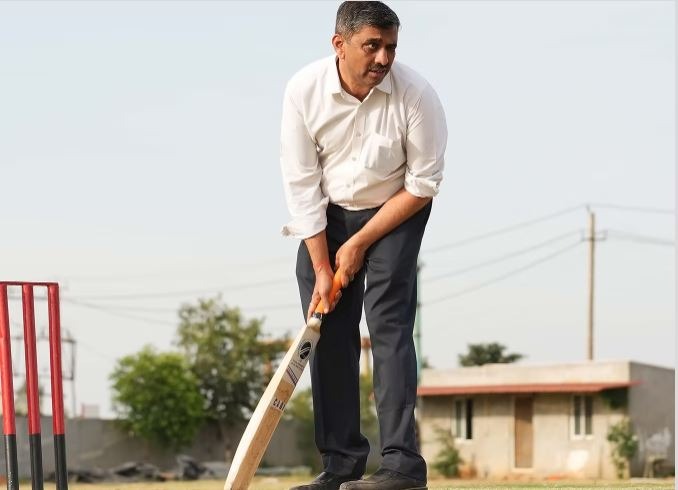
That philosophy runs through Samarthanam’s work in education, employment, performing arts, and sports. Its initiative, Cricket Association for the Blind in India (CABI), established in 2011, has helped take blind cricket to the international stage by organizing World Cups and supporting the development of teams in other South Asian countries.
For Dr Mahantesh, cricket is about much more than the game. It builds confidence, independence, and camaraderie while giving visually impaired players opportunities to travel and engage with the wider world. The same philosophy informs Samarthanam’s music and performing arts programs, which provide artists with disabilities a platform to showcase their talent.
An avid traveler through his work, Dr. Mahantesh was recently in the United States, where he combined cultural engagements—including a presentation and performance at the World Kannada Conference—with meetings to build partnerships and raise support.
In this conversation with Parveen Chopra, founding editor of A Lotus In The Mud, Dr. Mahantesh discusses the evolution of blind cricket, Samarthanam’s work in the arts and education, changing attitudes toward disability, and his vision of a world where people are recognized first for their abilities—not their disabilities.
Second part of the interview in two posts:
Parveen Chopra: What were your engagements in the United States during your recent trip?
Dr. Mahantesh: I live in Bangalore and travel extensively. I was here to give a presentation at the World Kannada Conference in Philadelphia in September. My music team accompanied me, and the Samarthanam Sisters also performed.
During my 18-day trip, I travelled to the Bay Area, San Jose, Los Angeles, Orange County, New Jersey, New York, Boston, and Philadelphia to meet with potential partners.
Do you get significant funding from America for your work in India?
Dr. Mahantesh: Not as much as we would like, but yes, we do receive some support. Last year, we raised close to half a million dollars. This year, our goal is to raise $1 million.
How did blind cricket begin, and what role has Samarthanam played in its growth and development?
Dr. Mahantesh: Cricket has been an integral part of my life. As a child, I followed cricket commentary closely, and much of my English came from listening to it. I also began playing cricket with modifications suited to visually impaired players.
In 1990, a special fiber-moulded plastic ball that produces a rattling sound was developed for blind cricket, and the modified game was first played in India that year.
In 2010, the organization running blind cricket asked (the late Samarthanam co-founder) Nagesh and me to take it forward. As passionate cricketers, we readily took up the challenge. In fact, Samarthanam was initially established largely to support blind cricket.
We took the game to the next level through intensive training and tournaments, including World Cups. For us, cricket is more than a sport—it builds confidence, connections, and independence while encouraging blind players to travel and engage with the wider world. As a nonprofit, we organized World Cups and invested millions in the sport. We remain committed to taking blind cricket forward.


Tell us about the World Cups.
Dr. Mahantesh: The T20 and ODI World Cups are held every four years, in separate cycles. Samarthanam has hosted three T20 World Cups, and India won all three. The fourth was held in Pakistan, but India could not participate, and Pakistan won.
In the ODI World Cup, India won the fourth and fifth editions. We lost the first three editions before Samarthanam took over the sport.
We currently have 11 countries participating in the World Cup. We have helped develop blind cricket teams in Afghanistan and Bangladesh, supported Nepal to some extent, and are helping establish a team in the West Indies. We are now also working to build blind cricket in the US.
Have any well-known cricketers supported Samarthanam?
Dr. Mahantesh: Yuvraj Singh, Rahul Dravid, and Sourav Ganguly have all been our ambassadors. However, we have not engaged them very actively.

Samarthanam is also getting known for its music and performing arts programs. How did that initiative begin?
Dr. Mahantesh: From the beginning, alongside cricket, we have focused on performing arts, particularly music and dance. We strongly believe that people with visual and other disabilities have talent that needs a platform. When they perform, you should see their ability, not their disability.
A few years ago, we started the Samarthanam Institute of Music and Performing Arts, led by its principal, Anusha. The program is free and welcomes children from diverse backgrounds, including those without disabilities, and is affiliated with Gangubai Hangal Music and Performing Arts University.
Our artists have performed across India and in the US for nearly three decades. Last year, we also launched Anusha and Vasundhara as the Samarthanam Sisters. Anusha is from Karnataka and Vasundhara is from Delhi, and both are accomplished Hindustani musicians. They travelled to the US last year and in 2026 to raise awareness and funds for blind cricket, including support to train and bring an American Blind Girls Cricket Team to India.
You have travelled extensively in America and other countries. Are some countries more disability-friendly than others?
Dr. Mahantesh: I have a very different perspective on this. In many countries, infrastructure and systems are designed to be more accessible, and people are generally sensitive to the needs of persons with disabilities.
That is not to say anything negative about India. In fact, India has a strong social fabric, and people—especially in cities—are often very helpful and willing to support others. In many other countries, people with disabilities can end up living quite isolated lives.
We are social beings, and in India, having people around can, to some extent, compensate for gaps in infrastructure and accessibility. I have personally never felt significantly limited by these gaps. At Samarthanam, we also connect people with volunteers, which helps them live more independently and comfortably.
Do you feel that Indian society is becoming more inclusive of people with disabilities?
Dr. Mahantesh: Yes, and I think the media has played an important role. The positive stories and features they share about people with disabilities are helping change public perceptions.
In some villages, there were misconceptions and beliefs that disability was linked to past karma. I think those attitudes are changing rapidly.
Acceptance has to happen on both sides. People with disabilities need to accept their disability, while parents and society need to accept them as they are, without placing unrealistic expectations on them. I think that shift is happening quite rapidly.

“In many countries, infrastructure and systems are designed to be more accessible, and people are generally sensitive to the needs of persons with disabilities. That is not to say anything negative about India. In fact, India has a strong social fabric, and people—especially in cities—are often very helpful and willing to support others. In many other countries, people with disabilities can end up living quite isolated lives.”
~ Dr G.K. Mahantesh
Which professions or careers are more accessible and easier to pursue for people with disabilities?
Dr. Mahantesh: Every person with a disability has different abilities and strengths. Technology has further expanded these possibilities. Screen-reading software, for instance, enables visually impaired people to work in many professions. Teaching, corporate learning and development, marketing, and other communication-based roles are good examples.
The Hindu newspaper, for instance, had a visually impaired editor, K.S. Garimella Subramanian, who had a PhD from the London School of Economics.
People with hearing or speech disabilities can pursue many technology-based careers, including coding, programming, engineering, and online communication, where verbal communication may not be essential.

Please name a few people internationally who did not let disability come in the way of their achievements.
Dr. Mahantesh: Helen Keller, Louis Braille, and Stevie Wonder, for example. In politics and public life, I can name British politician David Blunkett, who served as Home Secretary. Stephen Hawking is another powerful example of achievement despite severe physical disability.
Besides using Braille, how do the visually impaired learn?
Dr. Mahantesh: Braille is essential in the early years, and then you gradually migrate to technology. Today, devices such as smartphones and other assistive technologies make it possible to access information and communicate independently.
Can you share a few inspiring stories of Samarthanam beneficiaries who went on to achieve success in their lives?
Dr. Mahantesh: There are quite a few such examples. Suresh, for instance, graduated from IIM Calcutta and is now working in a senior position at Accenture.
Pankaj, who lost his vision while working as a teacher and was asked to resign, came to Samarthanam, continued his education, and graduated from the Faculty of Management Studies (FMS), Delhi. He is now a senior HR manager at Indian Oil.
Looking ahead 10 years, what do you hope to achieve, and what is the larger mission you want Samarthanam to fulfill?
Dr. Mahantesh: Our priorities are to touch more lives and use technology to reach more people. We also want to build more accessible infrastructure, develop our own sports city for cricket and other sports, and establish a global university.
We also plan to expand to countries such as the UAE and Singapore, while playing a more active role in working with governments to shape policies that are more inclusive and disability-friendly.
But will your main work remain in India?
Dr. Mahantesh: Rather than setting up operations in every country, we will probably work with like-minded organizations and NGOs already working there. This will allow us to collaborate locally and expand our reach more effectively.
For the first part of the exclusive interview with Dr. Mahantesh, go to…
For more information, visit the website: www.samarthanam.org
Leave a Reply