


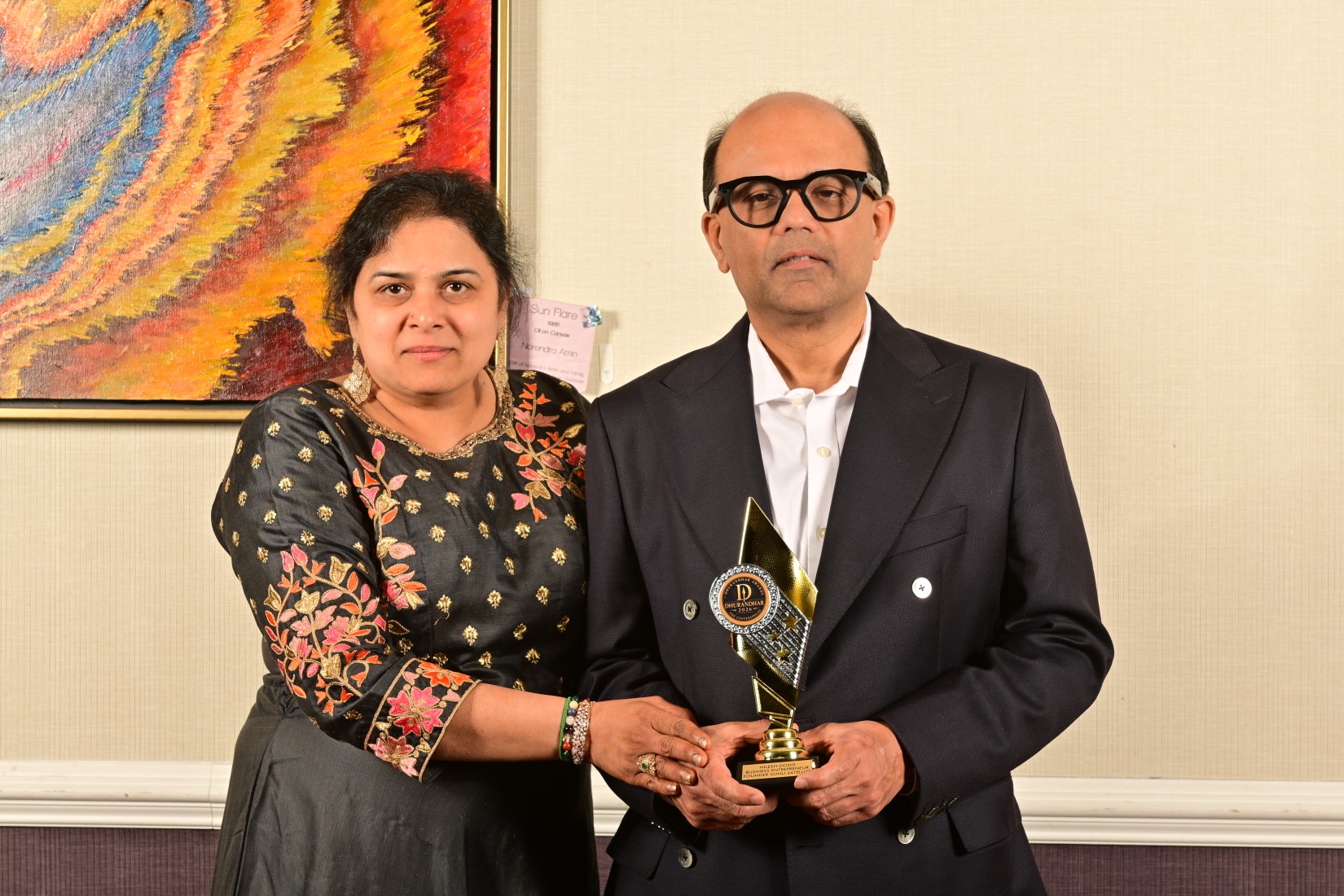
When Nilesh (Neil) Doshi lost his eyesight in the middle of his prime years, he could have allowed the impairment to define the boundaries of his life. Not this Indian American. He chose independence over dependence, curiosity over fear, and possibility over limitation. His circumstances changed, but his intention did not: to keep moving forward, to keep learning, and to keep showing up.
That choice became the quiet force behind a life he built in America after arriving from India in the mid-1980s. From taking odd jobs to becoming a bank teller, moving into customer service, and eventually working as a mortgage loan officer, Neil steadily built a career. Despite his diagnosis, he ventured into business, raised a family, and is now an advocate for people living with visual and other physical impairments.
For Neil, the most meaningful measure of that journey is not the success he accumulated but the independence he protected.
“I hope my grandchildren remember one thing above all: that I moved through the world with intention, not limitation,” said Neil, father to son, investment banker Bhavin, and daughter, Sonali, a lawyer.
“That I treated curiosity like oxygen. That I kept showing up—fully, stubbornly, joyfully—even when the path wasn’t lit in front of me. That I didn’t spend my life negotiating with obstacles but investing in possibilities. That I built a life defined by agency, not circumstance.”
Any physical handicap takes a toll on a person’s psyche, often leading to insecurity, complexes, and resentment. Not Neil. The New Jersey-based entrepreneur hopes to leave behind another legacy.
“I’d want people to remember that I loved people loudly. That I listened closely. I tried to make every room a little warmer than I found it. I believed in the power of showing up for others, even when I was navigating my own storms.”
From an immigrant to an entrepreneur
He immigrated to the United States from Rajkot, Gujarat, with almost nothing. He excelled at every assignment. Recognition followed him from one job to another, reinforcing something he would come to understand more deeply after losing his eyesight—that circumstances could alter the way he worked, but they did not have to determine the quality of his work.
His diligence, intelligence, and entrepreneurial mindset inspired him to start a business, Sonu Satellite (named after his daughter, Sonali), which became one of the country’s leading providers of satellite television services and earned multiple industry awards.
When asked which of his accomplishments means the most to him, he says, “My independence,” adding, “I believe if a person is independent, then they can achieve and reach all the milestones.”
That belief would become especially important when his vision began to change his relationship with the world around him.

When “why me?” was replaced by “what’s next?”
The year 1997 was a turning point in his life. He was diagnosed with retinitis pigmentosa—a rare retinal disease that gradually destroys vision and ultimately leads to legal blindness. The devastating news forced him to confront a reality he had never planned for.
Naturally, his first reaction was to ask, “Why me, God?”
But the question did not remain there.
“It raised many questions for me about what I have to do to keep my independence,” he recalled.
He didn’t find the answers immediately; it emerged through adaptation.
He learned to navigate differently. He learned to listen more carefully. He sought new ways of performing everyday tasks. Instead of treating his impairment as the end of independence, he treated it as a problem to solve.
“It made me much stronger and increased my confidence to overcome challenges,” he said.
For the outside world, he is a successful entrepreneur, a caring husband, a responsible father, and a community contributor. What people may not see is the continuous process of adjusting, learning, and figuring out another way.
Kavita Doshi—witness to Neil’s evolution
“He is a quiet force—he never boasts about his achievements. His actions speak louder than any words,” Kavita says about her husband. “His resilient nature shows in the way he embraces challenges that others might consider impossible. Instead of shying away, he leans in, adapts, and delivers results with a calm determination that sets him apart.”
For Kavita, what makes him remarkable is not simply what he has achieved, but the manner in which he carries those achievements.
“He doesn’t seek recognition. He simply focuses on doing what needs to be done.”
Independence as a way of life
Neil’s determination to remain independent also shaped his marriage and family life.
After he could no longer drive, Kavita took over that responsibility. But she says his other responsibilities and routines remained largely unchanged.
When he began pursuing business, she eventually became involved, a development she believes strengthened their relationship.
Her concerns, however, did not disappear.
“I am worried about him most of the time due to his impairment. His confidence and the strong mindset that he has, he is always ready to face his physical challenges and find a way to reach goals,” she said.
“He explains how he will get from point A to B,” she added.
That sentence captures much of Neil’s approach to life.
The obstacle may be real. The route may have to change. But there is still a destination.

Learning to listen differently
Losing vision changed the way Neil communicates and leads.
“Since I lost significant vision, I learned to listen carefully to make decisions, and it has helped me to increase my productivity and effective communication,” he said.
Listening, for him, is not simply about hearing words. It is about paying attention. And this new tool helped him navigate professional relationships, business decisions, and social interactions.
He acknowledges that people can underestimate those with disabilities. But rather than proving others wrong, he has preferred to let his work establish his capabilities.
He believes that the proof lies in performance—in completing personal, professional, and social responsibilities and in contributing to charitable and spiritual causes.
His disability, he suggests, is one part of his story, not his identity.
Technology as a bridge, not a barrier
As Neil’s life made twists and turns, so did the world around him. One important change has been the technological revolution. The digitizing world opened another door for him.
Tasks that once depended heavily on eyesight—reading emails, working with spreadsheets, interpreting information on a screen—can now be accomplished through assistive technology.
He uses screen-reading software on his computer and VoiceOver on his phone. More recently, smart glasses have added another layer of assistance.
“That’s a powerful combination. Each one fills a different gap, and together they create a smoother, more independent workflow for navigating both digital and physical spaces,” Neil proffers.
Smart glasses, in particular, have expanded the possibilities beyond the computer screen.
They can assist with identifying objects, reading signs, and understanding unfamiliar surroundings—turning what might otherwise be a difficult task into something more manageable.
Neil says technology is not about replacing independence; it is about enabling it.
And that distinction matters.
The goal is not to pretend the impairment does not exist. It is to find tools that make it possible to live fully with it.

From overcoming his own challenges to helping others
Currently, he is associated with two nonprofit organizations—he serves on the CSR Advisory Board for the Eye Foundation of America and as Director of PR & Media for the Cricket Association for the Blind, part of Samarthanam USA. On August 16, he was among 25 eminent people presented the inaugural Dhurandhar awards honoring them as visionaries and community leaders making a distinct impact.
Neil spends significant time now supporting people with visual impairments and other physical challenges.
“My goal is to make a difference in the lives of those who are either visually impaired or have any other types of physical challenges,” he said. “I want to help them build confidence and achieve their goals.”
He wants future generations facing physical challenges to understand that a diagnosis does not automatically dictate what they cannot accomplish.
He would tell them about his own experience—the challenges he faced, the adaptations he made, and the independence he fought to retain.
Most of all, he wants them to see themselves as no less capable than anyone else.
The legacy beyond blindness
When telling stories of people who build successful lives despite their impairments, there is a temptation to make the disability the central character.
Neil does not want you to fall into that trap.
Perhaps that is why the sentence he wants his grandchildren to remember is not about blindness at all.
“I moved through the world with intention, not limitation,” he said.
His story, therefore, cannot be boiled down to overcoming blindness. It is about the power of intention—how the decision to respond differently to adversity can alter the course of a life.
And perhaps that is where karma meets courage: not in what life hands us, but in what we choose to do with it.
For more about Neil Doshi family enterprises: www.sonumedia.com, www.sonucapital.com, www.sonulodging.com
QA with Neil’s brother and business partner Hiten Doshi

Q: After Neil lost his eyesight, what changed the most about the way the two of you worked together?
Hiten Doshi: The biggest change was how we divided responsibilities. We’ve always worked very closely together and approached every project based on the circumstances at the time. As Neil’s vision deteriorated, he gradually shifted toward responsibilities that were more manageable given his condition, while we continued to collaborate just as closely as we always had.
Did you ever find yourself becoming overprotective and attracting pushback from Neil?
Hiten: Yes, there were times when I was overprotective. Neil has always valued his independence and has consistently wanted to do as much as he could on his own.
How has Neil influenced the way you conduct business?
Hiten: Neil has shown me that determination can overcome incredible challenges. Watching him continue to build a business and solve problems has reinforced my belief that almost anything is possible with the right mindset, perseverance, and willingness to adapt.
QA with Neil’s son Bhavin Doshi, an investment banker, and daughter Sonali Doshi, a lawyer

Q: Growing up, when did you first realize that your father was doing what most people believed someone with visual impairment couldn’t do?
Bhavin Doshi: Growing up, dad traveled often for business. I remember learning the 50 states in school as a child, and I would ask which ones he had visited—the list would take us some time to go through. While his vision deteriorated, he continued to travel nationwide, often on red-eye flights. We in the family were worried and asked him repeatedly to slow down but he would just find another reason to keep going.
Sonali Doshi: Looking back, I don’t think there was a single moment when I realized my father was doing things others believed someone with visual impairment could not do. That understanding developed over time. What stood out to me first was his ability to seek out anyone in a room full of people and connect with them. That ability to build relationships and create opportunities has been central to who he is, both personally and professionally.
Did your father’s life make you see challenges in your own life differently?
Bhavin: It’s all about framing the challenge. We learned to leverage our strengths and allow them to compound day after day.
Sonali: My father taught me that success is not dependent on ideal circumstances; it comes from the ability to adapt, find solutions, and keep moving forward despite uncertainty and setbacks.
Which habit or value of your father has had the greatest influence on the person you have become?
Bhavin: Tenacity—we observed from a young age that Dad worked until the job was complete, no matter how small or big the task. Sonal Sonali: Drive to always look ahead. Dad showed me that growth doesn’t come from reaching a finish line—it comes from staying curious and continuing to challenge yourself.
When people describe your father as inspirational, what is one quality you wish everyone knew about him?
Bhavin: Dad is a giver—quietly and without asking for credit. When I was in middle school, I came home raving to my cousin about a friend’s new flat-screen TV, a nascent technology at the time. A few weeks later, I was surprised to see a big box waiting in the garage with a brand-new flat-screen. Dad does not watch TV himself; he just wants us to enjoy it.
Sonali: People often highlight all he accomplished despite his visual impairment. They miss that his drive to achieve is an intrinsic part of who he is.
Dear Reader, if you know of a person with an inspiring life story, like that of Neil Ghosh, that needs to be told, let us know at: lotus4usa@gmail.com
Leave a Reply