


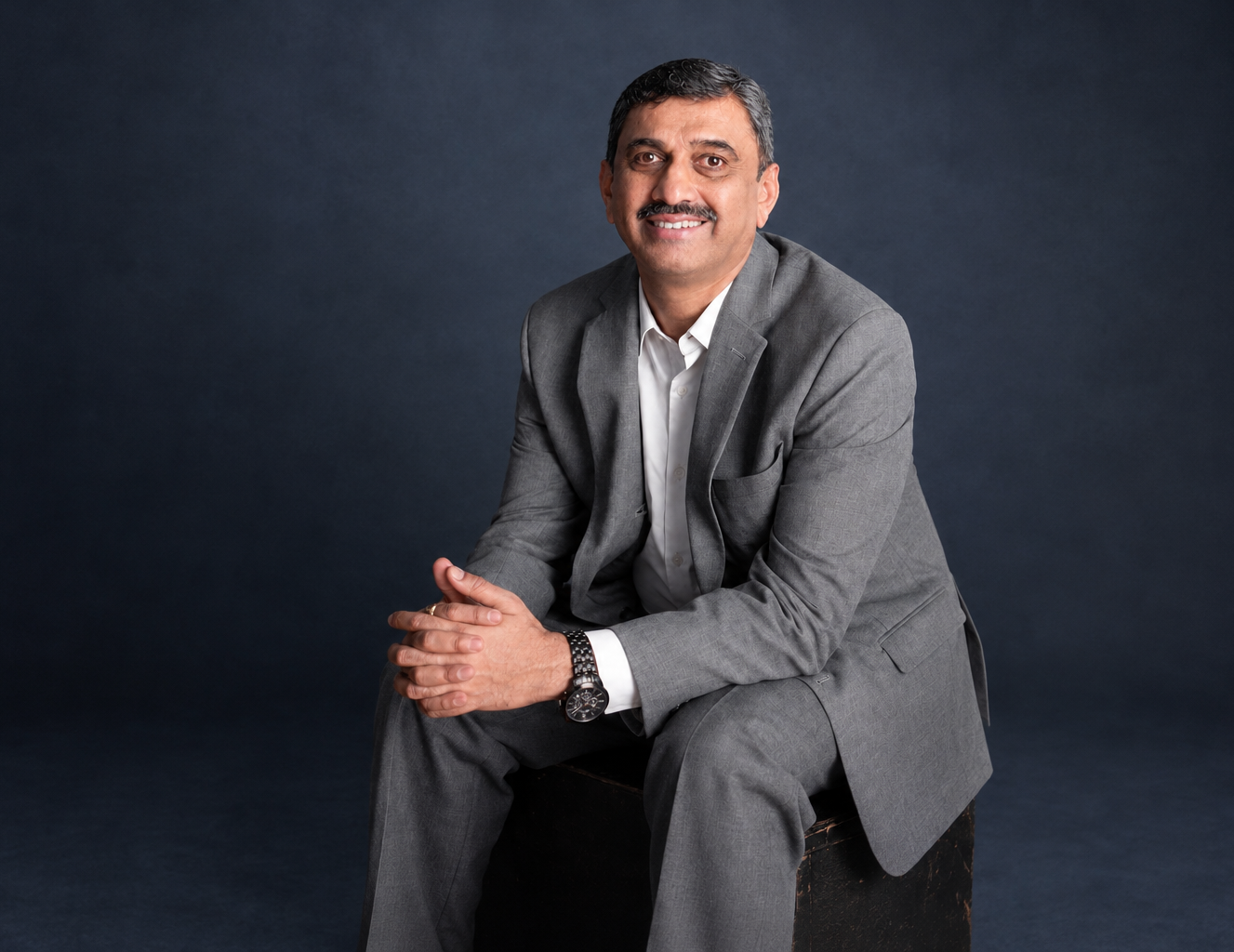
He lost his eyesight when he was just six months old. Undeterred, Dr. Mahantesh G. Kivadasannavar excelled academically and went on to create opportunities for hundreds of thousands of others with disabilities, making them independent.
He was born in Belgaum, Karnataka, to parents who did not allow his blindness to limit him. Their support, encouragement, and willingness to give him opportunities shaped the philosophy that later became the foundation of Samarthanam Trust for the Disabled.
When he was 26 in 1997, Mahantesh and his childhood friend, the late Sugur Paramashivaiah Nagesh, founded Samarthanam in Bangalore with a simple belief: focus on the opportunities people have, rather than the limitations they face. What began with a shared vision has spread to 19 cities across India, with a staff of about 1,000 and an annual turnover of approximately 100 crore rupees($10 million). Its international extension is the not-for-profit Samarthanam USA, which raises funds and awareness in the US.
Over the years, Samarthanam has touched nearly half a million lives, including more than 30,000 students supported in pursuing higher education and around 10,000 students who have benefited from its hostel facilities. It currently houses 180 students, while over 80 former beneficiaries have returned as employees and mentors, helping others follow similar paths. Among its many success stories is Suresh, who graduated from IIM Calcutta and now holds a senior management position at Accenture.
At the heart of Samarthanam’s work is a simple message: blindness does not define a person’s ability, independence, or potential.
As Samarthanam approaches its 30th year in 2027, Dr. Mahantesh, who has honorary doctorates from three academic institutions, remains focused on expanding opportunity.
In this conversation in New York with Parveen Chopra, founding editor of A Lotus In The Mud, Dr. Mahantesh shares his personal journey, the idea that led to Samarthanam, the people whose lives have been transformed along the way, and his vision for the next chapter of inclusion.

Samarthanam is bringing Dr. Kumar Vishwas’s “Apne Apne Ram” devotional program for the first time to the USA. The three events to raise funds for Samarthanam are scheduled in Chicago (Oct 23), New Jersey (Oct 25) and San Francisco Bay Area (Oct 30), as well as some gala dinners with Kumar Vishwas, such as the one in Hicksville, NY on Oct 24.
Dr Mahantesh told A Lotus In The Mud
First of the two-part interview:
Parveen Chopra: How did you think of starting Samarthanam?
Dr. G.V. Mahantesh: It came from our backgrounds and personal journeys. Rather than focusing on our struggles, my co-founder and childhood friend, the late S.P. Nagesh, and I chose to focus on the opportunities we had received and maintain a positive attitude.
We felt that the good fortune we had received should not end with us. The support from our families, institutions, friends, and volunteers had created opportunities for us, and we wanted to carry that legacy forward—spreading goodness, possibilities, and opportunities.
We saw this extending across education, sport, blind cricket, performing arts, and, importantly, networks. Nagesh and I were both active in sports and social activities, which helped us build a strong network.
We also saw that many people faced challenges beyond blindness—lack of family support, being raised by single parents, or having parents with little or no education. We realized that if we truly wanted to help, we needed a systematic platform. That is when we decided to create Samarthanam as a connector and catalyst.
Samarthanam is a Sanskrit word meaning support. But for us, it is multidimensional—it represents collaboration, self-belief, and empowerment.

“We customize our assistance—from screen readers, hearing aids, and wheelchairs to prosthetic limbs and, equally importantly, human support—based on each person’s needs. Samarthanam’s approach is simple: understand the individual, identify the need, and provide the right support to enable them to move forward.”
~ Dr G.K. Mahantesh
How did you lose your eyesight?
Dr. Mahantesh: When I was six months old, I contracted typhoid and developed a very high fever, which substantially damaged my optic nerves and retina. The condition is called optic atrophy. I retain some central vision in both eyes, although it is very limited. I can manage to some extent in bright light.
Tell us about your parents’ support.
Dr. Mahantesh: My parents were extremely supportive. They provided whatever I needed even before I asked. They created an atmosphere of encouragement and constantly motivated me to study further. My father, a state government officer, was particularly keen for me to pursue higher studies. I lost him while I was completing my MPhil; otherwise, he would have encouraged me to go to Oxford or Cambridge.
Tell us about your family.
Dr. Mahantesh: I have two children, a son and a daughter. Both are students interested in journalism and mass communication.
Before starting Smarthanam, what were you doing?
Dr. Mahantesh: I taught English at the University Law College in Bangalore.

Is Samarthanam mainly for the visually impaired or generally for people with any physical disability?
Dr. Mahantesh: Inclusion is at the heart of everything we do at Samarthanam. We started by working with blind people because we understood their challenges and the solutions they needed. We then expanded to other disabilities and to anyone who lacks support or access to essential services.
I believe that anyone denied opportunities is, in a sense, disabled.
We wanted to walk the talk on inclusion. Samarthanam is therefore not limited to one disability, program, or location. We work across India and address the individual needs of each person. Our support is customized—from screen readers, hearing aids, and wheelchairs to prosthetic limbs and, equally importantly, human support. Our approach is simple: understand the individual, identify the need, and provide the right support to enable them to move forward.
With so many people needing support, how do you decide whom to help?
Dr. Mahantesh: Whoever comes to Samarthanam, we try to help. If they can afford the support they need, we guide them on what to access or purchase. If they cannot, we try to mobilize resources from donors. Sometimes support may simply mean guidance or counselling or connecting them with an organization better equipped to help them or closer to their homes.
All right, then, tell us about the organization’s growth and reach.
Dr. Mahantesh: Samarthanam has grown into one of India’s largest disability organizations, with a presence in 19 cities. So far, we have touched the lives of around half a million people, and our goal is to impact one million lives by 2030.
Through Cricket for the Blind, we have a presence across all Indian states, with around 30,000 blind cricketers participating in the sport.
Our annual turnover is around ₹100 crore, and we want to expand our impact further. Through Samarthanam USA, a nonprofit, and our registered charity in the UK, we also hope to support people with disabilities internationally.
In the US, we are working to develop American Blind Cricket and strengthen India-US collaborations in culture, technology, sport, and education, including sharing best practices between the two countries.
In India, Samarthanam is a public charitable trust. We also have consultative status with the United Nations Economic and Social Council (UN ECOSOC) and are actively engaged with the World Blind Union.
What does your staff focus on?
Dr. Mahantesh: We work across teaching, training, and counselling. We run three schools for children with intellectual disabilities in Karnataka—in Bengaluru, Belagavi, and Mysuru—as well as a school for children with hearing and speech disabilities and an inclusive school.
We also work with around 1,000 colleges and 100 universities, helping visually impaired students pursue higher education, including at premier institutions such as the IIMs and IITs.
Our ultimate goal is to make people with disabilities independent, financially self-reliant, and contributing members of society—earning their own livelihoods and paying taxes rather than depending on loans or pensions.
What is the source of your funding?
Dr. Mahantesh: Around 80–90% of our support comes through corporate social responsibility (CSR) funds. Last year, more than 250 companies donated to Samarthanam.
We are a CRISIL-rated organization and fully compliant with applicable regulations, including the Foreign Contribution (Regulation) Act, or FCRA.
Do you get any grants from the government?
Dr. Mahantesh: Yes. We receive grants from the Karnataka state government. Overall, government funding accounts for around 10% of our support.
What do you see as the biggest barrier facing people with disabilities—poverty, inaccessible infrastructure, unemployment, social stigma, or something else?
Dr. Mahantesh: All of them. The bigger problem is that many people do not receive timely support, largely because of a lack of awareness.
There are many government schemes and organizations like Samarthanam, but parents often do not know about them or realize their importance at the right time. Doctors can play a major role by guiding families towards available support, schemes, and organizations.

Government programs must also be playing a role to support people with disabilities.
Dr. Mahantesh: There are many government schemes. But with technology advancing rapidly, schemes created years ago need to be updated and customized to meet current needs. That could make a much greater difference.
Infrastructure is another critical issue. Much of India’s infrastructure is still not disability-friendly, which can prevent people from accessing public spaces and services.

For more information, visit the website: www.samarthanam.org
For the second part of the exclusive interview with Dr Mahantesh, go to…
Leave a Reply