


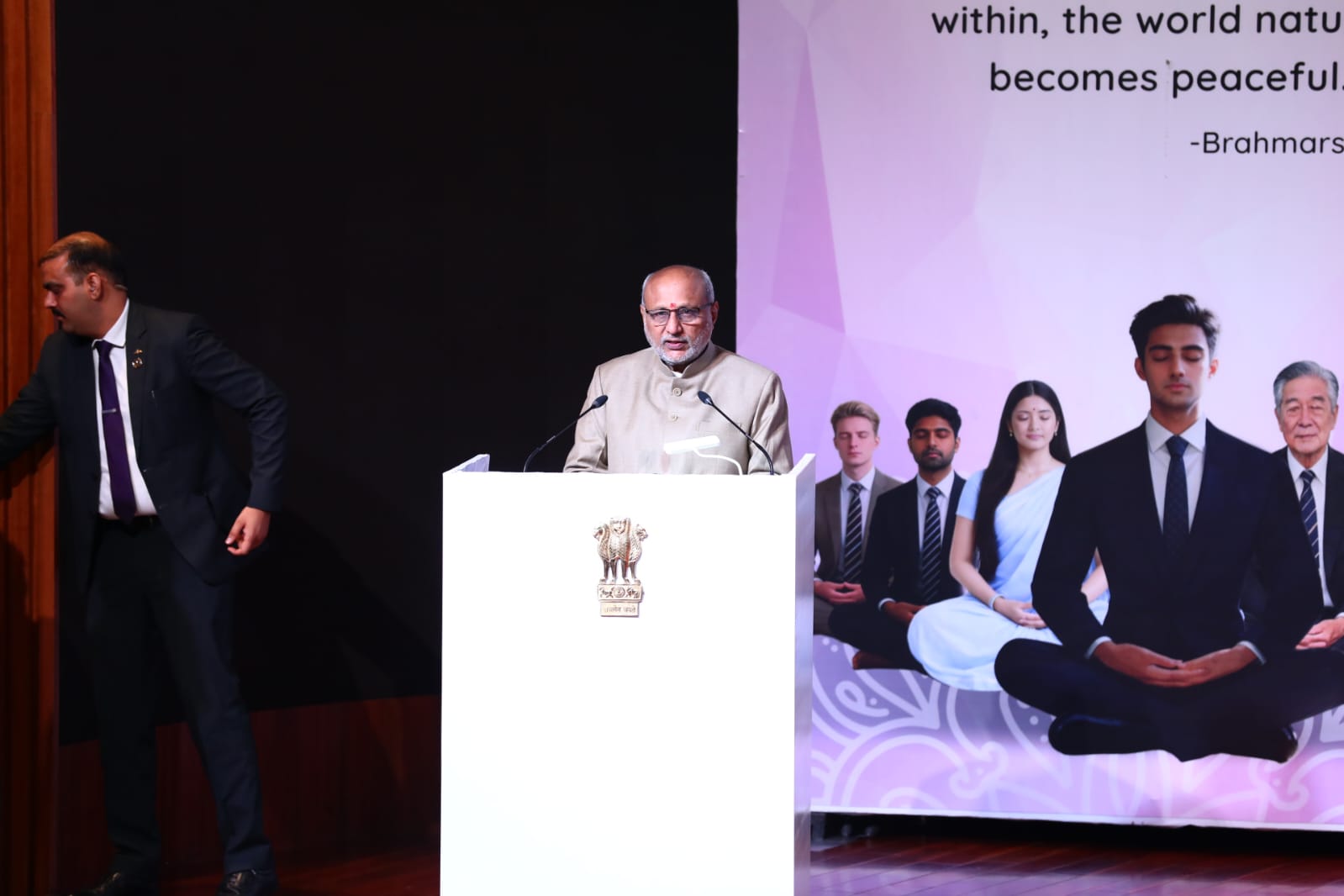
India’s Vice President C. P. Radhakrishnan inaugurated the second day of the two-day Global Conference of Meditation Leaders (GCML) at Bharat Mandapam, calling for deeper listening and inner peace in a world increasingly marked by conflict within and across societies.
The conference was organized by the Buddha-CEO Quantum Foundation and Pyramid Spiritual Societies Movement on April 4-5 at Bharat Mandapam in New Delhi.
Reflecting on rising tensions not only between nations but also within families and communities, he said the erosion of inner calm lay at the heart of many disputes, urging individuals to “truly listen” before attempting to change the world.
The gathering, which emerged as a confluence of consciousness, inspiration, and spiritual awakening, brought together spiritual leaders, policymakers, and scholars to explore meditation’s role in addressing global challenges.
Meditation as a key to transformation and leadership
“Meditation is the starting point of inner transformation. Better minds build a better world. Meditation can help combat drug addiction among youth,” the Vice President said, observing that the world is grappling with multiple challenges and that conflict exists not only externally but also within individuals.
He emphasized meditation’s transformative role in bringing peace, clarity, and a positive outlook while fostering the ability to listen and understand others. He added that meditation reduces stress, improves focus, enhances emotional resilience, and helps address overthinking and overworking, underscoring that its true power lies in transforming human beings.
The morning session was followed by the release of three books, including a youth-focused book by Chandra Pulamarsetti, the driving force behind GCML, and a meditation session led by Lakshmi Newton.
Swami Chidanand Saraswati, head of Parmarth Niketan in Rishikesh, emphasized the need for “Buddha CEOs,” stating that meditation enhances time management, thought management, and conscious living, leading to “happy, healthy, and harmonious lives.”
“Meditation is not a technique; it’s a transformation. Meditation is not a teaching; it’s a touch. The moment you become the touch, the transformation is right there. Now everybody’s looking for a magic wand—even God becomes like an ATM. You push the button, you want something, and it’s there. But meditation is not an ATM. Meditation is the food for the soul. Meditation is the best medication for our souls. Meditation is the best medication for all our education,” he said.
The Swami added, “We need leaders who can be ladders,” and noted that “Meditation helps us in time management, tongue management, and thought management.”

Habit-building and holistic healing
The day also featured a session by Saurabh Bothra, an IITian-turned-founder of Habuild, which teaches yoga online to 15 million people worldwide, whose presentation was interspersed with laughter and yoga practice.
He said, “Physical activity, when done with full attention, also leads you to meditation.”
“The real outcome of asanas is that you can manage your mind back,” added Saurabh, who created a record in January when almost one million people practiced yoga online in a single day.
Emphasizing a three-step habit-building process, he said, “First, practice a minimum of five minutes of physical activity and five minutes of meditation. Second, physical activity accompanied by meditation makes it much better. Third, if you want to make it a habit, talk about it.”
Among those who participated in the conference were Padma Shri D.R. Kaarthikeyan, former CBI and CRPF director; Newton Kondaveti, a physician-turned-spiritual teacher and the founder of Life Foundation and Quantum Life University; Chandra Pulamarsetti; and Vijay Bhaskar Reddy, chairman of Pyramid Spiritual Trust, along with meditation experts, policymakers, and scholars.
The final day also featured an expert panel of physicians and academicians, including Ittikorn, Dasaratha Ramaiah, Gopala Krishna, Sai Krupa Sagar, and Lakshmi Newton, who examined meditation’s comprehensive healing potential across physical, emotional, and psychological dimensions, presenting case studies and implementation models.
A separate session led by Rakesh Jalumane highlighted the “BeSupermind” approach to corporate well-being and leadership, presenting real-world evidence of improved team coherence, decision-making, and sustainable performance.
The conference lived up to its goal by bringing together a diverse range of experiences and perspectives from people across different walks of life.
For report on 1st day of GCML, go to
Leave a Reply