


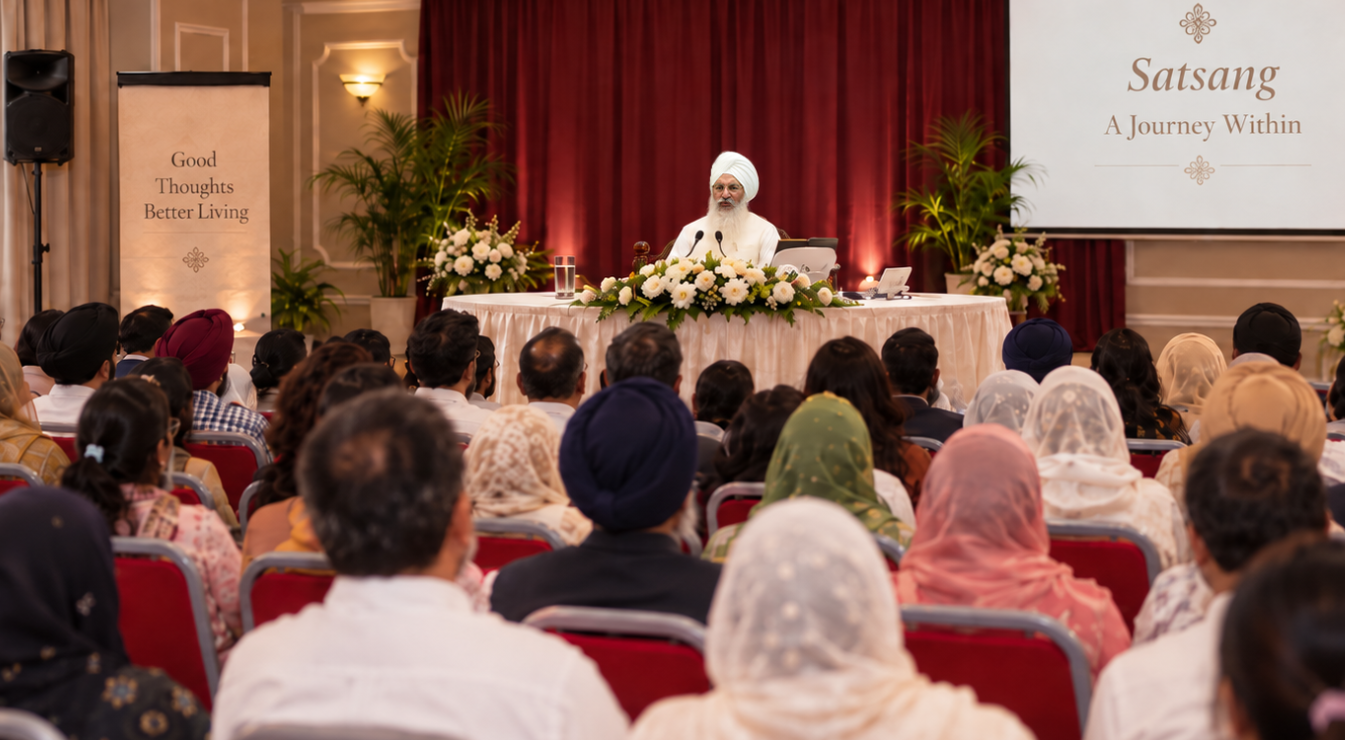
Exclusive interview with Sant Ji continued from Part I
Sanya Raj: Are ego and personal gain at the root of the wars happening around the world?
Sant Gobind Ram Ji: That’s the truth. It’s not only ego, it is also hunger—hunger for more. We can eat only three or four times a day and need only a few clothes. How many houses, beds, or how much money do we really need?
When someone proudly says, “I am among the 10 richest people in the world,” that is ego and hunger. Even wars, where leaders attack other countries and innocent people are killed, are driven by the same hunger and ego. But what is the real worth of it?
As human beings, we don’t even know whether we will see tomorrow. So why this endless hunger for more?
You often teach compassion and selfless service. Why is serving others such an important part of spiritual growth?
Sant Gobind Ram Ji: The moment you start serving others, you begin overcoming your ego. An egoistic person finds it difficult to serve, but serving without expectations helps suppress and ultimately overcome that ego.
True service means seeing the Almighty in every person, without giving importance to race, caste, creed, religion, or nationality. If we have the capacity to help someone without expecting anything in return, we should do it. That selfless service reduces our ego and brings out more humanity in us.
Can serving others also heal ourselves?
Sant Gobind Ram Ji: First, we need to understand what healing really means. Healing is not just about physical pain or problems in the body; it is also about our inner self.
The same applies to seva. True service, in the Almighty’s house, is without any return or expectation. The moment we expect something in return, it becomes a barter system: “I give you this, you give me that.” If we serve someone expecting our family problems to disappear or peace to come into our home, that is not true seva.
Serve simply for inner peace, without ego or expectation. Be grateful to the Almighty for choosing you to serve and ask to remain an instrument of service. Whatever mistakes we make, knowingly or unknowingly, ask for forgiveness—but never stop serving.
Spiritually, yes, healing can bring internal peace and help us heal from our bad karma. But outer, materialistic healing is different. Spiritual healing is about inner peace and transformation, not material expectations.

Many people today describe themselves as spiritual but not religious. How do you see the relationship between religion and spiritual experience?
Sant Gobind Ram Ji: First of all, the easiest way to run away from religious practices is to simply say, “I’m spiritual.” In our time, our parents would make us go to the temple or gurdwara, do paath and prayers, so we had a basic connection with religion.
Today, you cannot tell children to follow these practices. They simply say, “I don’t believe in this; I’m spiritual, I believe in all.” This has become an easy way of avoiding religious practice. That kind of spirituality is prevalent today, and perhaps that is why there is no peace. The moment someone from another religion speaks about your religion, suddenly that so-called spirituality disappears.
Spirituality is not what we are seeing today. In Sanatan tradition, we have the example of two gurus, Shukracharya and Guru Brihaspati. Both followed the Vedas, worshipped Lord Shiva, and chanted Om Namah Shivaya. But their difference was in whom they supported. Shukracharya supported the rakshas (demons)—those against humanity and the betterment of the world—while Brihaspati supported the dev (God), those working for humanity, nature, and the world.
Today, even if a guru has millions of followers, we have to ask: are they being guided towards dev vritti or rakshas vritti? If those millions truly followed spiritual values, they could make a difference.
We have become more attached to stories than the fundamentals of our scriptures. Knowing the Ramayana or Mahabharata does not necessarily make us religious or spiritual. We need to return to the core teachings of the Vedas and other scriptures and live them, rather than simply becoming fundamentalists.

The easiest way to run away from religious practices is to simply say, “I’m spiritual.” In our time, our parents would make us go to the temple or gurdwara, do paath and prayers, so we had a basic connection with religion. On the other extreme, we have become more attached to stories than the fundamentals of our scriptures. Knowing the Ramayana or Mahabharata does not necessarily make us religious or spiritual. We need to return to the core teachings of the scriptures and live them.
~ Sant Gobind Ram Ji
If a young person came to you today, feeling lost, anxious, or searching for meaning, what guidance would you offer?
Sant Gobind Ram Ji: When we talk about young people, we first need to understand their family environment. Even rehab may not help if they return to the same circumstances that contributed to the problem. I know a young man in Houston who struggled with alcohol, and despite guidance and temporary improvement, he relapsed. When I met his family, I found that his father and relatives also had alcohol problems.
So, when a young person says, “I am lost,” we must also look at the family. We have not given today’s generation the time and attention our parents gave us.
I ask young people to reset, identify what distracts them—often excessive phone use—and reflect on how they spend their day. I don’t immediately turn them towards religion or chanting. First, they need to understand their own importance.
Please suggest some simple steps to help them gain some direction or solace?
Sant Gobind Ram Ji: Nowadays, it’s really hard. The question is: how can we blame the young generation when we are the one who gave them these circumstances? There was a time when films showed the hero as someone who worked for the betterment of humanity and society. Today, we make heroes out of characters who do wrong, and we allow our children to watch them. So it’s not only the children’s fault; it’s our fault—the parents, society, and leaders who allowed these things to become normal.
The same applies to the internet, food, and relationships. We have given children unlimited access to junk food, phones, and information, and then complain that they are distracted or going off track. Even within families, relationships and boundaries have suffered.
Religious and spiritual leaders, politicians, organizations, and parents all have a responsibility. We cannot keep blaming the younger generation. We need to look at ourselves first—limit phone use, be mindful of what children consume, and take responsibility for what we are teaching them. We all contributed to the problem, and we all need to work on ourselves. If we don’t start now, it may be too late.
If somebody wanted to begin living a more conscious, spiritual life, what daily practices would you recommend?
Sant Gobind Ram Ji: First, we need to understand what we mean by spirituality. Let me ask you: What exactly are you looking for in spirituality? What are you searching for? What do you hope to find?
As far as I’m concerned, I’m looking for myself.
Sant Gobind Ram Ji: Okay, so if you want to look only at yourself, what’s difficult about that? You just need a mirror. When you stand before the mirror, you can see yourself completely, with or without clothes. But spirituality is about going beyond what the mirror shows and looking within yourself. Sit quietly and find the mirror within. If thoughts or relationships come up, push them aside. Look within and see what is making you dull and what is helping you become better. That is what spirituality is—not seeking outer help, but sitting alone and finding yourself.
Sanya Raj: If you could leave only one message for humanity: what wisdom would you want everyone to carry in their heart?
Sant Gobind Ram Ji: I would explain this through Saint Kabir’s verse: “One Ram is Dashrath’s son; one Ram resides in every heart. One Ram is spread throughout creation; one Ram is beyond everything.”
Yes, we need to believe in the Almighty. The Almighty is the ultimate truth—that is what I call Sat Onkar. We should have faith in the Almighty and live according to the order He created, understanding good and bad karma.
For first part of the exclusive interview with Sant Gobind Ram Ji, go to:
About Nadar Gobind Foundation

Nadar Gobind Foundation (NGF) is a spiritual organization, founded by Sant Gobind Ram Ji. It is devoted to guiding individuals on a journey of inner peace, self-discovery, and spiritual awakening. NGF is on the path of Worldwide Wellness, Inner Peace, and the Metaphysics of Spirituality. At its heart is the timeless understanding that beyond the noise of everyday life lies a deeper dimension of our being — a place of stillness, awareness, love, and inner wisdom.
Guided by this vision, Nadar Gobind Foundation offers a path for those seeking to reconnect with their true nature and live with greater awareness, balance, and purpose. In a world often filled with stress, distraction, fear, and uncertainty, the foundation creates a space for reflection, healing, and conscious living — helping individuals move inward and rediscover the stillness within.
Through meditation, spiritual practices, selfless service, and the sharing of wisdom, NGF encourages individuals to cultivate greater awareness, compassion, balance, and harmony within themselves and in their relationships with others, regardless of background, beliefs, or life path. There is no barrier to seeking inner peace. NGF’s doors are open to anyone who feels called to explore their inner world, discover greater clarity, and experience a deeper connection with themselves, with others, and with life itself.
At the heart of its mission is a simple understanding: when we transform ourselves from within, we contribute to the transformation of the world around us.
For more info go to:

Leave a Reply