
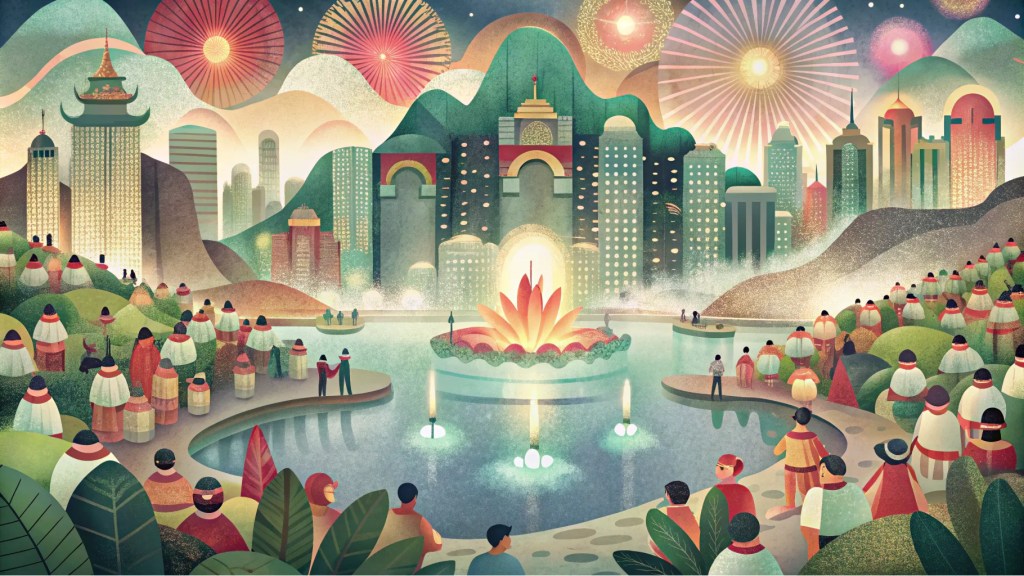


I have never been good with rigid New Year resolutions. They feel brittle, too easily broken by the first unexpected turn of life. Yet every December, something within me still longs to pause, to take stock, to ask quietly: What has this year done to me? Not in terms of achievements or numbers, but in terms of expansion—of the inner widening that happens when a book unsettles you, when a conversation cracks open a long-held belief, or when grief or wonder reshapes the way you see the world.
As I step into the New Year, I want to hold on to one simple intention: whatever stretches my inner world deepens my strength. Not louder. Not more impressive. Stronger in the quiet way—more grounded, more compassionate, and more capable of staying with discomfort without fleeing into certainty.
The year that stretched me
Looking back, I realize that I have not grown through ease. I have grown through friction.
This year brought me face-to-face with my own fragility in a way I could not have imagined before—my brush with cancer and the recurring health challenges that have touched almost every member of my family. Hospitals became familiar landscapes. Medical vocabulary entered our everyday language. Waiting rooms transformed into classrooms, where patience, fear, hope, and surrender coexisted in the same breath.
Illness has a way of stripping life down to its essentials. It silences the noise of ambition and leaves you with one urgent question: What truly matters when the body falters?
Somewhere between test reports and whispered prayers, I understood expansion differently—not as achievement, but as endurance, not as accumulation, but as presence.
The books that opened windows
During this period, my relationship with books deepened into something almost devotional. I no longer read to escape; I read to remember who I am beyond the diagnosis, beyond the role of caregiver, beyond the fear.
A few works stayed with me long after their final pages—books that did not offer solutions but asked better questions. Literature that explored grief without rushing to redeem it. Spiritual writing that resisted the temptation to spiritualize pain. Psychology that acknowledged that healing is rarely linear and never tidy.
Apart from Uma Lohray’s The One Way Ships and Arundhati Roy’s Mother Mary Comes to Me, Brené Brown’s The Gifts of Imperfection reminded me that vulnerability is not a detour from strength but its very foundation. Meghan O’Rourke’s The Invisible Kingdom gave language to the disorienting terrain of chronic illness, validating the emotional and existential upheaval that accompanies a body you can no longer take for granted.
Every book I read in 2025 slowed me down. They expanded my emotional vocabulary, giving language to feelings I had never been able to articulate. In the New Year, I want to read with this same intention—not to consume, but to be changed.

When words began to blur and silence felt too heavy, music became the language my spirit understood.
Some days, it was a single voice—raw, unguarded—that held me when nothing else could. Other times, it was the hum of a familiar melody looping softly in the background, reminding me that beauty can exist even in the middle of pain. Healing did not come from grand symphonies but from smaller sounds: a slow piano piece that mirrored my heartbeat on hospital nights, a song I played on repeat because its rhythm steadied my breath, the way rain against the window sometimes synced with the music and felt like a quiet conversation between the world and me.
Apart from Thaikkudam Bridge, Gordon Lightfoot, and John Coltrane, my friend Cyrus Dali Vesuwala’s music resonated with me in a rare honesty this year. There is a quiet directness in his lyrics, carried by a feather-light touch on rhythm and picking that allows even the darker edges to breathe. In its gentleness, the music somehow makes room for truth.
Music became prayer when I could not pray, movement when my body would not move, and a companion when words failed. It met me where I was—tired, uncertain, tender—and lifted me into spaces where light could still reach. In the New Year, I want to keep listening with that same kind of attention. Not to distract myself from life’s noise, but to remember the deeper rhythm beneath it—the one that says, quietly but firmly: you are still here. You are still becoming.

I step into the New Year with my old ideas of strength quietly dismantled.
I choose inner growth over hardened survival—because true strength is created through expansion, not endurance alone.
I used to admire resilience—the heroic kind that soldiers on regardless of inner cost. But illness teaches you a different grammar of strength. It is strength to rest. Strength to receive care. Strength to admit you are afraid.
It is strength to say, I do not know how this will turn out.
It is strength to sit with uncertainty without searching for premature hope.
It is strength to let grief coexist with gratitude.
Instead of asking how do I become tougher? I now ask: How do I become more spacious?
The people who changed my landscape
No year is shaped only by books and ideas. It is shaped by people—some who show up quietly, some who leave abruptly, and some who appear just long enough to remind you what compassion looks like in action.
This year, I met extraordinary courage in ordinary places—nurses who remembered names, strangers in waiting rooms who shared stories, friends who showed up, and readers who wrote to say that something I had written mirrored their own silent struggles.
Each interaction expanded my inner geography. Each reminded me that suffering does not isolate us; it weaves us into a larger human tapestry.
The garden that became my teacher
In 2025, my connection with the earth felt less metaphorical and more visceral. Shifting to an apartment has meant that I got a chance to watch a plant struggle for light between concrete walls, which is not very different from watching a body fight to heal. Growth does not announce itself. It happens invisibly, stubbornly, even when the odds seem unkind.
I learned that healing—of land or limb—is rarely dramatic. It is quiet persistence, small mercies, and daily tending.
What I intend to practice in the New Year
Instead of resolutions, I choose practices:
- To honor my body’s rhythms without guilt.
- To write even when words feel fragile.
- To seek voices that unsettle my certainty.
- To rest without explaining myself.
- To cultivate beauty—not as a distraction, but as medicine.
Most of all, I will pay attention to what expands me, even when it comes disguised as loss.
The courage to be changed
Perhaps the deepest intention I carry into the New Year is this: to remain open to being changed.
Books will continue to unsettle me. Illness will continue to humble me. Love will continue to surprise me. And through it all, I trust that what stretches me—emotionally, spiritually, physically—will also strengthen me in ways I cannot yet measure.
I begin 2026 not with certainty, but with tenderness.
Not with goals, but with grace.
To grow not by becoming harder, but by becoming wider.


Leave a Reply to Punita Sachdeva Cancel reply