
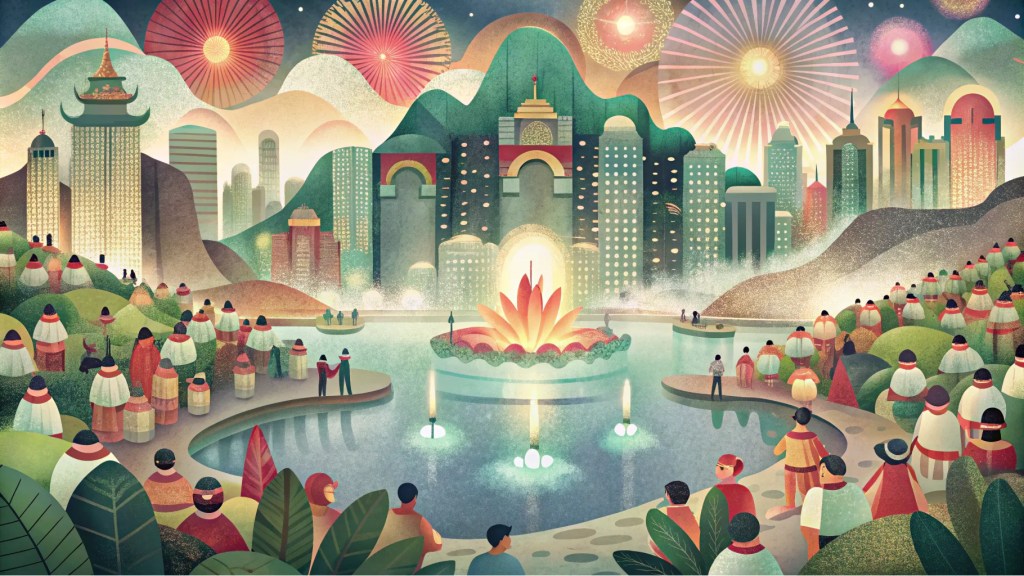


“The Guru is like a lit lamp, who lights other lamps.” ~ Adi Shankaracharya
There’s a hush in the early morning air on Guru Purnima. The kind of hush that makes space—for reverence, for remembrance, and for something beyond words. It’s not just another full moon. It’s a day when time folds into itself, offering us the chance to look back, look within, and look up—to the ones who showed us the way.
In a world obsessed with self-help hacks and viral wisdom, we forget something essential: true transformation rarely comes from a quick tip—it comes from presence. From the gaze of someone who sees who you really are, even when you cannot. From the guiding light of a teacher, a mentor, a soul who midwifed your becoming.
Guru Purnima is the day we remember those lights.
Not as ritual. As relationship.
And that relationship is more relevant than ever. In 2025, as the speed of life outpaces our ability to process it, we’re craving depth. We’re seeking roots. We’re trying to remember what it means to walk a path—and what it means to be shown how.
Related read: The Evolution of Faith: A Transformative Journey by Megha Bajaj | Alotusinthemud
What is Guru Purnima, really?
Guru Purnima, traditionally celebrated on the full moon day in the month of Ashadha (July 10 in 2025), is not just a festival—it’s a spiritual homecoming.
This is the day that honors Maharishi Vyasa, the sage who compiled the Vedas and authored the Mahabharata, regarded as one of the greatest teachers of ancient India. It is also a day that honors the universal Guru Tattva—the principle of inner and outer guidance.
“Without the Guru, the scriptures are like a tangled forest through which it is impossible to find a path. The Guru is the compass, the map, and the light.” ~ Vanamali Mataji
“Guru” in Sanskrit means dispeller of darkness.
Not just academic ignorance, but the veils over our consciousness.
And a true Guru—human or divine, seen or unseen—doesn’t give you answers.
They show you where to look.
You may also like: Nine Doorways to Self-Knowledge: The Ancient Wisdom of the Enneagram
Have we lost the art of reverence?
We live in a culture that worships independence. We’re taught to hustle, DIY everything, and mistake freedom for disconnection. In that process, we often forget to acknowledge the shoulders we stand on. The ones who held us when we were unformed. The ones who dared to reflect back the truth, even when it stung.
The guru might not always wear robes.
She could be your therapist.
He could be your dying parent.
They might be a stranger whose words stayed with you for life.
Sometimes, your greatest teacher is your pain.
When we fail to pause and recognize the forces that shaped us, we miss the sacred web of interconnection that makes us whole.
Deepen your reflection: The Heart of Caregiving: Between Love, Duty and Self-Compassion

An invitation: make Guru Purnima your inner pilgrimage
Guru Purnima isn’t just about thanking your teacher. It’s about remembering how to be a student—curious, humble, open.
Here are simple, soulful ways to honor this day:
1. Write a letter to your Guru (even if they’ve never met you)
Whether it’s Thich Nhat Hanh, Amma, a schoolteacher, or a mentor from afar, write a letter of thanks. Not to flatter, but to acknowledge the transmission.
2. Light a diya and sit in silence
Create a small space with a candle, incense, and an object that represents your learning. Sit. Breathe. Let the silence teach you.
3. Offer seva in their name
Do one act of service—feed someone, plant a tree, or donate to a cause—that would make your teacher smile.
4. Reflect on your lineage
List the people, books, experiences, and even heartbreaks that taught you something vital. This is your living lineage. Bow to it.
Practice rest as a sacred act: Rest Is the New Luxury—And You Don’t Need to Travel to Find It
A story from my path
Years ago, I recall standing outside the meditation hall at the Ramana Ashram in Tiruvannamalai, Tamil Nadu, India, unsure, my mind crowded with thoughts that fluttered like restless birds. At the far end of the hall stood the Sri Bhagavan Shrine: a small, still space where a Shiva Lingam sat in quiet presence, with a statue of Ramana Maharshi watching over it. I had come searching for answers, expecting insight to arrive in the form of clarity or even revelation. But what I received was something quieter and more enduring: a sense that I wasn’t alone in my seeking, and that the real pilgrimage was inward.
In the Buddhist tradition, the role of the teacher is not to dispense wisdom like scripture, but to help you directly perceive the true nature of your mind. I’m reminded of Lama Thubten Yeshe’s words:
“A guru is a person who can really show you the true nature of your mind and who knows the perfect remedies for your psychological problems. Someone who doesn’t know his own mind can never know others’ minds and therefore cannot be a guru.”
That day, I didn’t hear any teaching. But in the hush of the meditation hall and the unwavering gaze of the statue, I glimpsed the edge of something sacred: the beginning of knowing my own mind. And a vast, still kindness.
I didn’t get my questions answered.
I got something better.
I got reminded of who I was beneath all the noise.
That is the power of a true guru. They don’t give—they awaken.
“The purpose of a guru is not to create followers. It is to awaken teachers.” ~ Om Swami
Related: Biology of Belief: What Bruce Lipton Taught Us About Mind, Matter and Consciousness
Guru Purnima is not a day; it’s a posture of living
In the light of this full moon, I invite you to remember:
That wisdom is not a product to consume.
That reverence is not outdated.
That guidance is not weakness.
To bow is not to become small—it’s to recognize the vastness within the one who bows.
On Guru Purnima 2025, may we all find our way back—to humility, to connection, and to that quiet inner voice that waits for us when we pause.And if you’re still seeking your teacher, remember—when the student is ready, the teacher appears.
But sometimes, it’s the student who must stop running and start listening. So, let this Guru Purnima be your turning point.
Not outward. Inward.


Leave a Reply to Shalini Gulati Cancel reply