

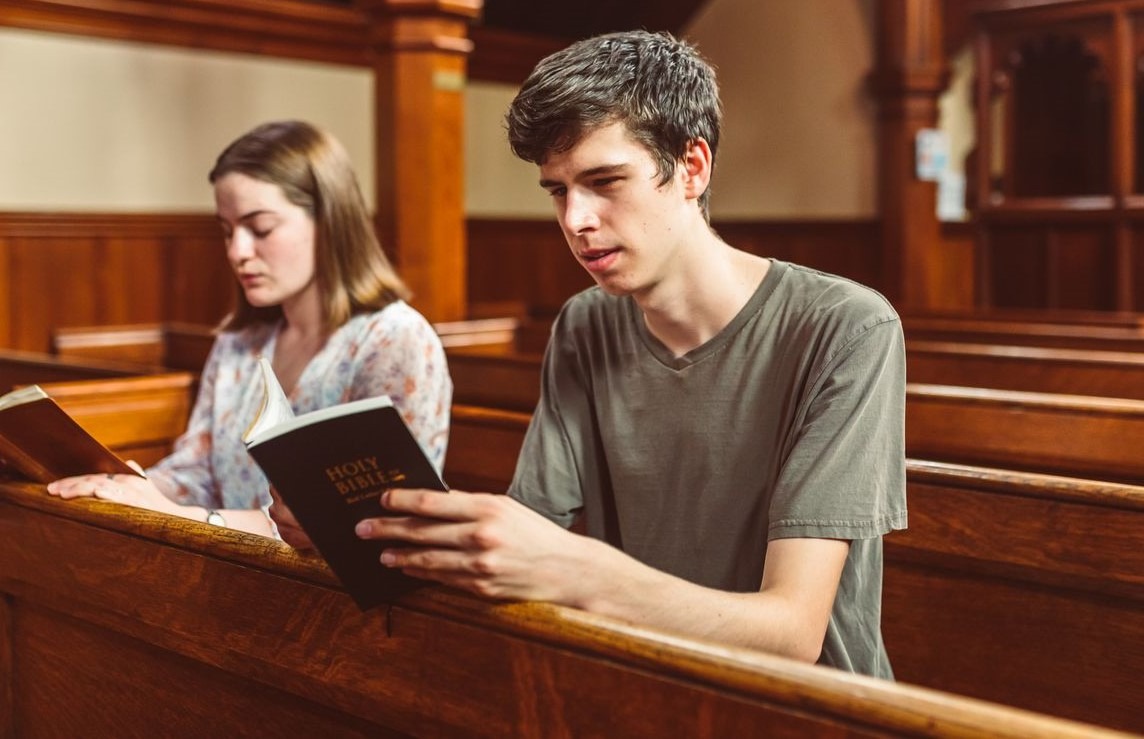
After embracing meditation and yoga, Gen Z appears to be turning its lens to religion and faith in age-old rituals.
For a generation raised on smartphones, social media, and unprecedented access to information, the renewed interest in religion and spirituality may seem surprising. However, Gen Z is not necessarily returning to faith in the same way previous generations practiced it. Young people are searching for something more personal: meaning, purpose, identity, belonging, and a sense of inner stability.
From prayer and meditation to religious traditions, therapy, and mindfulness, spirituality is finding new relevance among young adults. Researchers have found signs of renewed religious interest among young people in several countries, although the evidence varies and does not necessarily point to a broad religious revival.
In Britain, for instance, Theos researcher Nick Spencer says that unusual trends in religious belief among young people warrant closer study, while cautioning against declaring a revival too quickly. The Bible Society later retracted its original Quiet Revival research because of faults in the underlying YouGov data.
The bigger question, therefore, may not be whether Gen Z is becoming more religious, but why young people are searching for spirituality in an era of so much distraction.
A generation questioning everything
“An established religion can provide a sense of structure, identity, and belonging at a time when young people are already figuring out who they are and what they want their lives to mean.”
~ Chetna Luthra, clinical psychologist at Marengo Asia Hospitals, Gurugram

For Dr. Pooja Upadhyay, counselling psychologist and founder of Kalyanam Counseling & Psychotherapy, the answer begins with the way Gen Z approaches almost everything.
“For most of my career, I’ve worked with the younger generation, popularly known as Gen Z. And if you understand the way their minds work, you start to see something interesting: they’ve watched the generations ahead of them, and they’ve got the exact memo of what not to do,” she says.
“They question and challenge everything.”
That questioning does not necessarily push young people away from established religion. In fact, Chetna Luthra, Clinical Psychologist, Marengo Asia Hospitals, Gurugram, believes having more choices can sometimes make an established faith more attractive.
“Having access to thousands of different beliefs and worldviews can sometimes make it harder to know what you actually believe,” she says. “An established religion can provide a sense of structure, identity, and belonging at a time when young people are already figuring out who they are and what they want their lives to mean,” says Chetna
Religion, she adds, offers something that a personally constructed belief system may not always provide: community and continuity.
“Rituals, festivals, traditions, and shared values connect people to their families and to something that existed before them,” Chetna says.
But this does not necessarily mean unquestioning acceptance. “There is much more questioning now,” she says. “Someone can identify strongly with a religion while still questioning certain rules, practices, or interpretations.”
From religion to meaning-making
“Religious coping can help people to feel supported, to keep their hope, and to find meaning in their suffering.”
~ Dr. Rahul Chandhok, Senior Consultant and Head of Psychiatry, Mental Health and Behavioural Sciences at Artemis Hospitals, Gurugram

Dr. Rahul Chandhok, Senior Consultant and Head of Psychiatry, Mental Health and Behavioural Sciences at Artemis Hospitals, sees the trend somewhat differently.
“It can be misleading to describe this simply as a return to religion,” he says. “Many young adults are exploring spirituality, meditation, prayer, philosophy, and religious traditions but not necessarily adopting formal religious identities.”
For Rahul, what is taking place may be better understood as a search for meaning.
“Young adulthood is a time of uncertainty and big decisions, so ‘Who am I?’ and ‘What makes my life meaningful?’ are questions with particular force,” he says. “Religion can offer answers, but so can secular spirituality and personal belief systems.”
That distinction is important. Gen Z may not see religion, spirituality, meditation, or therapy as competing choices. Instead, young people can combine them according to what they find meaningful.
Chetna sees this as a move towards personalized faith.
“The strict boundary between religion and spirituality is weakening,” she says. “Someone might pray, follow religious festivals, and believe in God while also practicing meditation, yoga, mindfulness, or going to therapy.”
In her view, this is not necessarily a rejection of religion. “It could actually represent a shift from institutional religion towards individually meaningful religion.”
Searching for stability in an uncertain world
The timing of this renewed interest may also matter.
Gen Z has come of age amid the Covid-19 pandemic, wars, economic uncertainty, social disruption, and an increasingly difficult digital environment. Research discussed by the Lowy Institute has identified similar patterns internationally, with young people in parts of Asia turning towards religious and spiritual practices following the pandemic as they grappled with uncertainty, identity, and the search for meaning.
“Gen Z leaned toward spirituality because ‘the algorithm gave them everything except meaning.”
~ Pooja Upadhyay, a counselling psychologist and founder of Kalyanam Counseling & Psychotherapy, Ireland

Pooja believes those experiences have fundamentally altered how young people view certainty.
“They’re being raised in a timeline where they’ve lived through a pandemic and wars, all within one lifetime, and that’s a lot to take in,” she says. “These life-threatening events shook the very certainty of life for them.”
“When the world stops feeling predictable, the mind goes looking for something that restores that predictability,” she adds. “That, I’d argue, is a large part of why spirituality has quietly made its way back into the conversation.”
Rahul agrees that uncertainty can make faith psychologically meaningful.
“Economic hardship, conflict, loneliness, health worries, and an uncertain future can increase the need for reassurance and hope,” he says. “Religious coping can help people to feel supported, to keep their hope, and to find meaning in their suffering.”
But he cautions against assuming that religion is automatically beneficial.
“Religion can be a salve, but it can also be a source of fear and guilt,” says Rahul.
A 2026 study published in the International Journal of Psychology studied 484 emerging adults in India and found that negative religious coping was associated with higher anxiety symptoms, while positive religious coping was not associated with anxiety in the same way.
For Chetna, the distinction lies in whether faith helps a person confront life or avoid it.
“Genuine spiritual seeking usually involves wanting to understand oneself better, finding meaning, developing inner peace, and becoming a better person,” she says.
Religion can become an escape, she adds, when someone uses it “mainly to avoid facing anxiety, loneliness, uncertainty, or difficult situations.”
Research published earlier this year by the Barna Group and Gloo’s State of the Church report found that Gen Z churchgoers now attend services nearly twice a month—the highest frequency of any generation and almost twice as much as they did five years ago. Millennials are showing a similar pattern.
The findings do not suggest that Gen Z as a whole is suddenly returning to church. Rather, among young adults who already identify as churchgoers, attendance is becoming more frequent.
Meanwhile, one of the largest coordinated church invitation movements in the US is also reporting growth.

Missing piece: belonging
Thanks to technology, the world has become a global village where people are more connected than ever before. Ironically, in an increasingly connected world, people often feel lonely; community may be one of the strongest attractions of religion.
“Young adults can feel isolated even though they interact with each other at all times through technology,” Rahul says. “A religious community can provide face-to-face relationships, shared rituals, emotional support, identity, and a sense of being needed.”
The Lowy Institute’s global analysis similarly points to community and identity as important elements of the renewed interest in faith among young people. In some countries, religion is also intersecting with questions of gender and belonging, particularly among young men.
For Gen Z, however, community does not necessarily mean returning to traditional institutions.
The internet itself has become a gateway to spirituality. Religious teachings, meditation practices, spiritual influencers, and philosophical ideas can now reach young people through short videos, podcasts, and social media.
And that creates an intriguing paradox: the digital world that can leave young people isolated may also be introducing them to spirituality.
Pooja puts it more sharply: “They’ve seen so much suffering up close, and so they seek connection through spirituality, in a world that otherwise feels disconnected.”
Faith on their own terms
Perhaps the most significant change is that Gen Z does not appear to want spirituality dictated to them.
“They are spiritual on their own terms,” Pooja says. “Not the way their parents or grandparents were.”
For this generation, she says, spirituality is less about proving devotion through rituals and more about “finding meaning, purpose, and alignment.”
Chetna sees the same shift through the lens of autonomy. Young people increasingly want to decide what their beliefs mean to them rather than accept an entire system without question.
“They may disagree with certain institutional rules but still feel deeply connected to their faith,” she says.
This also explains why the future of religion among young people may not be neatly divided between believers and non-believers. A young person may pray, meditate, attend a festival, practice yoga, and see a therapist without considering these choices contradictory.

A phase or a lasting shift?
Whether this search for spirituality becomes a lasting part of Gen Z’s identity remains uncertain.
“Young adulthood is already a period of intense identity exploration,” Chetna says. “People are questioning their careers, relationships, values, and ideas about themselves, so spirituality can naturally become another area they experiment with.”
But she does not dismiss the trend as a passing phase.
“If someone discovers that religion gives them a genuine sense of meaning, emotional comfort, community, or purpose, it can become an important and stable part of their identity as they grow older,” she says.
Ultimately, the question may not be whether Gen Z is becoming religious again. It may be what young people are asking of religion—and what they are asking of spirituality.
Pooja believes the answer lies in the need for something deeper than the endless stream of information and stimulation that defines modern life.
“They are overexposed, and at the same time underrepresented, undermined, and undervalued,” she says. “And yet, they’re also the first wave of fresh air we’ve seen in a long, long time.”
Perhaps, she suggests, that is why spirituality has returned to the conversation.
“Or to quote one of these young minds,” Pooja says, “they leaned toward spirituality because ‘the algorithm gave them everything except meaning.’

Leave a Reply