


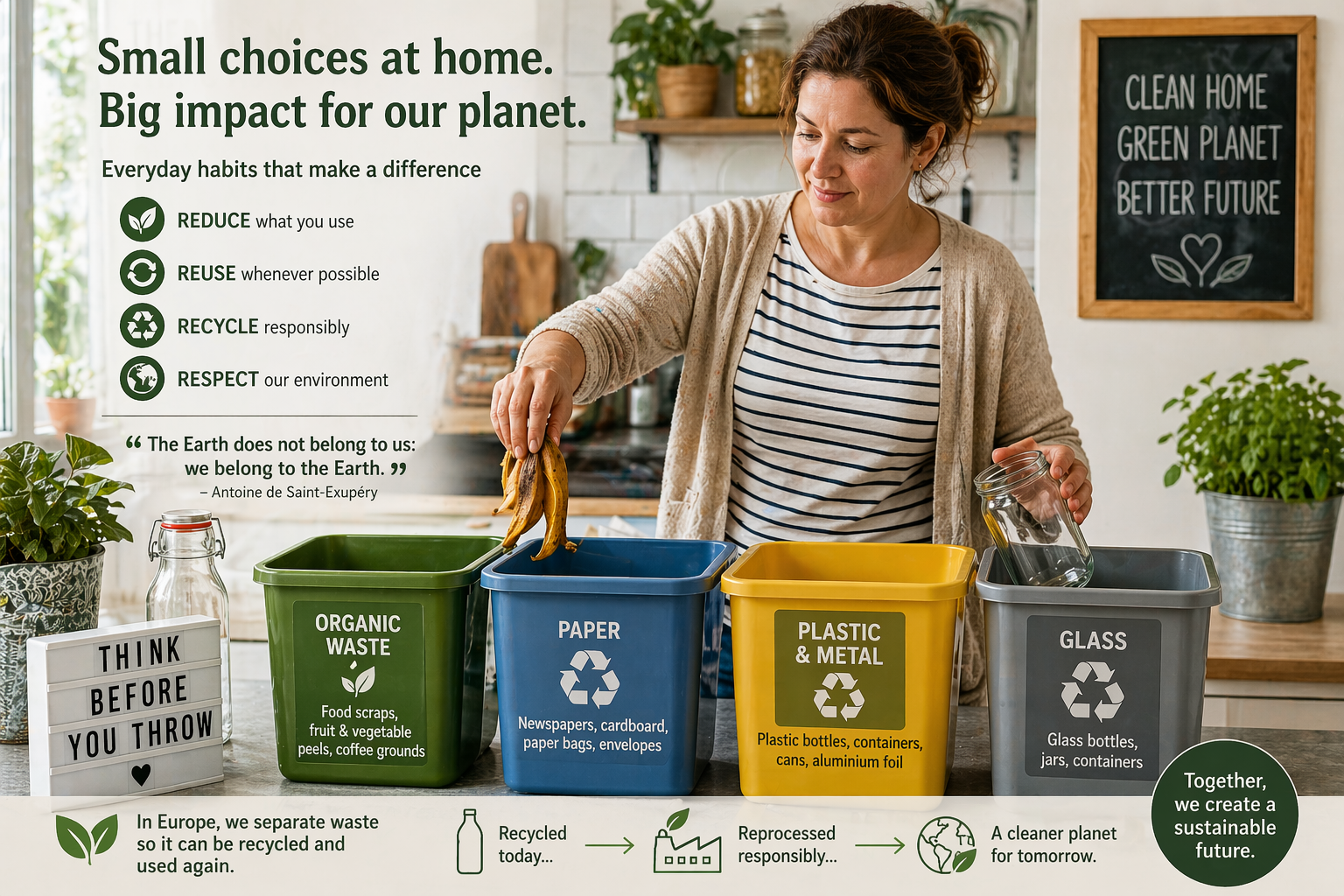
On Earth Day, observed on April 22, these words resonate more deeply than ever. Together, these words serve as a powerful reminder that waste is not just an environmental issue—it is a human responsibility. And much of that responsibility begins at home, where everyday choices shape what we consume, discard, and recycle. In households across the world, women—often the primary leaders of daily living—are uniquely positioned to turn this awareness into action, playing a crucial role in reducing waste and protecting both environmental and public health.
It wasn’t very long ago—back in the 1980s—that waste, as we understand it today, barely existed in everyday rural life. I remember watching my grandmother and neighbors sit together, patiently sorting through worn-out saris and dhotis. The softer, well-worn fabric was carefully set aside to be repurposed as diapers or gentle wraps for newborns, while sturdier sections were reused in other ways.
Old kurtas were often transformed into lightweight blouses, perfect for beating the summer heat. Even the borders of saris and dhotis were not spared—the thicker threads were extracted and reused to stitch and mend clothes, giving fabric a second, sometimes even a third, life.
In the kitchen, nothing went to waste. Vegetable scraps were sorted with intent—fresh green peels and leftovers were set aside as fodder for cows and buffaloes, while onion skins, potato peels, garlic, and ginger waste found their way into a pit, slowly turning into manure. What we now call “wet waste” was simply part of a natural cycle.
Even containers were never discarded. Large 20-liter oil tins were cut, reshaped, and fitted with lids to store flour, rice, and grains. Same for the small ones.
There is no such thing as ‘away’. When we throw anything away, it must go somewhere.
~ Annie Leonard, Greenpeace USA.
Only we humans make waste that nature can’t digest.
~ Capt. Charles J. Moore.
Even everyday habits and an eco-friendly way of living
Grocery shopping meant carrying cloth bags—a practice I saw well into the late 1990s. After that, plastic bags slowly took over and have since become a menace.
People carried their own water bottles long before single-use plastic bottles flooded the market. Milk and beverages were delivered in glass bottles, which were carefully washed and returned for reuse—a system that extended to most beverages.
Street vendors serving chaat relied on biodegradable sal leaf plates that would naturally decompose without harming the environment.
Back to the present
Even today, villages are producing less waste. Some of the most troublesome waste plastic continues to be reused by villagers, but sometimes in unsafe and unhygienic ways.
In many villages, despite increased access to LPG through government initiatives, firewood remains a preferred cooking method. In the absence of kerosene oil, polyethylene bags, instead of being treated as a nuisance, are often burned or used to light fires.
Villages in India, Europe, and other parts of the world still generate remarkably little waste. It is only when you move beyond them—even one meter into towns—that the landscape begins to change. Garbage piles up, plastic litters the streets, and disposal replaces reuse.
1955 — Throwaway living
How did this shift begin? In 1955, in the United States, a cultural turning point quietly took shape with the idea of “throwaway living.” When LIFE magazine published its now-famous article celebrating convenience, it framed disposability as progress. Cleaning, repairing, and reusing were seen as outdated burdens. Items designed for single use became symbols of modernity, and the act of throwing things away was almost liberating.
At the time, the idea seemed harmless—even aspirational. But what followed was a steady rise in waste generation, first in high-income countries and eventually across the globe. Convenience replaced consciousness.

A planet under pressure
The consequences are no longer distant—they are visible, measurable, and deeply concerning. The world is drowning under the weight of garbage. According to the World Bank’s What a Waste 3.0 report, global waste is projected to reach nearly 4 billion tonnes annually by 2050.
Even more alarming is how poorly this waste is managed. Around 30% of municipal waste is still dumped or left uncollected. In low-income countries, only a fraction is properly processed, leaving communities exposed to open dumping, burning, and contamination.
On a per-person basis, countries like Austria, the United States, and Denmark generate the highest volumes of waste—over 800 kilograms annually per person, nearly three times the global average. But the issue is no longer confined to any one region.
Urbanization and consumerism are rapidly increasing waste generation in developing nations as well.
The hidden cost: Our health
Waste is not just an environmental issue—it is a public health crisis.
Burning plastic releases toxic chemicals that can lead to respiratory diseases, heart conditions, and even cancer. Poorly managed waste becomes a breeding ground for disease-carrying insects and animals, increasing the risk of infections such as dengue and cholera. Contaminated water sources, often a result of improper waste disposal, affect entire communities, especially children.
Microplastics—tiny particles formed from degrading plastic—have now entered our food chain. They are found in water, soil, and even the air we breathe, with growing evidence linking them to long-term health risks.
From “housewives” to changemakers
Interestingly, the very idea that normalized throwaway culture also points to a powerful solution. In 1955, convenience was marketed to housewives as freedom from labor. Today, women can redefine that narrative—not as passive consumers, but as active stewards of sustainability.
“In the Indian context, the domestic sector generates the highest volume of waste. This is primarily due to the country’s large population, which leads to significant daily generation of household waste such as food (wet waste), plastic wrappers, packaging materials, and other municipal solid waste,” said Lokesh Agrawal, co-founder, GG Wastech Pvt Ltd.
This makes household-level action critical. Segregating waste at source, composting kitchen scraps, reusing containers, and choosing sustainable products may seem small, but they have a far-reaching impact. When children grow up observing these habits, they carry them forward, creating lasting change.
Beyond the household: Shared responsibility and systemic solutions
While women often manage household waste, sustainable change requires equal participation from all members of society—along with systemic shifts in production and policy.
The industrial sector ranks second in producing waste.
“It produces a wide variety of waste, including hazardous waste. While the volume may be lower than domestic waste, its impact is more critical because hazardous waste requires specialized handling and disposal, making its management more complex,” said Lokesh.
“The agricultural sector comes third and is comparatively easier to manage, as it is largely biodegradable and can be effectively utilized for purposes such as composting, biogas production, or as organic fuel,” he said.
After collection, household waste is typically transported to a material recovery facility (MRF) or a transfer station. Proper segregation ensures that waste can be processed effectively and safely.
At the MRF, waste is sorted into categories: biodegradable waste becomes compost or biogas; recyclable materials like plastic, paper, and metal are sent to recycling units; and non-recyclable waste is converted into fuel or sent to landfills. Special waste streams such as e-waste and biomedical waste are handled under strict regulations.
Learning from global practices
Across the world, there are encouraging signs of change. Europe, for instance, is setting a strong example in circular living. Its second-hand clothing market—valued at $32.12 billion in 2025—is projected to grow significantly, reflecting a cultural shift toward reuse and mindful consumption.
Every day behavior mirrors this trend. Homemakers in countries like Belarus and Ukraine—through popular vlogs such as Olesya & House or Tanita Giu—regularly showcase how they source, reuse, and even resell second-hand goods. This is not just about thrift; it is about extending the life cycle of products and reducing waste.
This is a habit worth cultivating globally. Choosing second-hand, repairing instead of discarding, and rethinking consumption can significantly reduce the burden on landfills.
What can we recycle at the household level?
Most households already generate recyclable materials:
Paper, plastics, glass, metals, electronics, and textiles can all be reused, recycled, or repurposed. The real challenge is not availability but awareness and consistency.
Waste is typically managed in three ways: reused, recycled, or discarded.
Biodegradable waste can be composted; recyclables enter the recycling chain through scrap dealers; and non-recyclables are either converted into fuel or sent to landfills.
From problem to opportunity: Rethinking waste
While waste is a global challenge, it also presents significant business opportunities and space for innovation and problem-solving.
As industries expand, they generate multiple streams of waste—plastic, metal, organic, and hazardous—each requiring distinct handling methods based on its composition and recyclability.
For instance, plastic waste is broadly classified into seven types, of which certain categories, such as PET (Polyethylene Terephthalate) and HDPE (High-Density Polyethylene), are highly recyclable and are efficiently processed through recycling units to produce new materials.
“In contrast, low-value plastics like multilayer packaging are far more difficult to recycle and are often converted into Refuse-Derived Fuel (RDF), which is then used by cement industries as a substitute for conventional fossil fuels like coal,” said Lokesh.
Other materials, such as metals and paper, follow a more direct recycling route, where they are collected, processed, and reintroduced into manufacturing cycles, reducing the demand for virgin raw materials.
This circular approach not only helps reduce environmental burden but also opens up avenues for sustainable enterprises and resource recovery-based business models.
Returning to mindful living
Perhaps the answer to our growing waste crisis lies not in new solutions, but in rediscovering old ones. Earlier generations practiced sustainability not as a choice but as a way of life rooted in respect for resources.
This Earth Day, the question is not whether we can reduce waste—it is whether we are willing to change our habits. The shift from a throwaway culture to a circular one begins at home.

Leave a Reply