


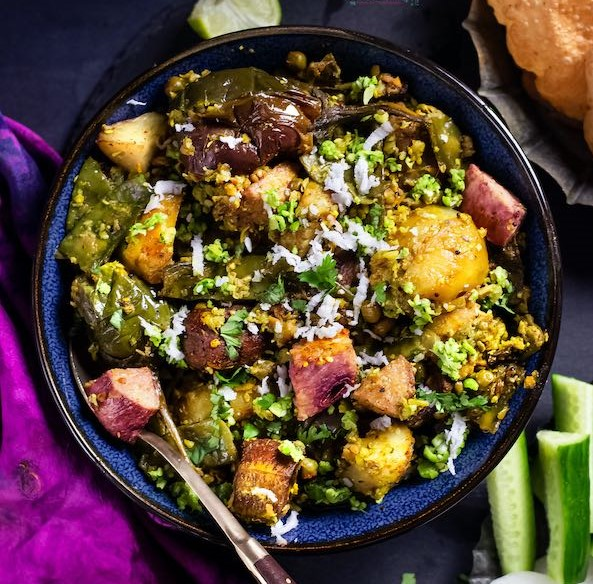
Every winter, like clockwork, my hands reach for lilva tuver (green pigeon peas) before my mind does. The ritual always begins in silence: a steel plate between my mother and me, heaps of shelled beans collecting like tiny green moons, and that unmistakable winter stillness seeping into the home.
Years rearrange themselves quietly. Once, I hovered beside her, absorbing every proportion and every scolding; now she sits back, half amused and half proud, watching me take charge of the undhiyu pot. Her undhiyu (seasonal Gujarati winter dish) was fiery, steeped in red masala and dry garlic. Mine is greener, softer, and more fragrant with fresh coriander and winter garlic. But the emotion behind it has never changed.
At fifteen, undhiyu felt ceremonial. At fifty, it feels like a grounding practice—an act of mindfulness, a return to myself.

Undhiyu as a Spiritual Practice of Patience and Presence
Undhiyu isn’t just cooked; it’s carefully assembled, or as I like to say, curated and layered with winter’s generosity: surti papdi, kand, shakariya, raw bananas, brinjals, tuver, and potatoes. At its heart are the muthiyas: the rough methi-besan dumplings rolled with oiled palms and infused with green masala of coconut, coriander, garlic, ginger, and chillies.
Nothing is rushed. Undhiyu demands time, attention, and respect, mirroring the quiet resilience and deep transformation that the patient acts we cultivate in life.
On Uttarayan (harvest festival in January), as kites fill the Gujarat sky and rooftops turn into open-air dining rooms, undhiyu becomes memory, sunlight, laughter, and belonging woven into a single dish.
“Seasonal eating is a form of conscious consumption, a way of honoring farmers, reducing food miles, supporting biodiversity, and practicing gratitude for what the earth offers.”
Ubadiyu: When the Earth Itself Cooks
If undhiyu carries memory, ubadiyu carries the earth.
I once witnessed it being made in Valsad, Gujarat. The ritual felt older than any written recipe. A clay pot brimming with winter vegetables, sealed with dough, inverted into a pit in the ground, and covered with firewood. Fire above, heat below. Hours later, the seal cracked open, releasing smoke like a blessing.
What emerged from the pot tasted primordial: charred papdi, caramelized sweet potatoes, and purple yams glistening with raw sesame oil. Food kissed by fire and soil, tasting of grit and grace. That day reminded me of bioregionalism before the term existed: eating what your land grows, when it grows, the way your ancestors cooked it. An ancient, sustainable wisdom quietly passed down.

Books and Voices That Stirred an Inner Knowing
On my 50th birthday, my friend Arun Chatterjee, knowing my love for all things food and cooking, gifted me Memories on a Plate, stories from 100 Indian kitchens around the world. The book reaffirmed something I already felt in my bones: kitchens from Mumbai to Montreal speak the same fundamental language.
Food follows seasons. Food remembers soil. Food carries identity.
Later this year, when I encountered Rujuta Diwekar’s ‘Mitahara’, a cookbook and lifestyle guide, at a friend’s place, the echo was unmistakable. She spoke of nourishment not in calorie counts but in awareness—knowing when methi is tender, when tuver arrives, and when mangoes deserve their rightful season. It struck me that seasonal eating is a form of conscious consumption, a way of honoring farmers, reducing food miles, supporting biodiversity, and practicing gratitude for what the earth offers.
Regional Seasons, Regional Wisdom
Dr. Priyanka Pathak, Curator at INT Aditya Birla Centre for Performing Arts, often speaks about the deep belonging that comes from eating foods rooted in the region one inhabits. After shifting from Delhi to Mumbai, she felt it viscerally.
“Nothing matches Mumbai’s strawberries,” she told me, referring to the Mahabaleshwar berries that reach our markets within hours. Those mist-laced slopes, volcanic soils, and crisp plateau air create strawberries that taste like winter’s own joy.
Driving through Mahabaleshwar once, I saw rows of strawberry plants glowing red in the January sun—a sight so celebratory it felt like nature smiling.
Priyanka’s other discoveries were equally telling. Delhi’s amaranth, or green chaulai, is a short-lived winter delight. Here, she found the red amaranth available almost year-round. Leafy greens like paale bhaji appear even during the monsoon. And Mumbai’s figs—luscious, iron-rich, abundant—were a revelation.
It made me realize how deeply regional cycles shape our plates. What is rare in one city is everyday nourishment in another. Sometimes it takes an outsider to show us that our everyday produce is a quiet blessing.
The Next Generation Is Listening: A Renewal of Old Wisdom
What gives me hope is watching Gen Z and millennials return to traditional practices on their own terms.
My nephew’s wife, Smruti Rao Shah, a professional, mother, and superb cook who lives in Dubai, once told me, “We track regional harvests even here—aamras in summer, sarson da saag and bajra khichu in winter, rasam on chilly nights, and curd rice when it gets warm. Our elders always knew the science before anyone named it.”
Last year, when she asked me for an undhiyu recipe, I sent her to Gujju Ben na Nasta—Urmila Jamnadas Asher on YouTube, whose MasterChef India “Jhatpat Undhiyu” won hearts and an apron.
Right beside that lineage stands Sanjyot Keer of Your Food Lab—a modern interpreter of tradition. His undhiyu holds the same authenticity but is framed in a language the younger generation relates to: clear method, youthful energy, and a contemporary aesthetic.
And just like that, the chain continues—old wisdom, new interpretation, same soul.
“Food, in our own tradition, is something holy. It’s not about nutrients and calories. It’s about sharing. It’s about honesty. It’s about identity.”
Gratitude, Soil, and the Spiritual Practice of Eating
Seasonal eating is more than a dietary choice. It is a spiritual practice, a way to reconnect with the soil, honor farmers, reduce waste, support food justice, and participate in a cycle far bigger than ourselves.
Food, at its deepest, is an act of identity.
And perhaps it is only fitting that in Gujarat, on Uttarayan, when the winter sky fills with kites, we also celebrate National Undhiyu Day—honoring a dish that carries memory, soil, community, and season in every bite.


Leave a Reply to sonali Cancel reply