
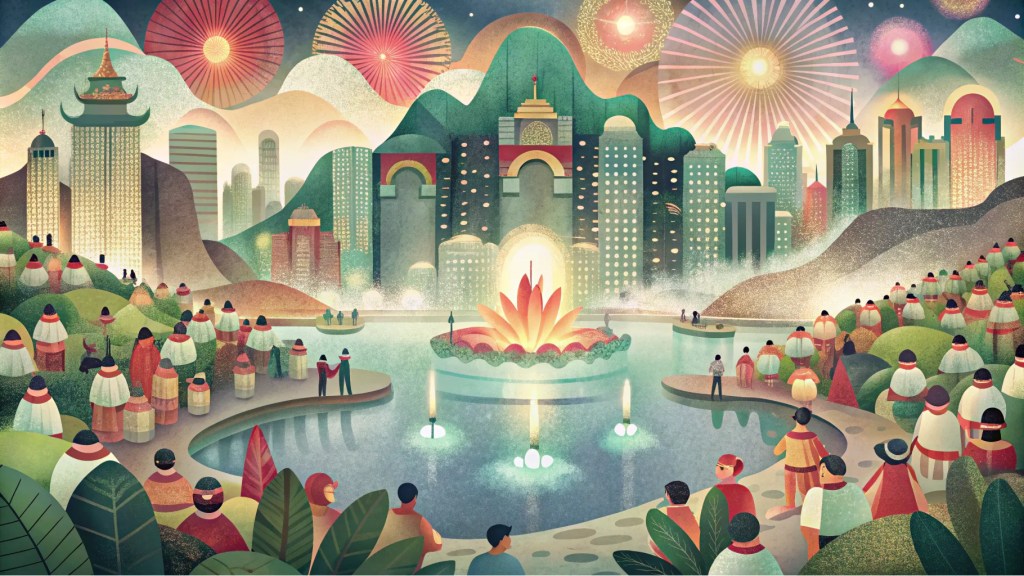


Early one morning, before the world has fully woken up, a line of Buddhist monks moves quietly along the road. Their robes catch the light…their footsteps are unhurried, as they passed the halfway mark on a 2,300-mile Walk for Peace. The group seeks to raise awareness of ‘peace, loving kindness, and compassion’ in the US and the world.
There are no banners flapping in the wind, no chants rising into the air, just the sound of walking: measured, deliberate, attentive. A group of Buddhist monks has people slow down as they pass. Some pause, and some bow their heads instinctively. Others watch, unsure of what they are witnessing because this is not protest as we have been trained to recognize it. And yet, it is unmistakably political.
The monks are walking for peace. Among their quiet but resolute demands is a call for Vesak—the day that commemorates the Buddha’s birth, enlightenment, and passing—to be recognized as a federal holiday. It is a request that appears modest on the surface, yet carries profound implications for how we understand power, spirituality, and the values we choose to collectively honor.
Walking as a language of presence
In Buddhist practice, walking is never just about getting from one place to another. It is a form of meditation, an embodied reminder to arrive fully in each moment. Each step is taken with awareness, and every breath is noticed. The body becomes a site of attention rather than urgency.
When monks walk for peace, the act itself becomes a form of communication. Not loud, not confrontational, but deeply unsettling in its restraint. In a culture addicted to noise, silence becomes a refusal. In a political climate shaped by outrage and immediacy, slowness becomes resistance.
This is political language stripped of spectacle. No slogans. No enemy. No performance for algorithms. Instead, there is the radical insistence that peace cannot be demanded through aggression and that change does not always announce itself loudly.
The walk asks a question without words: What would it mean to be fully present with one another, even in disagreement?

The walking monks come from Theravada Buddhist monasteries around the world. Theravada—meaning “the way of the elders”—is the oldest living Buddhist tradition and remains widely practised in Cambodia, Laos, Myanmar, Sri Lanka, and Thailand. The walk began at the Huong Dao Vipassana Bhavana Center in Fort Worth, Texas, led by Bhikkhu Pannakara. The monks are walking 2,300 miles to promote national healing, unity, and compassion.The walk is expected to end on Feb 12 2026. Buddha Purnima falls on Friday, May 1, 2026.
Vesak: More than a religious observance
To understand why Vesak matters, it must be freed from the narrow frame of “religious holiday.” Vesak marks three pivotal moments in the Buddha’s life—his birth, awakening, and final passing—but its significance extends far beyond doctrine or belief.
At its heart, Vesak is about awakening to suffering and choosing a path that does not deepen it. It honors restraint in a culture of excess, compassion in a world shaped by division, and awareness in an age of distraction.
This is why Vesak is already recognized internationally, including by the United Nations, as a day of global significance. Its teachings have shaped ethical frameworks, contemplative sciences, and social movements across cultures. Mindfulness, nonviolence, and interdependence—ideas now widely embraced—have their roots here.
Recognizing Vesak as a federal holiday is not about privileging one faith. It is about acknowledging that certain spiritual insights carry civic value—that they help societies pause, reflect, and recalibrate.
The politics of the pause
What a society chooses to honor reveals what it values. Federal holidays are not neutral. They mark collective memory, shared ideals, and the rhythms we agree to slow down for. Vesak offers something increasingly rare: a pause that is not about consumption or celebration, but contemplation. A day that invites people to reflect on how they live, how they relate, and how they contribute to the collective fabric.
In an era of burnout, climate anxiety, and moral fatigue, this pause becomes a public good. It legitimizes rest without guilt. Reflection without productivity. Silence without suspicion. The Buddha’s teachings were never about withdrawal from the world but about engaging it wisely. Vesak asks not for belief, but for attention. Not for conversion, but for consideration.
Silence as resistance
The monks’ march makes visible what Vesak embodies: silence as a form of strength. In a world where every position must be declared instantly and loudly, silence becomes a disciplined choice. This is not passivity. It is moral clarity. It is the refusal to mirror the violence—verbal or otherwise—of the systems one seeks to transform. The walk, like Vesak itself, does not offer easy answers. It offers presence. And presence, sustained over days and miles, becomes an ethical stance.
Those who witness the march often describe feeling unsettled—not because of confrontation, but because of its absence. The monks do not demand attention. They invite awareness. And that invitation lingers far longer than any chant.

Vesak as a cultural bridge
In pluralistic societies, the challenge is not whether spirituality has a place in public life, but how that place is held with care and inclusivity. Vesak offers a bridge rather than a boundary.
Its observances—acts of generosity, meditation, service, and ethical reflection—are practices that translate across traditions. One need not be Buddhist to recognize the value of compassion, restraint, or mindful living.
Recognizing Vesak federally would affirm that spiritual wisdom need not be privatized to be respected. That shared reflection strengthens, rather than fractures, the social fabric. It would also signal a maturity of vision: the ability to honor difference without fear and depth without dogma.
Rethinking progress
The monks walking for peace are not walking toward a finish line. They are walking toward a reminder—that how we move through the world matters as much as what we achieve. Their call for Vesak as a federal holiday asks us to reconsider our measures of progress. Is speed always advancement? Is growth without wisdom sustainable? Is success meaningful if it leaves compassion behind? These are not abstract questions. They shape policy, culture, and the everyday lives of people navigating a world that feels increasingly fragmented.
A quiet invitation
Vesak does not arrive with spectacle. It arrives quietly—with a lamp lit at dawn, a bowl offered in generosity, and a path walked with care. Its power lies in invitation rather than assertion. The monks’ march brings this invitation into public view. It asks little of us—only that we notice, that we pause, that we consider the possibility that awakening belongs not only in monasteries but also in civic life.
To recognize Vesak as a federal holiday would not solve the world’s conflicts. But it would offer something quietly radical: collective permission to slow down, to reflect, and to remember that peace is not merely the absence of violence, but the presence of awareness.
In choosing what we honor, we choose who we are becoming.
Perhaps it is time to choose awakening.
Leave a Reply to 2,300 Miles of Mindfulness: Buddhist Monks’ Peace Walk concludes in US Capital Cancel reply