


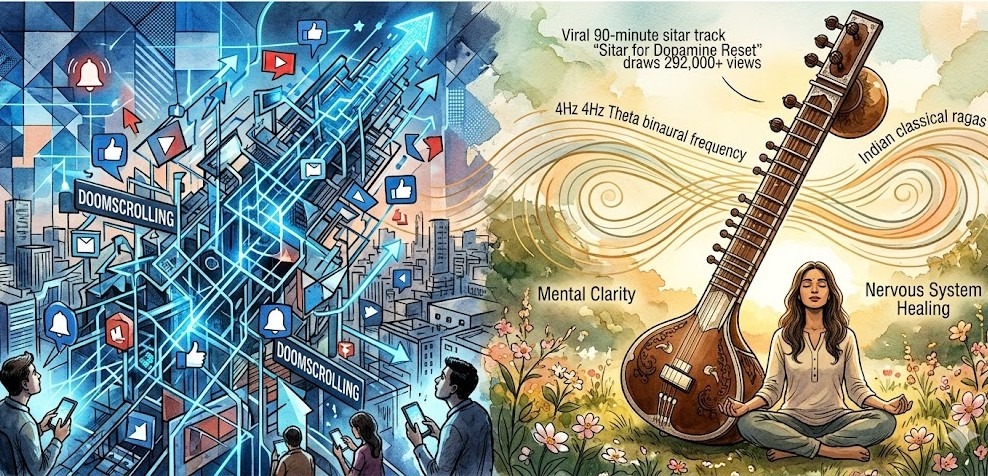
What if the antidote to digital overstimulation is not another wellness app, but the trembling resonance of a sitar string? What if certain Indian classical ragas—played at healing frequencies — can slow the mind, recalibrate the senses, and gently reset the brain’s reward circuitry called dopamine?
The question arrives at a moment when the modern brain is under siege. The Fourth Industrial Revolution arrived not with smokestacks or assembly lines but with glowing rectangles in our palms—endless reels, vibrating notifications, and dopamine engineered into every swipe. Attention became currency. Addiction became a design. And somewhere between doomscrolling and digital fatigue, the human nervous system quietly began to fray.
Neuroscientists say dopamine is not simply the brain’s “feel-good” chemical; it is the molecule of craving, the force that teaches us to return again and again to whatever delivers reward. Silicon Valley mastered that loop. But an unlikely counterforce may lie thousands of years older than the algorithm itself.
The YouTube meditation track is going viral
On April 29, a 90-minute sitar meditation—titled Sitar for Dopamine Reset | Indian Classical Music for Mindfulness—designed as an antidote to the overstimulated modern brain — quietly appeared on the YouTube channel Raga Focus.
Rooted in Indian classical ambient textures and composed for deep work, dopamine reset, and mental clarity, the recording seemed almost anachronistic in an age of hyper-edited content and shrinking attention spans. Yet by May 13, it had drawn more than 292,000 views — a striking sign of how urgently people are searching for stillness.
Beneath the cascading sitar melodies lies something listeners cannot immediately hear but may subtly feel: a 4Hz theta binaural frequency, associated with meditative awareness, emotional regulation, and deep states of concentration. The result is less a song than a neurological environment—music engineered not to overstimulate the brain, but to slow it down, soften its compulsions, and guide it toward a calmer, more sustained state of focus.
One comment beneath the video captured its growing appeal among an exhausted, hyperconnected generation. “I am preparing for the CA exam, and it is very helpful for me in increasing concentration and productivity,” wrote YouTube user @JimiModi—a small but telling testament to how ancient sound traditions are finding new relevance for those searching for relief from fractured attention.
The channel has so far posted 51 videos, including Sitar for Nervous System Healing, Deep Sleep Relaxing Music with Bansuri, and 2 Hours Stress Relief Music | 432Hz Indian Classical Raga for Anxiety Calm, but Sitar for Dopamine Reset garnered the most views.
Ancient sound therapy meets modern neuroscience
It is perhaps no coincidence. Long before neuroscience began studying dopamine and attention spans, cultures across the world were already using music as therapy.
Research cited by the National Library of Medicine found that listening to certain Indian ragas, including Desi-Todi, for 30 minutes daily over 20 days significantly reduced diastolic blood pressure, stress, anxiety, and depression while improving optimism and overall well-being. Changes in heart rate were found to be even more noticeable among women.
Why does frequency matter in healing music?
With increasing exposure to digital overload, many people are turning to raga-based music, sitar meditation tracks, and frequency-tuned soundscapes (such as 432Hz and theta wave binaural beats) as tools for mental clarity and nervous system regulation.
But practitioners say the healing effect does not come from ragas and instruments alone. Frequency matters, too. Increasingly, musicians and sound therapists are experimenting with frequency-tuned soundscapes designed to influence mental states and calm the nervous system.
Sitar for Dopamine Reset, for instance, was recorded with a 4Hz theta binaural frequency—a low-frequency brainwave pattern associated with meditation, deep focus, and emotional healing.
The intention is not merely to create relaxing music but to gently guide the mind into a calmer state and interrupt the cycle of constant dopamine-driven stimulation.
What “dopamine reset” really means
The term “dopamine reset” is not a clinical diagnosis, but it is widely used to describe reducing overstimulation caused by excessive digital content, fast-paced entertainment, and constant notifications.
When the brain is repeatedly exposed to high stimulation, attention becomes fragmented, and restlessness increases. Slow, repetitive, and harmonically structured music—such as Indian classical ragas—can help counterbalance this effect by reducing sensory overload, supporting attention stability, encouraging emotional grounding, and promoting calmer cognitive states.
Unlike highly stimulating media, raga-based soundscapes create a steady auditory environment that allows the nervous system to relax and recalibrate.
How Indian classical music calms the nervous system
For centuries, Indian classical traditions have held that ragas possess healing qualities—capable not just of calming the mind but of restoring balance to the body itself.
When used in meditative or ambient formats, raga music may support calming the nervous system, reducing stress response, deepening meditation, improving sleep quality, and enhancing mental clarity and focus.
These effects have made raga music increasingly popular in meditation, relaxation therapy, and focus-enhancement practices.
Sitar, Bansuri, and the rise of healing soundscapes
Traditional instruments play a central role in the therapeutic quality of Indian classical music. The sitar produces rich harmonic overtones that create depth, resonance, and emotional texture, while the bansuri, or bamboo flute, evokes calmness, emotional release, and introspection through its soft, breath-like tones. Each classical instrument carries its own distinct sonic character, capable of influencing mood, emotion, and mental state.
Together, these instruments create immersive sound environments that offer something increasingly rare in the digital age: sustained stillness.
Raga Focus is far from alone. YouTube is now filled with channels experimenting with Indian ragas, healing frequencies, and binaural soundscapes aimed at easing insomnia, stress, anxiety, digital fatigue, and even addictive behavior.
And the growing channels and viewership suggest that, for many listeners, the right melody at the right frequency is becoming more than background music—it is emerging as a form of mental restoration.

Leave a Reply