
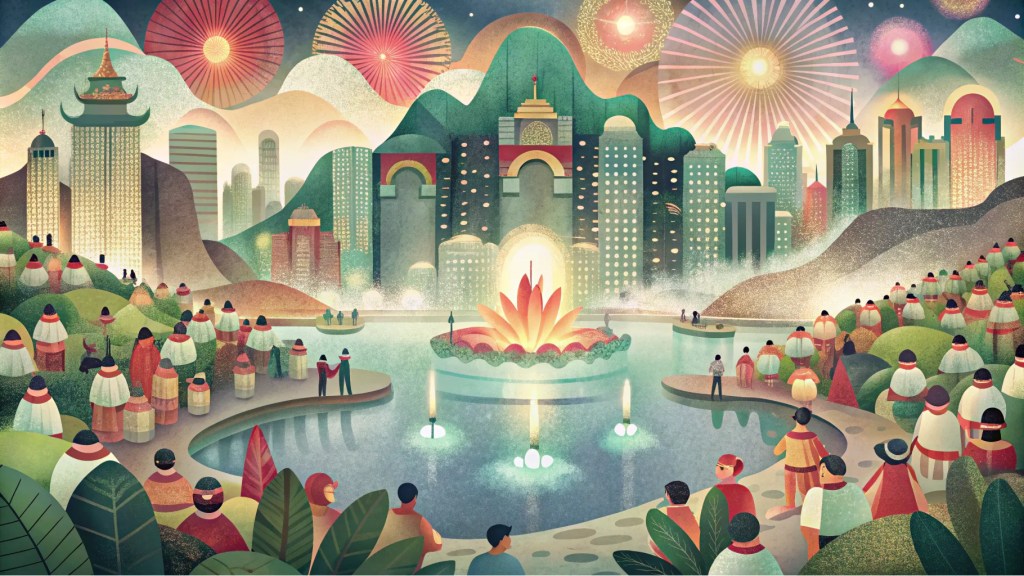


America@250: First article in the ‘Sacred Roots, American Soil’ series
Indian spiritual teachers helped introduce America to Hindu philosophy, yoga, and meditation. Ayurveda and vegetarianism followed. As the US celebrates 250 years of independence, we turn the spotlight on this lesser-known chapter of the American story.
Imagine two worlds standing at the cusp of change. In India, an ancient civilization shaped by the teachings of its scriptures—meditation in, fasting, chanting, and self-realization—was reeling under British colonial rule, grappling with economic hardship, and gathering strength for an uprising against foreign rule.
Across the seven seas, America was racing into modernity; agrarian life was giving way to urbanization; railways were shrinking distances; factories were replacing field labor; and the Gilded Age was announcing a new culture of wealth, disparity, and various movements. At the same time, the country was dealing with the Panic of 1893, unemployment, farmers’ protests, and anxieties about the impact of rapid industrialization on the common man.
It was into this changing and restless America that an Indian monk walked onto a stage in Chicago on September 11, 1893, carrying an ancient idea into a modern world: that true well-being begins not with material possessions but with inner peace. His name was Swami Vivekananda.

The icebreaker: When the East met the West
It was unexpected. It was unprecedented. No one in the packed hall expected what would happen when Swami Vivekananda rose to open his address at the first Parliament of World’s Religions on September 11, 1893.
He began with five simple words: “Sisters and brothers of America.”
The audience response was unexpected. A gathering of 7,000 instantly erupted in applause, giving the young monk a two-minute standing ovation in the World Congress Auxiliary Building, now known as the Art Institute of Chicago.
The turbaned swami started: “It fills my heart with joy unspeakable to rise in response to the warm and cordial welcome which you have given us. I thank you in the name of the most ancient order of monks in the world; I thank you in the name of the mother of religions; and I thank you in the name of millions and millions of Hindu people of all classes and sects.”
In that moment, something changed forever. An Indian monk, inspired by the ancient spiritual tradition, had captured the attention of a modern American audience—not through preaching, but by highlighting kinship, tolerance, and unity of humanity.
That incident is written as a landmark moment that introduced Hinduism and Indian spirituality to the American public. Vivekananda had not only arrived in America but had also opened a door to a new perspective of inner life.
He himself realized the impact of his speech in a letter to Alasinga Perumal from Chicago.
“When it was finished, I sat down, almost exhausted with emotion. The next day, all the papers announced that my speech was the hit of the day, and I became known to the whole of America,” the monk wrote in the letter dated November 2, 1893.
Representatives of 41 religious groups from across the world participated in the first multifaith event as part of World’s Fair, and they included Virchand Raghavji Gandhi, a lawyer who represented Jainism. But it was Vivekananda who captured the headlines and left an imprint that is felt even today. More than a century later, the influence is unmistakable; approximately 60 million Americans regularly practice meditation, according to research published in Scientific Reports journal.

He didn’t sell religion, just offered a perspective
He did not introduce Hinduism to the West. He did something profound. He opened a doorway between two ideas of progress—one measured increasingly in cities, factories, and materialism; the other measured in the depth of human consciousness.
At the helm of the message was Vedanta, the ancient Indian philosophy that sees the divine as present in every human being and emphasizes the underlying unity of existence. He presented spirituality not as a universal human quest, but rather as belonging to one particular civilization. His message was contemporary. He felt that religions could coexist, differences need not become divisions, and the search for truth can take various paths.
The speech was only the beginning.
His speech was not a one-time thing. His vision of Vedanta, yoga, and the unity of all religions had a longer-lasting impact and continued to penetrate Western society through books, teachers, psychologists, yoga sessions, and spiritual movements.
Among those influenced was the controversial American author Henry Miller (1891 – 1980), known for his provocative novels and censorship battles around his literary work. He acknowledged Vivekananda as a major influence on his thinking.
Miller wrote in The Air-Conditioned Nightmare, “I must confess that the experience which stands out most strongly in my mind is the reading of Romain Rolland’s two volumes on Ramakrishna and Vivekananda.”
Miller may seem the most unlikely follower of Vivekananda and Indian spirituality. Yet his interest went beyond personal inspiration. By writing about Swami Vivekananda and his guru Ramakrishna Paramahansa, he propagated their ideas among the wider Western audience.
Swami Vivekananda’s electrifying speech to the Parliament of the World’s Religions is a landmark moment that introduced Hinduism and Indian spirituality to the American public. He had not only arrived in America but had also opened a door to a new perspective of inner life.
Vivekananda’s spiritual movement in the West
The speech did not mark the end of his American visit. He stayed for another three and a half years. He travelled extensively across the country, covering thousands of miles, delivering lectures. One of the highlights of his visit was the foundation of the Vedanta Society of New York in 1894, giving his teaching a permanent home before returning to India in January 1897.
By then, Vivekananda had become more than a visiting monk. His talks were widely reported and discussed across American society.
After his departure, students and admirers formed groups to study and practice Vedanta. If these small circles helped keep his teachings alive, the interest of influential thinkers, writers, and eminent social personalities carried his ideas much further into American intellectual and cultural life.
One of the most important among them was Josephine MacLeod, an American disciple who moved comfortably among the social and intellectual elite.
She made it her mission to introduce influential people to Vivekananda’s ideas. Wherever she travelled, she sought out people who might be receptive to his message and shared it with an enthusiasm that was difficult to resist.
Her role was later summed up by Swami Shivananda, a disciple of Sri Ramakrishna, who told her that Vivekananda had left her in the world to “scour round the world in search of great men.”
A treacherous path
Yet, Vivekananda’s own journey through America had been far from effortless.
The man who would eventually be celebrated as a great spiritual teacher first encountered indifference, rejection, and hardship. He struggled for recognition, at times faced hunger, and was even forced to seek help on the streets. Then came the transformation: invitations poured in, prominent Americans opened their homes to him, and lecture organizers sought his presence.
The attention, however, came with its own complications. Wealthy admirers sometimes treated him more as a novelty than as a spiritual teacher. In Detroit, after enduring six weeks of such arrangements, Vivekananda rebelled. He cancelled his contracts and chose a more independent path, travelling from one city to another at the invitation of local societies and groups.
It was a turning point. No longer dependent on promoters or wealthy patrons, he travelled on his own terms, carrying a message that had already begun to take root.
The story of Vivekananda in America, therefore, is not simply the story of a spectacular speech. It is the story of how an encounter became a movement—and how the ideas of one Indian monk continued travelling through America long after he himself had returned home.

The monk who never really left
More than 130 years after Vivekananda arrived in America, his legacy is firmly rooted there. Today, 24 Vedanta Ramakrishna Centers, spread across the United States, carry forward the tradition he established. Among them is the Vedanta Society of New York, which Vivekananda founded.
His influence extends beyond institutions. His ideas about Vedanta, yoga, religious harmony, and the search for inner freedom continue to find new audiences in a country that has changed dramatically since he first stepped onto the American stage.
In 2024, that legacy was reintroduced to American audiences with America’s First Guru, the first full-length documentary on Vivekananda, which premiered on PBS. Directed by filmmaker Raja Choudhury and produced by his A Thousand Suns Academy, it draws on archival material, reenactments, and contemporary commentary to tell the story of the young Indian monk who went on to leave an enduring mark on America’s spiritual landscape.
From a crowded stage in Chicago in 1893 to Vedanta centers across the country and a documentary reaching American homes more than a century later, Vivekananda’s journey has taken an extraordinary path.
He came to America to speak about India’s ancient spiritual wisdom. He left behind a conversation that America is still having.
Before his death, he had written to a Western follower: “It may be that I shall find it good to get outside my body, to cast it off like a worn-out garment. But I shall not cease to work. I shall inspire men everywhere until the whole world shall know that it is one with God.”
For more, visit https://vedantasociety.net/sv-1895/ or https://www.vedantany.org/
Leave a Reply