

There is something quietly compelling about those who walk away from speed.
Varun Talwar once inhabited a world defined by velocity—trained as a computer science engineer at Punjab Engineering College, working with Tata Consultancy Services and Hewlett-Packard in the United States, and later building ventures of his own. It was a life shaped by precision, performance, and constant forward motion.
“And yet,” he says, “there was a growing sense that something wasn’t quite right. From the outside, everything looked successful. Inside, there was exhaustion.”
Christina’s journey began elsewhere, but arrived at a similar question. Trained as a pharmacist in Munich, her early work gradually gave way to art therapy and a deeper engagement with healing.
“I think I was always more drawn to understanding people beyond the physical,” she reflects. “That led me inward quite early.”
What brought them together was not a shared plan but a shared recognition that modern life, for all its advancement, often leaves little room for stillness.
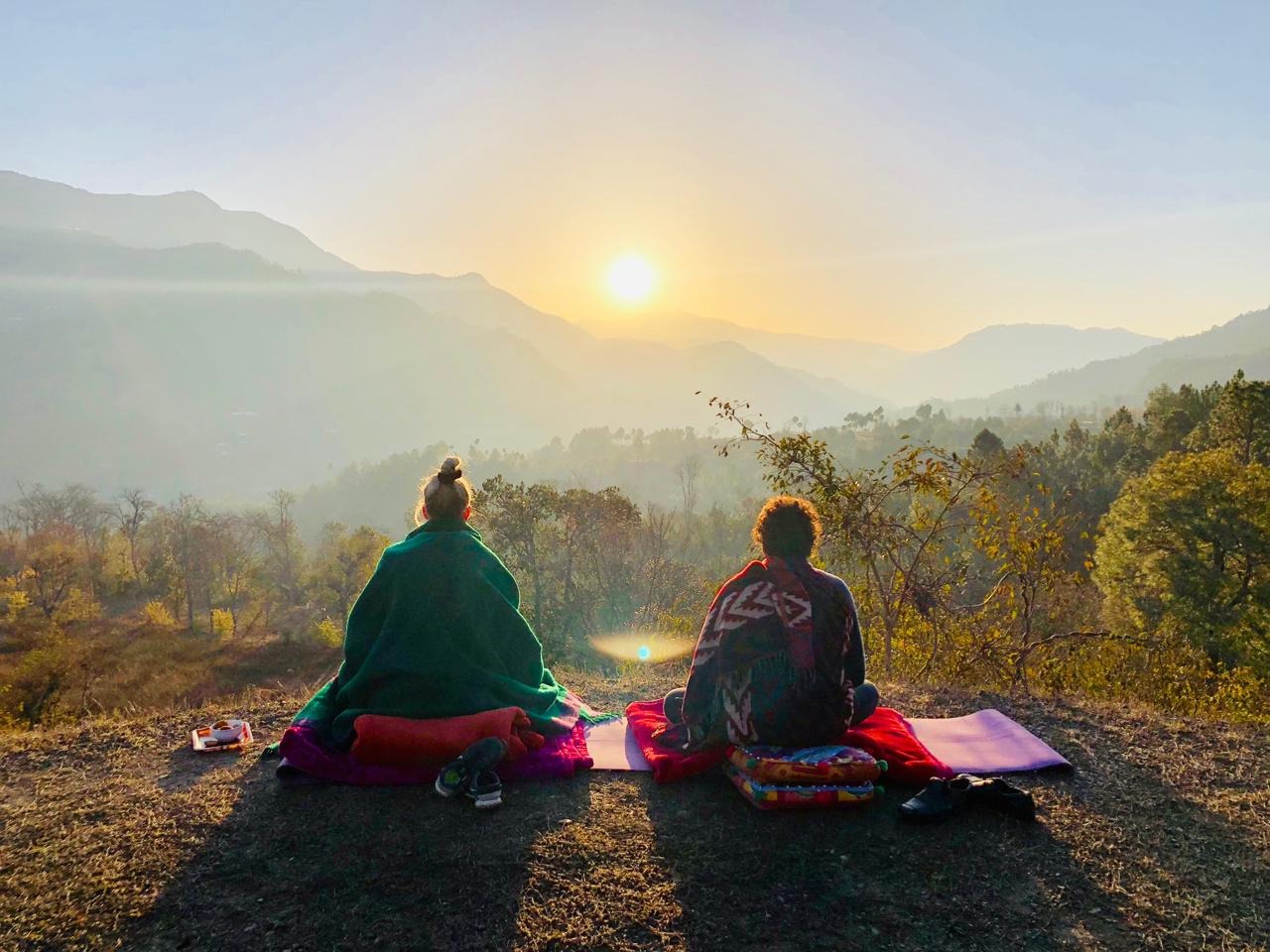
At White Light, Varun and Christina hold a space that is intentionally small, almost understated. Tucked into the Himalayan landscape, it is less a retreat center in the conventional sense and more a quiet invitation to step away from noise, to sit with silence, and to slowly find one’s way back to oneself. Some come for guided retreats, others simply to be, using the space as a gentle detox from the overstimulation of everyday life.
Varun’s journey spans technology, entrepreneurship, and investment—before an inward turn, shaped in part by his deep engagement with the Bhagavad Gita, began to redefine his path.
Success, burnout, and the quiet search
Over the years, Varun’s journey moved through multiple phases: corporate roles, entrepreneurship, and a funded e-learning venture. Each one deepened his engagement with the outer world. But alongside, almost quietly, another inquiry had begun to take root.
Even during his years in business and investment, he found himself drawn to the inner sciences. He studied hypnotherapy, curious about the deeper layers of the mind that lay beyond logic and strategy. Around the same time, the Bhagavad Gita entered his life—not as a text to be analyzed, but as something to be lived.
“I wasn’t approaching it academically,” he says. “It was more about how these teachings apply to the way we think, decide, and live.” In what now feels like another lifetime, he carried these insights into his work with CEOs and entrepreneurs using the Gita as a framework for clarity and self-awareness in high-pressure environments.
And yet, even this integration of boardroom and Bhagavad Gita was not the destination. It was, perhaps, a bridge because the question deepened over time. Not how to perform better in life, but how to step outside the constant need to perform at all.
“I had spent years building and doing,” he says. “But there was a fatigue that went beyond the physical. A sense that the pace itself was unsustainable.” Burnout followed. So did physical pain. And eventually, a pause that could no longer be postponed.
Christina, meanwhile, had already begun reorienting her life, moving from pharmacy into art therapy and her experiences in Africa served to expand her understanding of healing. “At some level, both of us felt that life had to be more than just routine or achievement,” Varun says. “That feeling was already there.”
From performance to presence
There was no single moment that changed everything. Instead, a series of experiences began to loosen the grip of the old life. The loss of a close friend brought mortality into focus.
“That was one of the first real turning points,” Varun shares. “It made things very immediate—what are we really doing with our time?” What began as intellectual curiosity—sparked in part by the Bhagavad Gita—soon became something far more experiential.
An unexpected introduction to hypnotherapy opened a different doorway. “What shifted,” he says, “was not belief, but experience.” A deep meditation followed one in which thought simply fell away.
“There was a moment where thinking stopped,” he says. “That changed everything.” A near-death experience deepened this further, followed by a prolonged period of silence. “That phase of silence was probably the most important.”
By the time he began stepping away from active business life, the transition was less abrupt than it might appear. The ventures had already been institutionalized. What changed was not circumstance but orientation. “I didn’t feel the need to build in the same way anymore,” he says. “The question had shifted.”
Christina’s journey unfolded along parallel lines. “In India, I had an experience in meditation that shifted how I saw everything,” she says. “After that, there was no going back.”

White Light: A retreat without structure
Tucked in Solan’s Himalayan foothills on land Varun owned for years, White Light isn’t a flashy wellness resort. It’s mud-and-clay minimalism: no rigid schedules, no packed programs. Just space for silence, nature, and self-discovery.
“The space itself had a certain quality,” Varun says. “It didn’t need to be created—it needed to be protected.” What emerged from this was not a planned retreat center but a natural extension of how they were already living. At White Light, the emphasis is not on structured learning but on experience. The name itself draws from clarity, balance, harmony, and the space reflects this intention. Built with mud and clay, it is deliberately minimal, designed to remove distraction rather than add to it.
“There are no rigid programs here,” he says. “The idea is not to teach, but to allow the environment to do the work.” People arrive not to follow a schedule, but to sit with the space to learn, in a quieter way, from silence, from nature, and from themselves.
Varun and Christina have distinct roles, but not in a way that feels defined or fixed. Varun tends to stay close to the practicalities: the land, the upkeep, the small, ongoing work that allows the place to function without drawing attention to itself. Christina’s presence is quieter, less about doing and more about how she holds the space.
“There isn’t really anything we are trying to ‘run’ here,” Varun says. “We just try to keep things simple.” That simplicity carries through into how they engage with people who come. There are no sessions to attend, no framework to follow. They are around, available if needed—but more often, they step back. “It’s not about guiding someone through something,” Christina adds. “It’s more about letting them find their own way in the space.”
What is striking is that Varun hasn’t entirely left behind his earlier world, only reworked his relationship with it. He continues to engage with CEOs and entrepreneurs, but the conversations now sit in a different place: less about outcomes, more about attention, clarity, and how one shows up to what they are doing.
“I still work with people,” he says, almost matter-of-factly. “Just… differently now.”
Why silent retreats are rising
If there is one common thread among those who arrive, it is this: fatigue. “Most people who come are tired,” Varun says. “Not just physically, but mentally and emotionally.” In many ways, it is a fatigue he recognizes from his own earlier life. “What they need is not more information,” he says. “They need rest.”
This growing pull toward stillness is not incidental. As explored in our earlier piece on the rise of silent retreats, more people across the world are turning inward—not as an escape, but as restoration. The numbers reflect this shift. The global wellness tourism market, valued at nearly $995 billion in 2024, continues to expand rapidly, signaling not just a trend but a deeper reimagining of what it means to live well.
Within this landscape, silent retreats have emerged as a powerful response to modern life’s relentless pace. White Light, in that sense, feels both ancient and urgent. “A kind of dharamshala,” Varun reflects. “A place where you can pause, regain clarity, and then return.”
“What most people are looking for isn’t more answers. It’s a place where the noise finally stops.”
What remains after silence
And perhaps that is the quiet offering of White Light. Not transformation as spectacle. Not healing as performance. But something far more subtle and far more enduring, a softening, a slowing down. A return to a way of being that does not demand constant output or explanation.
Because in the end, what stays is rarely dramatic. It is a small shift in how one listens. A little more space between thought and response. A gentler way of moving through the world. And in a time that asks so much of us, that quiet return may be the most radical thing of all.
Ready to unplug? White Light invites inquiries for stays—
contact Varun Talwar here for details.

Varun Talwar
Varun has over three decades in tech (PEC engineering, TCS, HP), entrepreneurship (funded e-learning), and investing. Now, post-Bhagavad Gita awakening and hypnotherapy, he co-leads White Light silent retreats in Solan, Himachal Pradesh—coaching conscious leaders while protecting this Himalayan haven.
Leave a Reply