

Meditation is interpreted differently by different spiritual leaders. For Swami Vachanananda Guru, it was all about “Shwaasa,” which translates to “breath” in English. His emphasis on breath as a bridge between body, mind, and consciousness eventually earned him the title of “Shwaasa Guru.”
Born in a village in Belagavi district of Karnataka state of India, his tryst with spirituality started in his formative years. At the age of eight, he was sent to the monastery in Karnataka of his guru, Sri Marulashankara Shivayogi, where he studied yoga, Sanskrit, Vedanta, philosophy, and ancient Indian scriptures before undertaking intense yogic sadhana in the Himalayas.
Over the years, he founded the Shwaasa movement and nonprofit foundation based in Bengaluru, Karnataka, through which he conducts yoga programs, meditation retreats, wellness camps, and spiritual workshops across India and internationally.
His spiritual lineage is connected to the Lingayat tradition founded on the teachings of 12th-century philosopher-saint Basaveshwara, a movement from Karnataka known for its emphasis on devotion, inner realization, social equality, and service.
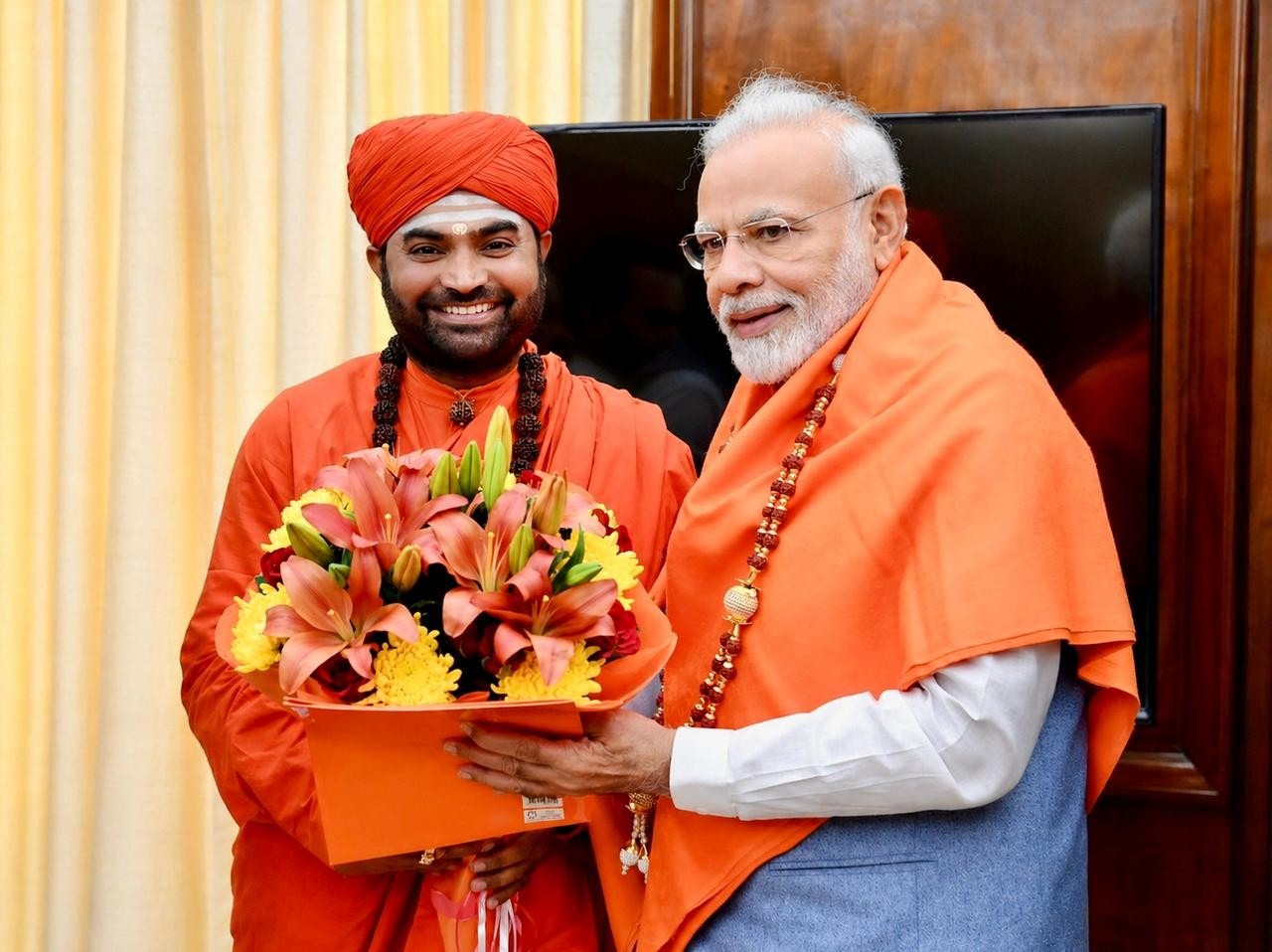
For decades, Shwaasa Guru has traveled extensively, interacted with spiritual and leadership circles in India, including Indian Prime Minister Narendra Modi, whom he describes as “a meditative man” who has a calm and centered presence.
In a reflective conversation with Shwaasa Guru, Navni Chawla explores his spiritual journey, yogic lineage, meeting with Prime Minister Modi, and the movement he has built around inner transformation and holistic living.

Navni Chawla: What was the inner shift that moved you from seeking to becoming a space for others?
Shwaasa Guru: The turning came when the breath became subtle and moved inward. In that stillness, it was revealed that the “seeker” was only a wave of the mind; the Self had always been present. The search dissolved into silence.
From that state, becoming a space for others began to flow naturally—like prana, effortlessly and nurturing.
When working at the intersection of breath, body, and awareness, what is the one thing people resist seeing within themselves?\
Shwaasa Guru: People resist seeing their inner restlessness. As the breath slows and awareness deepens, it becomes evident that the mind is constantly trying to escape the present moment. In that mirror, a truth is unveiled—the disturbance is not outside but within.
To truly see this requires surrender… and that is what many silently avoid.
“Shwaasa” feels like a living field of consciousness, not just a method. What are you truly building through it?
Shwaasa Guru: What I am building is not a method—it is a field of consciousness. Through the breath, I am nurturing a living space where body, mind, and awareness merge into one rhythm. Here, one touches inner stillness and begins to share that same peace with the world.
It is not an institution—it is a vibration.
Not a practice, but an experience.
Not a structure—but a flow of consciousness.
In your experience, what is the difference between healing and true inner transformation?
Shwaasa Guru: Healing is adjustment—you feel better, yet remain the same. Transformation is a profound shift—the old “self” dissolves, and a new awareness arises. One offers relief; the other offers liberation.
Many spiritual spaces today risk becoming performative. How do you keep your work rooted in authenticity?
Shwaasa Guru: The moment you try to appear spiritual, authenticity is lost. I do not preserve an image—I remain in awareness. In awareness, all masks dissolve on their own. Authenticity is not created; it is what remains when all that is false falls away.

What has this path asked you to let go of, internally and externally?
Shwaasa Guru: It asked me to release inner restlessness, desires, and even the identity of being a seeker. Outwardly, it guided me toward simplicity, discipline, and a life aligned with truth. Nothing real was lost—only the coverings dissolved, and the Self began to shine in its silent light.
Beyond practices and teachings, what is the one truth about conscious living that people often overlook?
Shwaasa Guru: Conscious living is not a practice; it is the ending of escape. It is not about adding more, but allowing the false to fall away. Amidst that, awareness shines by its own nature.
You’ve had the opportunity to engage with leaders like Prime Minister Narendra Modi in spaces driven by power and decision-making. Where do breath and awareness find their place in such environments? And when you met PM Modi, did you feel he embodied that sense of yogic awareness?
Shwaasa Guru: The first time I met Prime Minister Modiji, I did not feel I was meeting a politician. I felt I was meeting a yogi. There was an intense calmness, a quiet strength, and a very subtle divine presence around him. The moment he greeted me, it was with warmth, love, and simplicity.
He is a meditative man.
As Hatha Yogi Gorakhnath says, meditation is not just about sitting for an hour with closed eyes. The real meditation is reflected in the remaining 23 hours—in how calm, joyful, playful, and centered you remain amidst life and responsibility.
My connection with the prime minister began in an unexpected way. During International Day of Yoga, through our Yoga Ratna Awards initiative, we honored unsung yoga practitioners from across India. One year, we recognized a 98-year-old yogini from a small Tamil Nadu village who had silently dedicated her life to yoga.
Later, the then ISRO Chairman, Dr. Kiran Kumar, mentioned this to Prime Minister Modiji during a meeting. Modiji was deeply touched and asked to connect with me.
At that time, I was in New York teaching yoga. I kept receiving calls from an unknown number. Since international roaming charges were high and the number was hidden, I assumed it was a fraud call and kept disconnecting it. Eventually, I even blocked it. Then Union Minister Anant Kumar ji called and said, “Swamiji, the Prime Minister is trying to reach you, and you are cutting the calls!” I was shocked and embarrassed.
Soon after, Modi ji himself called again and jokingly said, “Puri duniya hamare call ka intezaar karti hai, aur aap call cut kar rahe hain!” (The whole world waits for my call, and you are disconnecting mine!) We both laughed, and I apologized sincerely.
Before ending the call, he said, “Once you come back, let us meet personally.” That was how our first meeting happened.
For me, that experience showed that breath awareness and meditation are not separate from leadership or politics. In fact, they are essential. When a leader carries inner stillness, clarity, and awareness, it naturally reflects in the energy they bring into the world.
I told him, “It is not only your fortune to have become the prime minister of India; it is also the country’s fortune. Mother India herself has chosen you.

For someone with no time or always in a hurry, what is a simple one-minute practice to reconnect with their breath and themselves?
Shwaasa Guru: Sit for a minute and observe your breath. Take a deep inhalation and a slow exhalation. If you practice mantra meditation, synchronize your mantra with the breath. As you exhale, gently remember the mantra again. Daily practice of 30 seconds to one minute can bring you back to your center, to your consciousness.
The moment you sit in your car, reconnect with your breath. Before entering the office, sit on your chair and take a conscious breath. These tiny pauses have a profound impact on the mind—one minute of conscious breathing can carry an hour of calmness within it.
Nowadays, when I travel, I observe people. If a train or flight gets delayed, they immediately become restless—they reach for coffee, soft drinks, and stimulation. But I drink the breath. Breath is my Thums Up. That inhalation and exhalation itself becomes energy, nourishment, and balance.
Sometimes I observe people, and sometimes I read, but I keep returning to the breath every hour. Before eating, before sleeping, before taking a shower—every act can become sacred. Like abhishekam in temples, where water is offered to the deity, your body too is a temple. You are a walking temple, a talking God. Live with that awareness.
That is why we must practice superconscious meditation. Remember, this body is made of the five elements.
Books like Path of Fire and Light by Swami Rama or Conscious Living can help you understand that spirituality begins with small, consistent practices. No one can teach you the advanced if the basics are not mastered first.
Practice simple technique at the same time, in the same place, continuously and sincerely. Slowly, auspiciousness arises—satkala. You become grounded.
If you sow a seed, it takes time to become a tree. We wait patiently. We water it every day. Spiritual practice is the same.
Don’t keep running after new techniques. Choose one practice. Stay with it. Master it.
Learn the basics:
- how to sit,
- how to breathe correctly,
- diaphragmatic breathing,
- how to relax deeply.
Real yogis rarely rush toward the advanced. The basics lead you there.
An external guru only points the way, but through sincere practice, your inner guru awakens. Even awareness itself becomes your guru. The true role of the outer guru is to connect you to the guru within.
As the Yoga Sutras of Patanjali reminds us, practice with a relaxed mind. Keep trying again and again, gently polishing yourself through awareness.
Share with us the most important life lesson.
Shwaasa Guru: In life, four blessings and forms of grace are essential.
First is the blessing of your parents.
The second is the grace of the Guru—Guru Kripa.
Third is the grace of the scriptures, the wisdom that guides and anchors you.
And fourth is your own grace.
What is your own grace? It is the ability to recognize what is right. It is discernment—listening to your inner voice, your antar dhwani, before making any decision. Life will always bring hurdles, confusion, and distractions, but your task is to keep moving forward.
A river flows, carrying debris, pebbles, and dirt—it does not stop to examine them. Its nature is to flow. In the same way, difficulties will come and pass. Don’t become consumed by them. Your job is to cross the river with awareness and focus.
You yourself are the divine. The spiritual path is ultimately about recognizing that truth within yourself.
When we begin cleansing the chitta—the subconscious mind and mental impressions—our real nature slowly reveals itself. Through awareness, discipline, and inner purification, we begin to recognize our true form.
Spiritual practice is simply the polishing of the self until the inner light becomes visible.
For more about Shwaasa Guru, visit http://www.shwaasa.org

Leave a Reply