


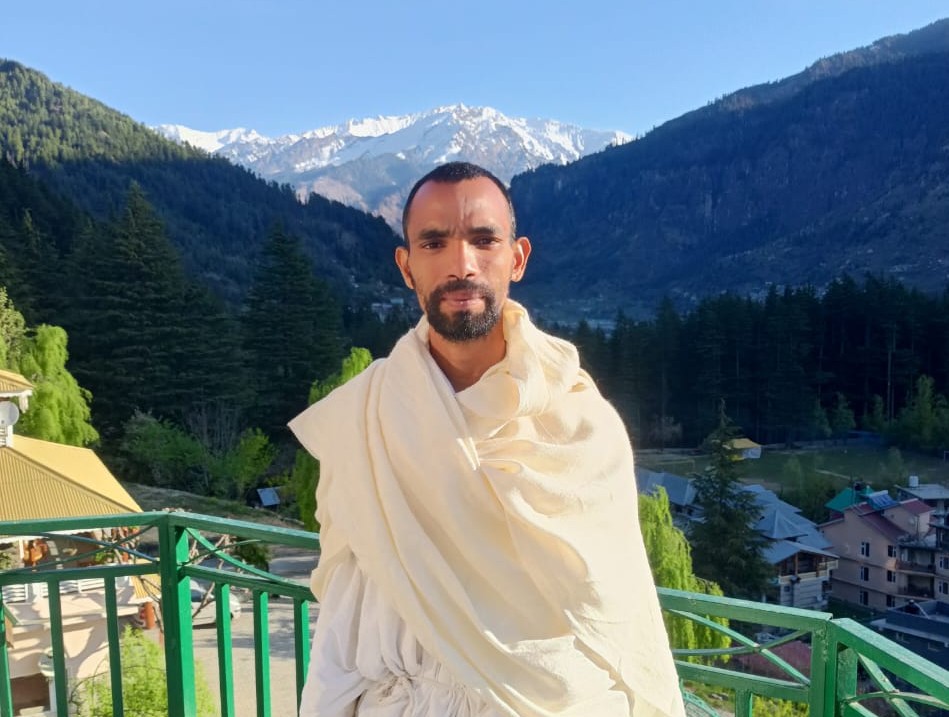
He had everything a young person would want—an engineering student, family comforts, etc.—but he walked away from all this at the young age of 25. Not because of disappointment, heartbreak, or personal struggle, but because, as he puts it simply, “only for God.” Yogi Brahma Vidya Chaitanyaji made a choice that defies every worldly expectation.
A direct disciple of the late Yogi Protoplasm (Swami Prajna Aranyaji) and Ramana Maharishi, he continues his guru’s legacy through intensive meditation retreats rooted in Advaita Vedanta, self-inquiry, and prolonged silence. Like his guru, he has been living on a milk-based diet for the past ten years, spends hours in uninterrupted meditation, and teaches seekers that spirituality is not about collecting knowledge but about experiencing truth.
“I entered spiritual life only for God,” Yogi Chaitanyaji, a disciple of Yogi Protoplasm (Swami Prajnaranyaji) and my gurubhai, told me during an interview last month in New Delhi for the YouTube channel vandekrsna of my Vande Krsna Foundation. He visited my house and held a satsang and meditation session. He leads silent week-long retreats at his Vedanagari Ashramam in Tiruvannamalai, Tamil Nadu, and at other places in India.
Unlike many seekers whose journeys begin with suffering or personal crisis, Yogi Chaitanyaji’s path was born from an inner calling.
When people ask why he chose renunciation at just 25, he explains that three rare blessings came together in his life.
The first is the gift of human birth itself. “Human birth is very rare. Even if you get human birth, the desire for self-realization is rarer still. After that, to find a real Guru—a Guru who knows the Truth—is even rarer. All these happen only through God’s grace.”
“Second, in previous births we earn great punya. Most of it may already be there. The remaining has to be completed in this life by entering spiritual life,” he said.
The third comes from the Bhagavad Gita’s teaching on the continuity of spiritual effort. Those who sincerely practice yoga never lose their progress. “In the next birth, one is born into a spiritual or noble family. My grandfather was a yogi. It was a very rare opportunity. That is why I turned towards this life,” said the Yogi for whom the decision was never a sacrifice.
It was simply the next step in a journey that had begun long before this lifetime.
Finding a guru
For Yogi Chaitanyaji, meeting Yogi Protoplasm transformed spiritual theory into a living experience.
He says the greatest lesson was not found in his guru’s lectures but in witnessing unconditional love.
“I personally experienced how Guruji loved his disciples, how he took care of them physically and spiritually, and how he arranged everything for them. I experienced that very personally.”
“Sometimes I would just sit before Guruji. Just by looking at me, he would give the answer I needed,” he said, talking about his guru’s extraordinary state of awareness.
Recalling one incident, he says, “One day I wanted to go outside. Guruji told me, ‘Today is not good for you. Don’t go.’ That whole day it rained heavily. The next day, he said, ‘Now you can go. Everything will be arranged.’ I have many such experiences.”
For a common man it would be a miracle, but for him it was an expression of a consciousness no longer confined to the body.
Recounting another episode that has remained etched in his memory, he said that his guru was resting on one side of a bed when someone asked him to move towards the middle.
“Guruji smiled and said, ‘How can I move? I am everywhere. Without body limitation, I am everywhere. How can I move?’”
To Yogi Chaitanyaji, such statements reflected the lived reality of Advaita rather than philosophical concepts.
“They were living beyond body consciousness.”
Choosing a milk-based diet
The path to moksha begins with mastering the senses, for every unchecked craving strengthens bondage while self-restraint awakens inner freedom. Like his Guru, Yogi Chaitanyaji mastered the art of freeing himself from the clutches of endless craving by sustaining himself on milk for over 10 years.
When asked if there was a secret technique or mystical practice behind it, he said, “Only obedience.”
“Our Guru maintained a milk diet for many years. In our ashram there were no regular cooked foods, only very simple sattvic food, fruits, and sprouts. One day he asked me what I normally eat. I told him, ‘Milk, sprouts, and a little food.’ Guruji remarked, ‘Why don’t you try living only on milk?’Immediately I decided. It was Guruji’s instruction. So I followed it.”
He attributes his ability to continue this lifestyle not to personal discipline but to divine grace.
“It happened because of God’s grace and Guru’s grace. The more sattvic the food, the longer you can sit in meditation.”

From learning to living
One of the strongest influences of Yogi Protoplasm, Yogi Chaitanyaji says, was the insistence that spirituality must move beyond intellectual understanding.
“Scriptures alone cannot transform a person. Practice can,” he said.
His guru’s retreats reflected that philosophy, with participants meditating for long hours, beginning at 3 a.m., spending much of the day in silence, and practicing 6 stages of Om chanting (Pranava Nada Anusandhan) with unwavering discipline.
Watching his guru conduct these retreats changed his understanding of spiritual life.
Knowledge, he realized, becomes wisdom only when it is lived. “We should not stop with listening. We have to practice.”
That conviction continues to shape every retreat he conducts today, where seekers are encouraged not merely to understand Vedanta but to experience it.
Meditation is meant to be practiced, not discussed
For Yogi Chaitanyaji, the greatest challenge facing modern spirituality is not the lack of knowledge but the lack of practice. He believes many seekers have become collectors of scriptures, lectures, and philosophies without making the inward journey those teachings demand.
That is why the meditation retreats he conducts across India differ from conventional spiritual programs.
“Everywhere people are giving lectures. They are doing śravaṇa and manana—listening and reflecting. But here we are practicing nididhyāsana (meditation). We have to live the teachings practically,” he said, adding, “The Bhagavad Gita contains 700 verses; merely memorizing them is not enough. What is the use of repeating the shlokas? We have to live them. Even if you learn a single verse, you must practice it.”
The retreats are inspired by the teachings of both his guru, Yogi Protoplasm, and Ramana Maharshi’s timeless question, “Who am I?” – am I this perishable body that will certainly get diseased, decay, and die, or am I a divine, eternal soul—one in all!
Rather than focusing on intellectual debate, participants spend long hours in silence, meditation, and self-inquiry.
“Our Guru designed this course to know yourself. Yoga and pranayama help control the mind, but if you can sit for three hours continuously, many benefits come naturally.”
He remembers attending his first retreat under his guru in Bengaluru.
“I sat for three hours without moving. After two days, Guruji called me and said, ‘Now you can sit for three hours. Come to the ashram. Soon you will be able to sit for six hours.’ Then it became six hours, nine hours, and even twelve hours. All this happened because of Guruji’s grace,” he said.
Today, his own retreats follow the same disciplined format.
“We conduct nine hours of meditation over three-hour sessions in a day. It gives physical, mental, and spiritual benefits, but finally it helps you know yourself.”
Don’t fight the mind; watch it
One of the recurring questions Yogi Chaitanyaji encounters is how to control the restless mind.
“What is the mind? First ask that question. There is really no mind. The mind is only a bundle of thoughts. If there are no thoughts, there is no mind.”
Most people, he says, try to conquer the mind through force, only to find it becoming stronger.
Instead, he recommends observation.
“Don’t fight with the mind. Just observe whatever comes. Be a witness.”
With continued observation, thoughts gradually lose their momentum.
“When thoughts become zero, breathing also becomes zero. Both happen together.”
Beyond the body
Yogi Chaitanyaji’s lifestyle often surprises visitors. Whether it is living on milk alone or wearing no woolens during winter, he insists these practices are not demonstrations of austerity but natural consequences of changing one’s identity.
“People are attached to the body. That is why they forget their real self. The first lesson in spirituality is to clearly distinguish between the body, the mind, and the self. I am not the body. I am not the mind. I am Sat-Chit-Ananda.”
“When we know clearly that I am not the body or the mind, then winter, summer, or any situation does not disturb us.”
This does not mean neglecting the body, he clarifies, but refusing to be enslaved by its demands.
“Whatever situation comes—good or bad—we should accept it. Don’t think, ‘This is good, I want it,’ or ‘This is bad, I don’t want it.’ Learn to remain peaceful in every situation,” he said.
Such equanimity, described in the Bhagavad Gita as the hallmark of a yogi, is not cultivated overnight. It emerges through steady practice and self-awareness.

Journey of Self-discovery
He encourages seekers to move beyond names, forms, and appearances to discover the unchanging awareness behind every experience.
“Ask two questions: ‘What am I?’ and ‘Where am I?’”
The answer, he says, is not found in intellectual reasoning but in direct experience.
“The ‘I’ is existence, awareness, and bliss—Sat, Chit, and Ananda. Name and form keep changing, but existence and awareness never change.”
He explains that everything people identify with—the body, possessions, relationships, and achievements—is temporary. What remains constant is consciousness itself.
“People ask, ‘Where is Atman?’ They say, ‘Inside.’ But who is saying that? The chair doesn’t say it is a chair. The light doesn’t say it is light. It is ‘I’ that knows everything.”
“My consciousness is everywhere. I am Sat-Chit-Ananda. We have to experience that reality.”
The real goal is Self-realization
Although participants often join his retreats seeking relief from stress, anxiety, or physical ailments, Yogi Chaitanyaji reminds them that these are only secondary benefits.
“We are training people for the ultimate union of Atman and Paramatman. Those who attend the retreats receive physical and mental benefits, but the final goal is self-realization,” he said, adding that the real purpose is far deeper.
It is a message that echoes throughout his life and teaching. For a man who renounced a promising engineering career, lived in the shadow of a realized master, and dedicated himself to silent practice, spirituality is not an escape from the world but a return to one’s true nature.
His invitation is remarkably uncomplicated.
Practice rather than merely listen. Observe rather than struggle. Question who you really are. And through discipline, silence, and inquiry, discover what he believes has always been present.
“Know yourself” is his ultimate guidance.
You can watch the interview on vandekrsna YouTube channel
or go to: www.Vandekrsnafoundation.org

Leave a Reply