


There are many spiritual abodes in India, each associated with a spiritual leader, a tradition, or a particular form of practice. The School of Ancient Wisdom, however, does not quite fit that mold. Most importantly, you enter this place only if you are destined to.
Set across nine acres of nature-integrated land facing Nandi Hills in Devanahalli, Bengaluru Rural, the campus is close to Kempegowda International Airport, yet feels removed from the rush of the city. There are no loud signboards announcing its presence, no aggressive publicity campaigns, and no attempt to position it as a conventional spiritual destination.
Its founder, the late Mrs. Manize Sait (1934-2012), now known as Maa Manize, believed that none of that was necessary.
“She never believed in advertising it. She used to say that the people who are destined to come here will come. She also believed that people who came here would leave transformed,” says its Managing Trustee Dr. Natraj Varadharaj, a dentist who came to the center by sheer destiny and eventually took over its reins.
People may plan visits to ashrams, retreats, and spiritual centers. But, according to Dr Natraj, there is something different about crossing the threshold of this campus.
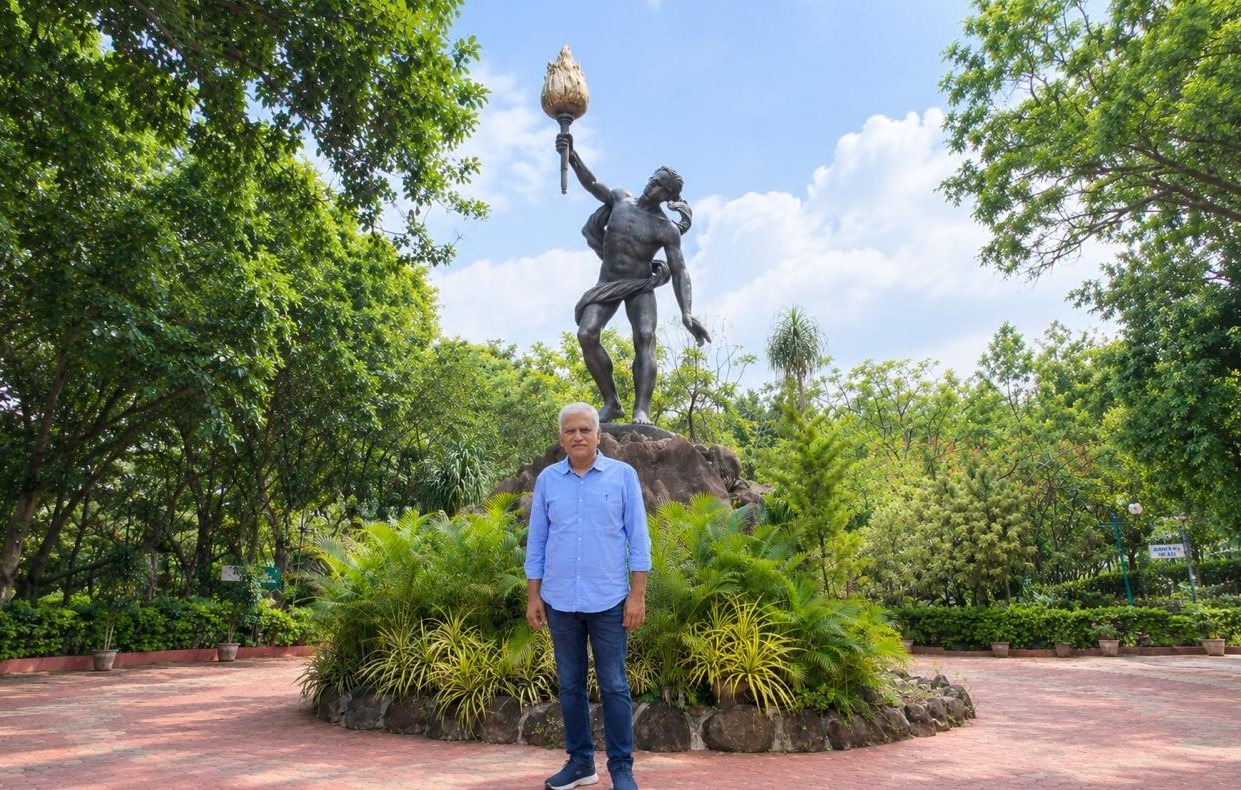
“People from across the globe come here. Once they enter, they often say they feel a certain energy,” he says. “We have a huge bronze statue of a torchbearer, which is an embodiment of life.”
That sense of energy was central to Maa Manize’s journey.

Maa Manize: A journey from design to spiritual seeking
A pioneering industrial designer, Maa Manize graduated from Mumbai’s Sir J.J. School of Applied Art and became an art director at Hindustan Thompson at the age of 21 before starting her own consultancy. Her design career included work for well-known brands, but her life took a very different direction.
After her battle with cancer, she turned towards spirituality. She travelled to Australia, New Zealand, and Switzerland, looking for a place that resonated with her ideas and offered the energy she was seeking.
“Eventually, she found this place near what is now Bengaluru International Airport, although the airport did not exist at that time,” says Dr Natraj.
“It is believed that Agastya Maharishi had meditated in this area centuries ago, when it was surrounded by a jungle. Maa Manize felt that energy and acquired nine acres of land,” Dr. Natraj says.
The campus’s main hall, which can accommodate over 120 people, is built in the shape of a pyramid and named Agastya Hall.
Maa Manize was associated with the Theosophical Society and served as president of its Singapore chapter from 1995 to 1997. Her spiritual worldview was broad rather than confined to one religion or school.
“She believed in the Universal Masters and said they guided her on aspects such as the design and colors of the buildings. She followed that intuition while developing the campus,” Dr. Natraj says.
The result was not intended to be another traditional ashram.
“She built the campus so that spiritual teachers could bring their students, teaching them and conducting workshops,” he says.
A campus for many paths
The School of Ancient Wisdom (SAW) land was purchased in 1995. A trust was formed, and activities began in 1997.
The idea was to design a space where different spiritual teachers and traditions could coexist. Maa Manize herself was from a Parsi family and was associated closely with the Theosophical Society. She was involved in holistic healing, worked as a Reiki healer, and conducted special satsangs every day that attracted many people.
“But she believed in all religions,” says Dr Natraj.
“Maa Manize wanted to create an ecosystem where spiritual and philosophical practitioners from different traditions, gurus, and their disciples could come, stay, and conduct workshops. We provide accommodation, sattvic (vegetarian) food, and a serene environment surrounded by trees,” he continues.
Among those who have used the campus are Sri Sri Ravi Shankar and his followers for Sudarshan Kriya programs. Sadhguru (Inner Engineering) and Osho Rajneesh have also held workshops here. There have been programs associated with Sathya Sai Baba and other spiritual teachers.
The campus has books representing different religions and photographs connected with Christianity, Islam, Zoroastrianism, and others.
Maa Manize’s idea of an inclusive spiritual space continues to define the institution even after her death in April 2012.
“Nothing has changed in that respect,” says Dr Natraj. “We welcome people from across the globe, and people of different religions come and use our space. There are no restrictions.”
The property has no temple or idol of a deity.
How a dentist found his way here
Dr Natraj’s own journey to the School of Ancient Wisdom began through a friend, Mahesh, who had worked in the corporate world before turning towards spirituality. He eventually joined the School of Ancient Wisdom as a librarian.
“He invited me to visit. I came once or twice, but at that time our founder was no longer there,” Dr Natraj recalls. The institution was going through a difficult period after Maa Manize’s death. There were financial misappropriation issues.
During Covid, he was asked to step in. He became a trustee in 2021 and took full charge in 2022.
A dentist by profession, he might seem an unlikely administrator for a centre devoted to spirituality and alternative medicine. But spirituality, he says, had always been part of his life.
“From a very young age, we followed religious practices. We would perform puja every morning and recite mantras. During Navratri, we’d perform Devi Parayan.”
Meditation and yoga were also familiar practices.

Reconnecting with ancient wisdom
For Dr Natraj, the name ‘School of Ancient Wisdom’ (SAW) is not merely a title. It describes what he believes the institution should ultimately do.
“For me, it connects us with ancient wisdom,” he says.
He points to the knowledge associated with stalwarts such as Adi Shankaracharya, Madhvacharya and Ramanujacharya, as well as sages such as Agastya Maharishi.
“They possessed a great deal of ancient knowledge. For several generations, much of this knowledge was not transmitted because our education system changed. I feel that SAW can reconnect us with the sages and their wisdom.”
But the vision extends beyond India.
“It is not necessarily wisdom from India alone. There were sages and spiritual practices across the world. I believe we can bring back the glory of the world’s ancient wisdom,” he says.
That philosophy is reflected in the programs conducted on the campus. Meditation, breathwork, yoga, laughter yoga, and Kriya Yoga are among the practices offered, while different teachers and organizations conduct their own programs.
The center also holds satsangs every day, including online sessions, with different spiritual teachers participating.
Rebuilding after a difficult period
When he took charge, the challenge was to revive the physical campus while rebuilding its activities. COVID made the task harder. With programs suspended, there was virtually no revenue.
The centre gradually began repairing buildings, repainting them, and improving maintenance. As groups returned, new initiatives were introduced, including organic farming and improvements to the goshala, or cow shelter.
The institution also began developing Ayurveda as an important part of its ancient-wisdom mission.
Vandana Khaitan, founder of the VandeKrsna Foundation in Delhi, conducted a meditation workshop here for about 150 engineering students. She describes the serene space as
“deeply spiritual and healing for the mind, body, and soul.”
Ayurveda meets an evolving spiritual campus
“We initially started with small weekend clinics,” Dr Natraj says.
The Abhyanga therapy facilities were expanded from two rooms to four, with additional therapists hired.
Today, around 10 to 12 people work in the Ayurveda division. The team includes a senior doctor with a PhD in Ayurveda, a junior Ayurveda doctor who is also a nutritionist, full-time naturopathy doctors, four therapists, and an Ayurveda pharmacy.
Research is another component. The center conducts Ayurveda research on cancer, enzymes, animals (Pashu Ayurveda), and plants (Vriksha Ayurveda), collaborating with organizations including the World Ayurveda Foundation and presenting papers. Its 25-bed hospital offers treatment and retreats for weight loss, joint pain, and gastric problems, with plans to expand to 100 beds. The hospital and pharmacy generate revenue.
Building a self-sustaining ecosystem
Financial sustainability is now a central part of the institution’s future.
“We started building multiple revenue streams,” Dr Natraj says.
These include retreat programs, for which guests pay for accommodation and food; the Ayurveda hospital; the Ayurveda pharmacy; and the goshala.
The School of Ancient Wisdom also creates livelihoods for its local community. Several staff members who joined as construction labourers were trained and retained in roles such as housekeeping, gardening and kitchen work. The campus further supports sustainability through a 40-kilowatt solar system and biogas facilities.
Not a party place
Despite its openness, the School of Ancient Wisdom is not an unrestricted venue. Companies can use the campus only as part of a retreat program or through its hospital therapies. Alcohol, smoking, and non-vegetarian food are not permitted on campus.
“It is completely sattvic,” Dr. Natraj says.
The center has several halls, with capacities ranging from about 30 to 150 people, allowing different groups to conduct programs without disrupting the serenity of the campus.
“It is definitely not a place for corporate events involving dining and dancing. There is no noise. It is a serene environment, and we do not allow excessive noise,” says Dr. Natraj.
The accommodation is deliberately positioned somewhere between an ashram and a luxury resort.
For Dr Natraj, however, the defining quality is that “it provides an environment that can be restorative for the mind and body.”
Still a well-kept secret
Perhaps the most unusual aspect of the School of Ancient Wisdom is that, despite its international visitors and decades of existence, it remains relatively unknown in Bengaluru.
“We are known as one of the best-kept secrets in Bengaluru. Even today, many people do not know about us,” says Dr. Natraj.
That anonymity would perhaps have pleased Maa Manize.
Today, visitors come from more than 100 countries. Some arrive for yoga or meditation; others for retreats, satsangs, Ayurveda, or workshops led by spiritual teachers. Some may simply be looking for a quiet place away from the noise of modern life.
“People today experience a great deal of stress, both physical and mental. For them, this can be a good place to come. Once they come, they feel the energy of the place. Even if someone visits for only half an hour or an hour, they can experience it,” he says.
“Once you enter the gate, you encounter an environment that you would probably never expect to find there,” he says.
And perhaps, decades after she first walked onto these nine acres near Nandi Hills, Maa Manize’s belief still held.
You do not necessarily find the School of Ancient Wisdom.
You are destined to arrive.
For more, visit the website: https://theschoolofancientwisdom.org/
Contact: theschoolofancientwisdom@gmail.com; theschoolofancientwisdom@tsoaw.Org
Ph: +91 6366658002
Staying at the School of Ancient Wisdom was truly uplifting: Vandana Khaitan

Vandana Khaitan, Delhi-based founder of the VandeKrsna Foundation, conducted a workshop at the School of Ancient Wisdom in Bengaluru in September 2026. Speaking to A Lotus in the Mud, she described the experience as deeply healing for the mind, body, and soul.
“Through Guru Kripa, I conducted a three-day movies-cum-meditation workshop at the School of Ancient Wisdom. The workshops were based on my films exploring Vedanta and science, inspired by my guru, Yogi Protoplasm, who was a disciple of Ramana Maharshi and Yogi Rama.
“It was deeply healing for the mind, body, and soul to be at the School of Ancient Wisdom. Its serene, spiritually charged campus, adorned with photographs of saints from different faiths, was truly uplifting,” she says.

Leave a Reply