


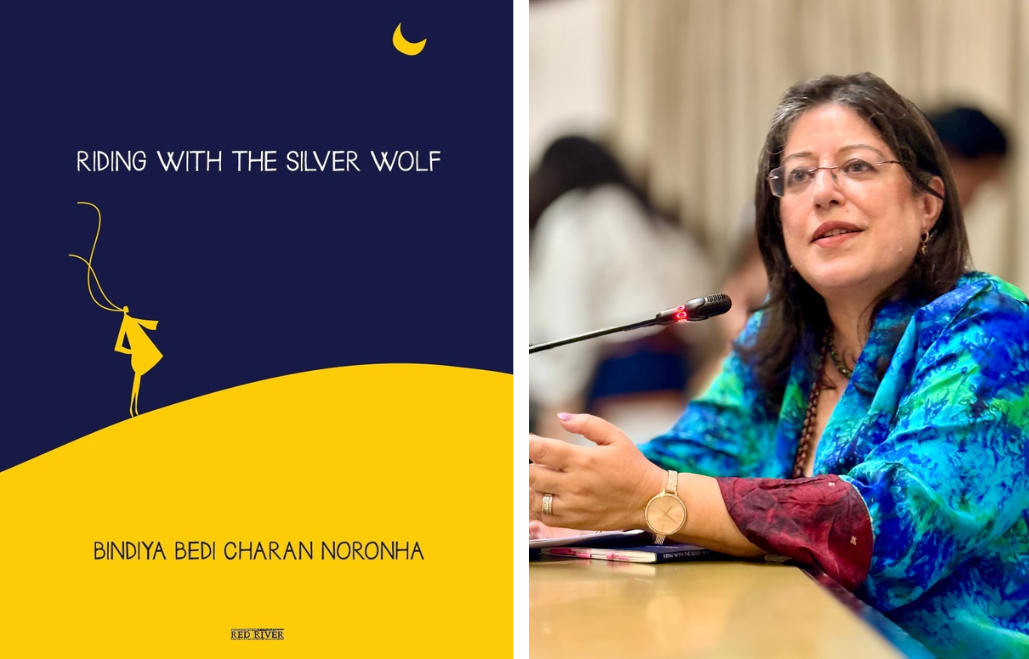
Every once in a while, there comes a book of poetry that heightens one’s sense of being alive, that peruses the hitherto unexplored, vast dimensions of everyday living, and gives names to the complex emotions that exist within the reality of the human being. ‘Riding with the Silver Wolf’ is one such book.
Far from the screaming headlines of the media, the glitter and madness of showbiz, the transactions of business, and the mayhem of politics, ‘Riding with the Silver Wolf’ is an intimate portrait conceived within the stillness of a poet’s mind—of a life that has survived over five decades on planet Earth and still retains optimism and hope.
Hope and renewal
Certainly, this is a book filled with hope. Hope and a sense of renewal resound across its pages like twin beacons illuminating the darkness. It is not a naïve optimism, though, but a tried and tested hope that has faced the gloom and contradictions of daily living and still chooses to believe in redemption. The emotional center of this work is healing, faith, and spiritual transformation. This poetry collection seems to function for the reader almost like an inner journey through the poet’s mind.
In her poem ‘Tiny Buddha,’ the poet writes:
“I am the tiny Buddha,
hidden,
a flicker beneath your skin,
waiting.
…From the quiet of your heart
a prayer
and I will come,
a whisper of light,
to lead you,
stepping through the veils of doubt,
to the Big Buddha,
where Courage stands,
where Compassion breathes,
where Wisdom waits.”
Where poetry meets spirituality
Certainly, spirituality is one of the central themes of the book. Whether it is the Buddha, Waheguru, or Krishna, the poet moves freely across the spiritual paradigms she was either brought up in or has more recently acquired.
There are other themes as well: Nature with its birdsong, monsoons and moonrise; poems about resilience among the storms of life with the symbol of the solitary rose that survives the tempest; about the integration of the heart and the mind; about the poet’s life—”You are in the world to listen and write your verse; the rest is all an illusion of desire and purse”; the histories of forgotten monuments where once wars took place but where now only the craftsman’s glory remains; places such as Paris, a symbol of the poet’s youth and joy; somber Varanasi with its abandoned widows; Macau, where nothing is as it seems; and Pondicherry, where an unforgettable personal memory was formed; as well as the cycle of life and death.

When verses confront society
The poet engages with social realities as well. She writes about homelessness, corruption, human trafficking, the aftermath of the pandemic, and the exploitation that can hide behind religious spectacle, among other things.
The style Bindiya Bedi Charan evokes is spare and written in accessible free verse. More interested in reflection than verbal fireworks, it is gentle, meditative, and emotionally sincere. For example, in the poem ‘Beyond Denial,’ Bindiya Charan writes:
“The animals suffer before they arrive at my plate.
What about it?
The pleasure is mine to take.
Global warming, a distant hum,
lulled by convenience.
What do we fear?
not the world, but the loss of ease.”
The collection also appears less interested in literary irony or intellectual games than in asking enduring questions:
- How does one remain hopeful in a wounded world?
- How can suffering be transformed into wisdom?
- What does compassion look like in everyday life?
- How does nature reconnect us with ourselves?
- Can love survive disappointment and loss?
In her poem, ‘Feisty Fifties,’ the poet muses:
“Saris and jewellery matter no more;
angst to prove a point is long gone
leaving a calm acceptance of all that is.
Every moment is more precious
a wrinkle here, a crease line there
will not dim my passion;
I radiate in freedom from doubt and fear.
Looking back at treasured times,
Forgetting the grudges and the grind
I no longer yearn for the youthful form
liberated, I flourish in my feisty fifties.”
A metaphor for self-discovery
The ‘Silver Wolf’ that appears in the book title ‘Riding with the Silver Wolf’ is not presented as a literal animal. It functions as a layered symbol that seems to represent intuition, courage, solitude, self-discovery, and the untamed inner self.
The clearest explanation of the poet’s silver wolf metaphor comes from the publisher’s description, which includes the lines:
“I ride with the silver wolf…
into the nights to find myself…”
In that sense, the wolf becomes a companion on an inward journey. Rather than running away from darkness, the speaker rides toward it to confront fear, insecurity, and hidden truths. The journey is ultimately one of transformation.
Across cultures, wolves have carried symbolic meanings that relate to instinct and intuition, independence, survival, wisdom gained through hardship, and the ability to navigate wilderness and uncertainty. Bindiya Charan appears to draw on these associations, but she softens the wolf’s image. Her wolf is not a predator; it is more like a spiritual guide.
The poem ‘Conundrum’ reads:
“Sunset or sunrise?
Mountains or seas?
Lovers or friends?
In silence, I realised:
Cause and effect will prevail.
What goes far will return.
It is between my maker and me.
The rest is ephemeral.
Here today, gone tomorrow.”
The poet behind the poems
Incidentally, Bindiya Charan is a linguist who has studied English, French, and Portuguese at Jawaharlal Nehru University and the University of Lisbon.
Professionally, she works with the Portuguese embassy in the capital. She serves the diplomatic mission while simultaneously pursuing writing and literary activities. Her literary life seems deeply intertwined with community building.
She founded India Stanza, a poetry collective affiliated with poetrysociety.org.uk, and has also been involved in social outreach initiatives such as ‘Mil Baant Ke: Sharing with Dignity’ and ‘The Tarini Network‘, which focus on empathy, dignity, and community care.
The poet’s personal experiences appear to have profoundly influenced her poetry. Bindiya has spoken about finding poetry amid the challenges of family life, raising her son, difficult relationships, financial pressures, and health struggles. She has also talked about the influence of Buddhism and Buddhist philosopher Daisaku Ikeda on her life. As a consequence, her poems are emotionally honest yet resilient; they often emerge from lived experience rather than abstract philosophy.
If her outlook on life could be summarized in a short sentence, then it must be this: “To be human is to improve oneself and work together towards a happier, caring, more thoughtful society.”
‘Riding with the Silver Wolf’ by Bindiya Bedi Charan Noronha, 94 pages, published by Red River in November 2025. Hardcover: Rs 270, Buy on Amazon

About the author Bindiya Charan Noronha
A writer, teacher, and polyglot, Bindiya Bedi Charan Noronha wears many hats. She is fluent in English, Portuguese, Hindi, Punjabi, and French; she combines her passion for languages with a love of literature. A senior technical officer at a diplomatic mission in New Delhi, she teaches Portuguese while pursuing her creative calling as a writer.
She debuted as an author in 2019 with her book, Dream Keeper: A Poetography Ensemble, which merges poetry and imagery. She also wields a pen to write articles, short stories, and poems that have appeared in diverse journals.
Bindiya is also the founder of India Stanza, a poetry collective affiliated with The Poetry Society UK that fosters a vibrant community of poets across India.
Beyond her literary pursuits, Bindiya is actively involved in social initiatives focused on bibliotherapy, literacy, skill development, and the welfare of women, children, and the elderly. Married and a mother, she believes that “to be human is to improve oneself and work together towards a happier, more compassionate society.”
She can be contacted at bindiya.charan@gmail.com

Leave a Reply