


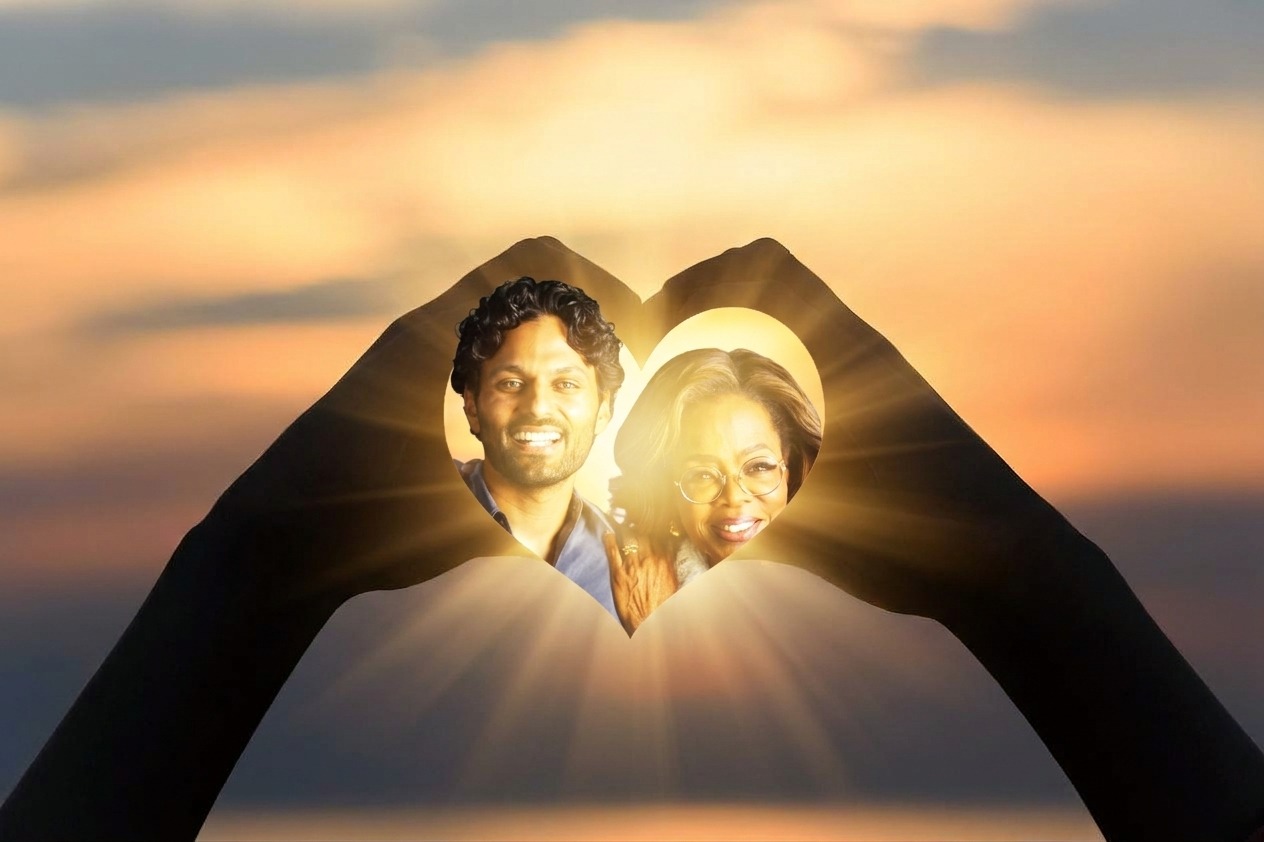
On Jay Shetty’s podcast titled ‘On Purpose’ in September 2026, Oprah Winfrey traces her life from a little girl reciting in church to the most trusted voice in American television. Her thread through all of it is a quiet inner calling she chose to obey. These are the lessons from that conversation and how they found me on a day I needed them most. Some lotuses need the mud. Oprah’s story is proof that the darkest water can grow the brightest bloom.
The day I found this episode
It was one of those low days. Nothing dramatic had happened, but everything felt heavy, and I kept asking a question I couldn’t answer: what am I really here for?
I wasn’t looking for a podcast. I was looking for a reason. Then I stumbled on Jay Shetty sitting across from Oprah Winfrey, and I could see how humbled he was to have her there.
Within minutes, I had stopped scrolling. By the end, I had pages of notes and something I hadn’t felt in a while: the sense that my search for purpose wasn’t a problem to fix. That was the point.
This is everything that conversation gave me.
A little girl who knew her life would be bigger
As a child, Oprah watched her grandmother work as a domestic helper for white families. Somehow, even then, she knew that would not be her life. She couldn’t explain it. She just had the feeling that her life would be bigger.
She calls what she did next “leaning into God’s dream of me.” That phrase stayed with me more than anything else in the episode. It suggests each of us carries a dream larger than the one we plan in our heads, and our work is to lean toward it.
Valued before she was loved
Oprah didn’t feel loved at home. But from the age of three or four, standing up in church to recite Easter pieces, she felt something else: valued. The church gave her a foundation and the confidence to speak in front of people.
As a young girl, she found William Ernest Henley’s poem Invictus. She didn’t yet understand its meaning, but she put its closing lines on her mirror:
I am the master of my fate; I am the captain of my soul.
Those words became her mantra long before she knew why.
Taking God out of the box
Oprah spoke about freeing her idea of God from rigid dogma. Universal, divine energy, she said, cannot be confined to rules about trousers, earrings, or who may sit where.
Her prayer has stayed the same since childhood: “Use me, show me, lift me. How do I rise to the calling?” She marveled that in the early 1990s most people didn’t speak of spirit as something beyond body and mind. Today, she noted, there are conversations about it every single day, even on Netflix.

The still, small voice
Oprah says she has been led by the hand of God throughout her life, and she has tried to listen. Her mistakes came when she didn’t, when she overrode that still, small voice.
It rarely shouts. It begins as a whisper, quiet and easy to ignore, and grows louder the longer you avoid it. You can ask as many people as you like for answers, she said, but no one outside you has them. You always come back to that inner voice.
From the darkest place
In the most poignant part of the conversation, Oprah spoke about being molested as a child. Years later, searching for her own answers, she interviewed some 200 survivors of abuse on her show.
She saw education as her only chance. And after her darkest years, doors began to open. She was chosen to attend a youth conference at the White House. She became known as an orator. Then a local radio station picked her for a contest, and she became the first Black girl to win it.
“What do you want to be?”
At that contest, someone asked her what she wanted to be. That very morning she had watched Barbara Walters on the Today Show. She pictured herself doing that work and answered that she wanted to be a journalist who tells stories so people can see the best in themselves.
When she went back to the station to collect her prize, a man asked her to read aloud in the studio so she could hear her own voice. People gathered to listen. That reading became her first radio job.
Then a local television station called. Then a talk show. Then the move to Chicago and a national show. Each step, she said, was a response to an inner calling.

Manifestation is a partnership
Oprah describes manifestation as leaning into that whisper: being willing to work with the greater forces of life. It isn’t wishing. It’s responding.
She turned to Jay and told him he carries that same power and that he is already on the path because he keeps searching for the reason he is here.
She was honest that not every dream was lofty. As a young woman, she was obsessed with pop singer and actress Diana Ross: the diamonds, the glamor, and the mascara that didn’t run in the rain. She got all of it. She even had Diana Ross on her show and was overwhelmed with emotion.
Intention drives everything
With every guest, Oprah’s intention was simple: to let people see themselves in each other’s stories. That pure intention is why her show felt ahead of its time.
The thousands of people who shared their lives with her left imprints on her heart. She says they made her fuller, wiser, and more expanded as a human being. They taught her, in her bones, that we are more alike than different. There are common threads, and she paid attention to them.
Why are you here?
Maya Angelou, American memoirist and essayist, once told Oprah she had been blessed with so much because she was obedient to the call of her life.
Oprah’s challenge to the rest of us: you may be paying attention to what your head says you want. But why are you here? is the most important question you can ask yourself.
When your personality comes to serve the energy of your soul and aligns with it, that is authentic empowerment. And when you combine your personality with the real reason you were called to this planet, nobody can stop you. You become your own phenomenon because you are doing what you came here to do.
Maya Angelou said Oprah’s legacy would not be the shows or the awards. It would be every life she touched.
Service is the way out
Oprah believes you can rise out of anywhere you are stuck by serving something greater than yourself. Jay agreed and named the two practices that make it possible:
- Master your mind and your emotions.
- Use your talents and gifts in service of something bigger than you.
Two lessons to carry
On people: The best advice Maya Angelou ever gave Oprah: when people show you who they are, believe them the first time.
On forgiveness: Forgiveness means giving up the hope that the past could have been different. You accept it, and you move forward. And you forgive yourself, not the other person.
What I carry from the mud
I started that day feeling stuck. I ended it with a question instead of a weight: why am I here?
I don’t have the full answer yet. But Oprah reminded me that the searching is itself the path. The whisper is already speaking. My work is to get still enough to hear it, brave enough to follow it, and generous enough to use whatever I’ve been given in service of someone else.
A lotus doesn’t apologize for the mud. It rises through it.
So I’ll leave you with the question that found me on my lowest day: Why are you here? And what would change if you leaned into the dream that was always meant for you?
Leave a Reply