


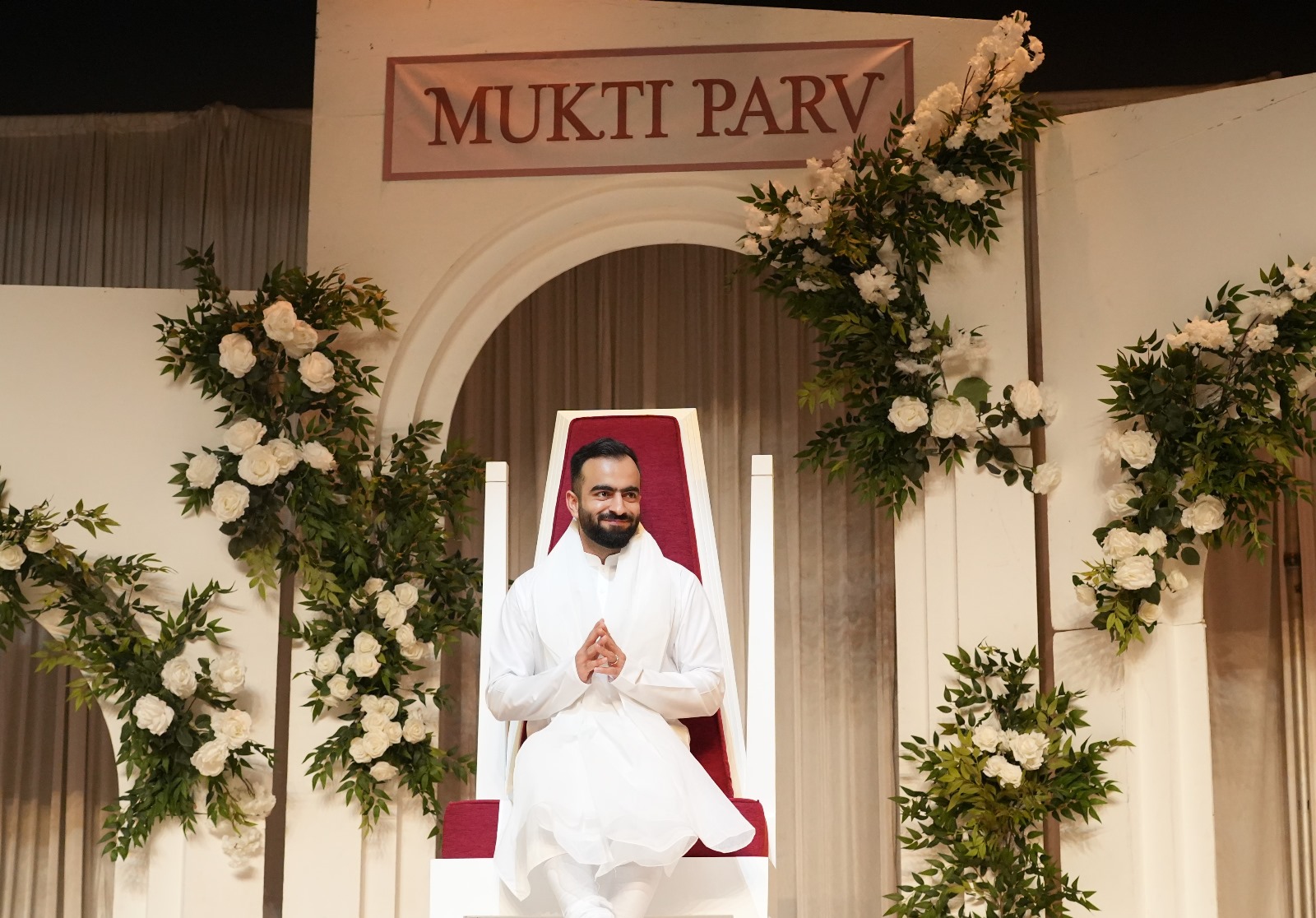
On the flight from London to New York for this Mukti Parv, I watched a movie. The plot was such that the protagonist had a genetic disorder preventing him from feeling pain. As a result, he had no friends. He followed a set daily routine – going to work, coming back home, and staying put.
Then he meets someone and mentions his condition. They ask him, “Why do you keep to yourself? How does this disorder stop you from interacting with others?”
He replies. “People think I can’t feel pain, so it must be a superpower. But they don’t realize it’s just that I don’t feel pain. But the damage (from a painful happening) is done. While growing up, I used to injure myself. But I only got to know about the injury when my clothes were soaked in blood. I would only know how badly I injured myself when people around me started fainting. Because of that, my parents just locked me up. The doctor said that people with such a condition hardly live to the age of 20 or 25 because they would seriously injure themselves and end up dying.”
The Unconscious Imposition: When Our Beliefs Cause Pain
I watched the movie about this character who remains unaware of his own pain. But we humans have become unaware of the pain we cause others by our actions, our words, our thinking, our narrow-mindedness, our feeling of superiority over someone else, our desire to let the world know that my beliefs are superior. Our quest to prove to the world that my community, my country, my religion, whatever I identify with, is superior and that is what everyone’s way of life should be. And when this imposition starts, unknowingly, we end up causing hurt.
That is at the macro level, where people attempt to impose their beliefs on others, as seen in communities, religious organizations, and similar institutions. However, let’s narrow it down to what we observe in our daily lives. A father imposing his belief system on his son or imposing his unrealized dreams on his children. A parent imposes their expectations of what a good life is on their children.
Now, in many ways, the content we consume reveals that by imposing our thoughts, we are alienating people, including our own family members —our sons, daughters, brothers, or sisters. Just because I am imposing myself unknowingly, I am hurting them in a way where the relationship reaches a point of no return. That character in the movie made me think about how tragic the situation has become for humanity.

We often read and repeat the statement that God made man in his own image. But the image that is emerging isn’t very inspiring; it isn’t very hopeful. We can see the significant progress we have made as a community, as a society, and as a species. But, unfortunately, the walls and the narrow-mindedness seem to be solidifying more than ever.
In the name of freedom, in the name of exercising freedom, people are imposing their own ideas on everyone else. But freedom doesn’t mean that I can force someone else to be the way I want them to be. Freedom gives me the right to do whatever I wish to do with my life, to practice my faith, to study what I want, and to travel the world. However, freedom does not mean that I have the right to exploit, hurt, impose my ideas on, or judge others.
And that is how everything else has been misunderstood. Religion, spirituality, salvation. These words have lost their meaning because they have been misunderstood and misrepresented on a scale so vast that we, as humans, feel we are better off without such high sounding concepts. Because of the oppression that is done in the name of religion, in the name of God. No other subject has been the cause or reason for so much oppression, so much damage to society.
Spirituality Is Not an Investment, It’s an Experience
And the biggest misunderstanding about spirituality or religion is that it is an investment. People talk about God, worship God, or practice faith as an investment, as an act that will someday pay me good returns. It is not done for the love of God, not to experience bliss. It is done as an investment. But have you ever wondered, when we drink water, is it an investment that someday, when I feel thirsty, my thirst will be quenched because I have had water two weeks before?
When I’m thirsty and I have water, my thirst is quenched in that very moment. It is not an investment for the future. It is not a promise of the future.
And devotion, faith, God, bhakti, is also not a promise of the future.
When I eat food, I feel full immediately. I can’t store up food in my body. Some species can, some animals can. Similarly, when I am in devotion with God, in love with God, the bliss that I experience, the salvation that I experience is in this very moment.
If this can be understood, if this one truth can be realized, all the tragedies, all the unfortunate events that we see in the name of God, in the name of religion, will cease to exist. Because any misbehavior, any oppression, anything that someone else was misguided to do, was with the promise of the future. That you do this in the name of God, and you will attain heaven. You do this in the name of God, and you shall attain whatever your heart desires.
And we see to what levels humanity has fallen in the name of God or religion. No matter how advanced in terms of our technologies we have become, we have gone far, far away from our true identities, from our true selves. And this is the moment when we can reflect and awaken to the idea, to the truth of my true existence, of who I really am.
However, as long as we maintain an investment-oriented relationship with God, we cannot experience even a drop of bliss. We can’t experience salvation, which is a state of pure love. A state of knowing my own true self. A state of knowing what God is. No misconceptions, no second-hand beliefs, no walls, no restrictions.

Waking Up to Our True Selves: The Path to Salvation
Arjuna got to see God in the truest form, as related in the Bhagavad Gita. And in that moment, he surrendered. Similarly, when I get to see that true form, I understand who I really am. From that moment begins my relationship of love rather than investment with God, this true all-pervading entity. And from there, my understanding of true freedom comes to life.
In the darkness, the ignorance that I was living in when I was so full of myself that I couldn’t even realize the pain I was causing to someone around me. Now I start waking up to that pain. I start realizing that my illusions, my ignorance, had been pushing me far, far away from this truth. Then we can wake up, be reborn. Often in India, we get to hear from saints that the day I receive God knowledge, the day I received this truth from my Satguru was the day I was born. That was my true birthday. Of the days and years gone by without that truth, I can’t say I was truly living. My true life begins now. My true life begins with this understanding, with this boundless identity that my Satguru has bestowed upon me. That, in the true sense, is what salvation is. Saints and gurus have taught us that the path to salvation lies in cultivating complete devotion and surrender.
That is very simple, but probably the most challenging thing to do. Very simple to understand, very simple to talk about. However, the most challenging aspect is to attain that state: the state of salvation, the state of Nirvana.
There’s nothing more to say when it comes to this truth. The lyrics of the song the youngsters sang before me go, “Lord, empty me of me, so I can be filled with you”. That summarizes what Nirvana is, what salvation is. The drop merging in the ocean, becoming the ocean, is mukti (salvation), and that is what the Satgurus gift us. The only reason we are deprived of that is because of our ego. That is why it is said that we can attain mukti only with the grace of the Satguru – it is Guru Prasad.
Sant Nirankari Mission hosts spiritual event at Hofstra

At the Sant Nirankari Mission’s well-attended Mukti Parv Samagam (Spiritual Salvation Convention) on August 17 at Hofstra University, a spiritually uplifting discourse was delivered by Nirankari Rajpita Ramit ji, husband of Satguru Mata Sudiksha Ji Maharaj, the current spiritual head of the global organization with headquarters in New Delhi.
The event at Hofstra’s John Cranford Adams Playhouse auditorium was organized by the New York-Connecticut chapter of the Nirankari Mission. It drew more than 1,200 participants, including over a dozen political and community leaders from across Long Island, according to a press release from the Mission.
In his reflective discourse, mixing English and Hindi, the young Rajpita Ramit Ji, who had arrived in New York after delivering back-to-back discourses in New Delhi and Birmingham, England, delivered a deeply thought-out message. He reminded participants that spiritual life is rooted in valuing human virtues. “Yes, we are free to practice our faith, but that should not restrict others’ freedom or disrespect them. Nor should we impose our faith on others,” he said in his 45-minute presentation.
He thanked the speakers who preceded him for relating their experiences to highlight the pivotal importance of Satguru, who brings us face-to-face with our true essence, after which the worldly problems fade way.

Dignitaries present at the afternoon event included New York State Senator Steve Rhoads, Town of North Hempstead Supervisor Jennifer S. DeSena, and Town Clerk Ragini Srivastava, as well as Tsewang Gyaltson, Consul at the Indian Consulate in New York.
Throughout the event, other mission speakers and devotees shared personal experiences of spiritual growth, describing how the convention deepened their understanding of faith and practice. The program also featured soulful hymns and devotional music, fostering an atmosphere of reflection, meditation, and community spirit.
A langar meal followed the program even as people queued up to greet Rajpita ji individually.

Leave a Reply