


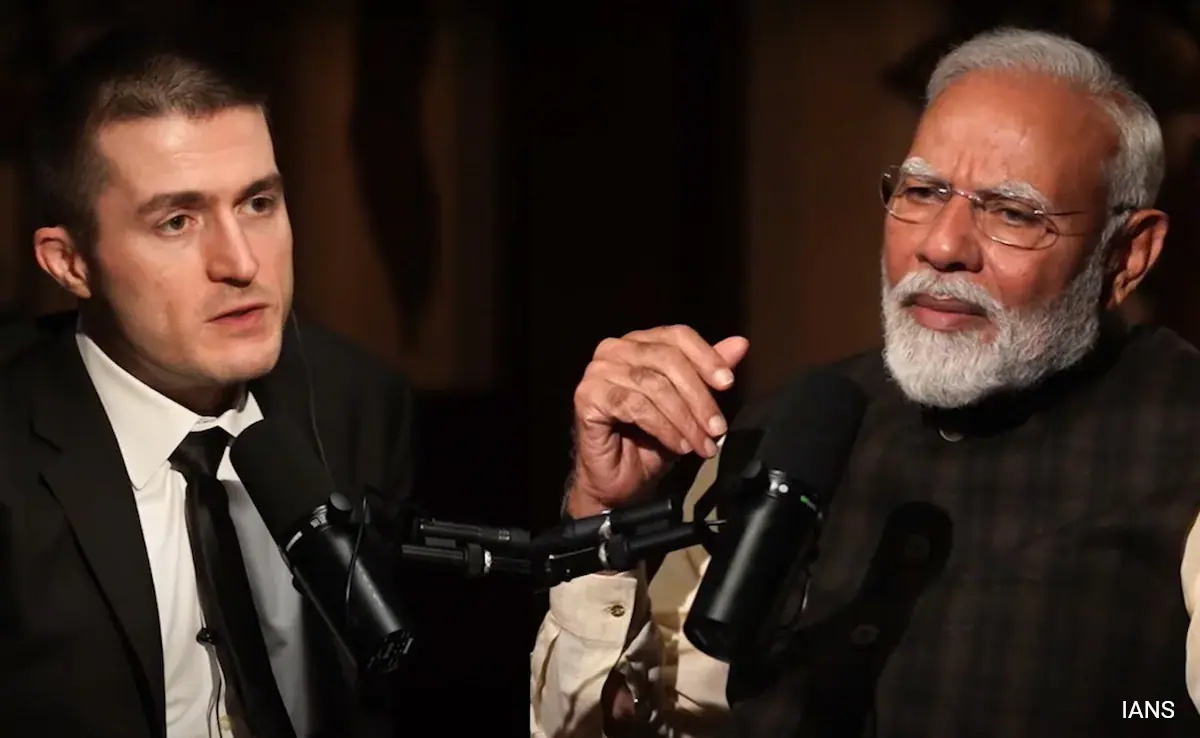
In a world captivated by political rhetoric and media spectacles, rare are the moments when we glimpse the inner world of a leader – his spiritual foundation, his discipline, his journey beyond the offices held. But recently, a riveting 3-hour conversation between Indian Prime Minister Narendra Modi and MIT scientist Lex Fridman on a podcast unfolded as something far beyond a political interview. It became a reflection on the timeless virtues that shape a man, a leader, and a seeker – self-discipline, service, and an unshakable commitment to Dharma.
Modi, serving his 3rd five-year term as Prime Minister, has often been described as a statesman, a strategist, a nationalist, and by his critics as a polarizing figure – but in this podcast, we see a different archetype emerging: the Rajarshi or the philosopher-king. The term, deeply rooted in Indian civilization, describes a leader who wields power not for personal gain, but with the wisdom of a sage, the detachment of a monk, and the decisiveness of a warrior.
The discipline of fasting: A leader’s inner strength
The conversation on the podcast, released on March 16 and heard by millions around the world, carried a remarkable undercurrent: both men had fasted before the interview. Fridman, a scientist of Russian-Jewish descent, practices intermittent fasting as a discipline for mental clarity. Modi, on the other hand, has observed fasting as a way of life – whether the Navratri fasts he has adhered to for decades or the deeper spiritual restraint that fasting represents.
“After fasting for two days, I recommend you ease into eating slowly. I hope you reap great benefits from this fasting experience,” Modi told Fridmanduring their discussion.
In Gandhian philosophy, fasting is not deprivation – it is mastery over the senses. The Bhagavad Gita echoes this wisdom, portraying the ideal man as one “unshaken by the dualities of pleasure and pain, praise and blame.” Modi’s life, as shared in this viral interview, has been shaped by such tapasya – from selling tea at a railway station to enduring Himalayan winters, to the unrelenting discipline of political life. His ability to endure, to renounce, and to stay laser-focused has been his greatest asset.
The Himalayas: A test of the spirit
Perhaps the most striking segment of the discussion was PM Modi’s recollection of his two years of solitude in the Himalayas. In an age where public figures meticulously craft their image for the world, here was a leader speaking not of political ambitions, but of renunciation.
Modi described waking before dawn, bathing in freezing waters, and observing monks who had renounced all possessions. Yet, despite being surrounded by silence, he felt his own restlessness. “A wise sage in the Himalayas once asked me to focus only on the dripping water from a leaf onto a bowl, ignoring all other sounds. That rhythmic melody guided me into deep focus and taught me the art of concentration.”
The Himalayas have long been the testing ground for seekers – Prince Siddhartha left his palace to seek truth in its silence and became the Buddha, Adi Shankaracharya walked its valleys before revitalizing Sanatana Dharma, and Swami Vivekananda found his awakening in its solitude. Modi’s time in the mountains was not that of a politician in retreat, but of a young man questioning the nature of existence.
Yet solitude did not mean detachment from duty. When a calamity struck a village, Modi did not sit back in contemplation – he stepped forward to serve. This echoes the karma yoga of the Bhagavad Gita: true spirituality is not found in renunciation alone, but in action without ego.
Meditation, focus, and decision-making
A leader’s mind is often clouded by pressure, expectations, and external noise. But what happens when a leader trains his mind the way a yogi trains his breath?
“The word meditation has been overused to the point that it feels like a cliché,” Modi noted. “In Indian languages, we usually refer to it as dhyan. It simply means freeing yourself from distraction.”
Throughout the conversation, one theme stood out – Modi’s clarity of thought and decision-making process. In today’s age of hyper-connectivity and distraction, few leaders can claim the ability to think deeply and act decisively. Modi’s method, as he described, is rooted in an old practice: detachment from praise and criticism, a mind trained to focus on action rather than outcome.
This is the essence of meditation – not just sitting cross-legged in silence, but the ability to hold stillness within, even amidst the storm. It is the ability to look at problems without anxiety and solutions without attachment. The ability to act without ego, as an instrument of something larger than oneself.
The idea of India: A civilizational unity
When the conversation shifted to Hindu nationalism, Modi did not offer a defensive stance, nor did he engage in rhetoric. Instead, he framed it as a question of civilizational continuity – a way of life rather than a political ideology.
“Hindu thought,” he said, “is not about exclusion – it is about harmony.”
He spoke of India not just as a modern nation-state, but as a civilization that has endured for many millennia. “India is so diverse that we say – every 20 miles, the language changes, customs change, cuisine changes, even clothing styles shift. Yet, beneath this diversity, there is a common cultural thread that binds us together.”
This echoes the teachings of Swami Vivekananda, who stood before the West not as a nationalist in the modern sense, but as a representative of Sanatana Dharma – the eternal way. It is not an identity to wield, but a wisdom to live.
Modi also highlighted the role of pilgrimage traditions in preserving India’s unity. “In Kashi, people bring water from Rameshwaram and take water from Kashi back to `Rameshwaram – this exchange symbolizes a spiritual and cultural bond that spans the country.”

The podcast revealed Modi emerging as Rajarshi or the philosopher-king. The term, deeply rooted in Indian civilization, describes a leader who wields power not for personal gain, but with the wisdom of a sage, the detachment of a monk, and the decisiveness of a warrior.
A leader forged in fire
Lex Fridman, having interviewed some of the most influential figures of our time – scientists, philosophers, world leaders – described this conversation as one of the most powerful of his life.
Why? Because it was not about politics. It was about something deeper: the making of a leader through sacrifice, discipline, service, and spiritual inquiry.
Modi’s insights on decision-making revealed a leader who relies not just on intellect, but on instinct honed through years of experience. “If a decision goes wrong, I take full responsibility – I don’t shift blame. When you own your decisions, your team trusts you and stands by you.”
In an era where leadership is often measured by popularity and power, here was an insight into an older tradition – a leader shaped by hardship, self-mastery, and an unwavering commitment to a higher purpose.
The Rajarishi archetype is not about titles, but about a state of being. It is the leader who rules not by force, but by wisdom; who walks the corridors of power yet remains inwardly untouched by it.
This conversation, then, was not just an interview. It was a meditation on leadership itself.
And perhaps, in listening, we too might learn something – not just about Modi, but about ourselves.
Lex Fridman’s take: ‘One of the most fascinating leaders’
Fridman, who has previously hosted Donald Trump, Benjamin Netanyahu, Elon Musk, Mark Zuckerberg, and Sam Altman, tweeted after the release of the podcast:
“PM Modi is one of the most fascinating human beings I have ever studied.”
In response, Modi shared his own reflections on the exchange:
“It was indeed a fascinating conversation with @lexfridman, covering diverse topics including reminiscing about my childhood, the years in the Himalayas, and the journey in public life.”
A must-listen podcast making global waves
The podcast of this episode has already generated massive interest across social media platforms, drawing listeners from India and around the world. With Fridman’s global reach and Modi’s towering presence on the world stage, this conversation provides an unparalleled insight into the mind of a leader who has made India count in the comity of nations.
This captivating conversation offers a rare window into Modi’s life philosophy, spiritual journey, and the leadership principles that guide him today. Tune in to hear history unfold.
The Modi interview has been translated in many languages, and besides the Podcast website (https://lexfridman.com/podcast), it is available on Apple Podcasts and Spotify, and on YouTube where the default audio track is overdub English.
Lead photo: courtesy IANS



Leave a Reply to Arish sahani Cancel reply