

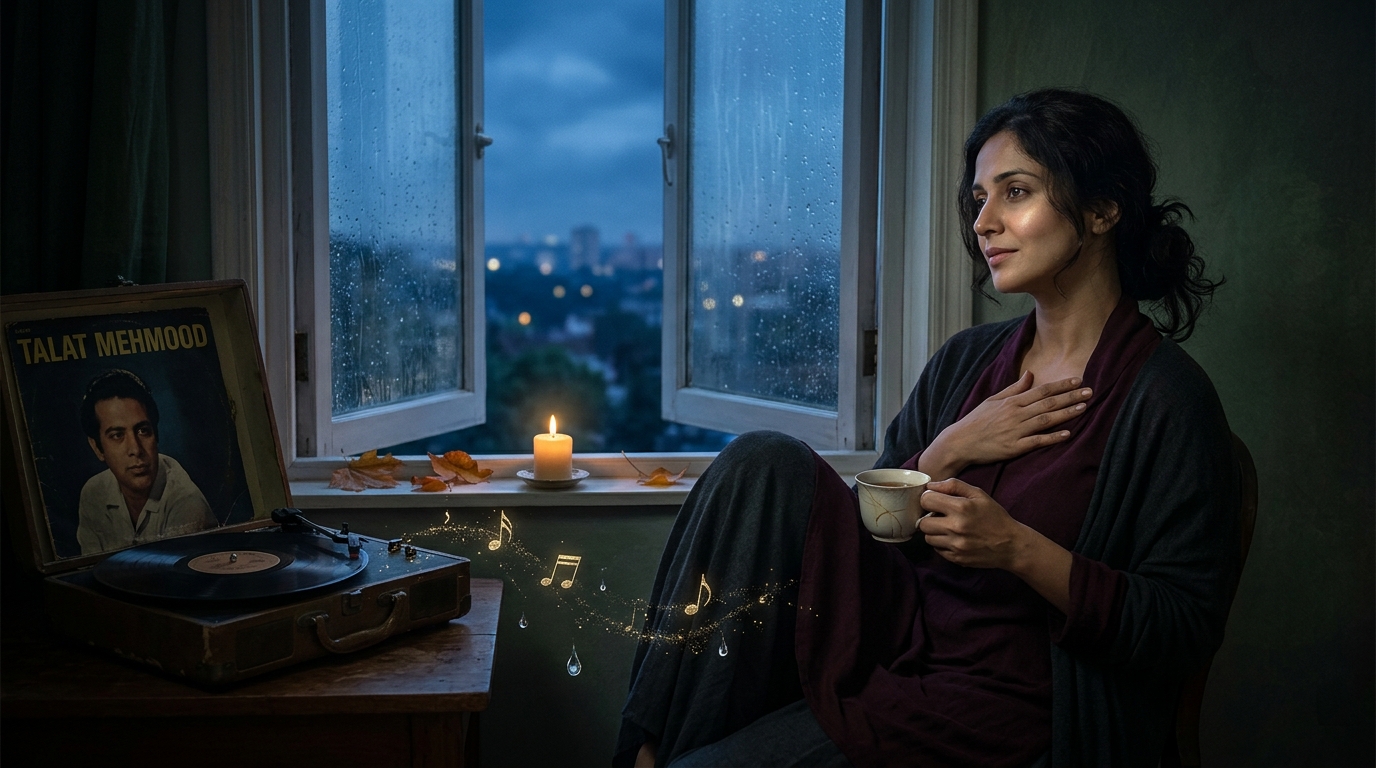
In the velvet hush of midnight, we listen to Talat Mehmood with the lights off. His melancholic voice weaves a quiet sorcery. It turns a key in a forgotten chamber of our heart where an old sorrow lies buried. That sorrow stirs, rising like an ember. Suddenly, it dawns upon us that grief is not the opposite of joy. It is joy’s older, wiser kin. The sibling who has wandered the wilds and come home with quieter eyes.
Now we know. The world lied to us about melancholia, branding it as a splinter in our heart. A blown fuse. A malfunction to be fixed. But what if a heart that cracks is not broken, but broken open? What if sorrow is not a descent into doom, but the soul’s own coronation?
The Bollywood songs of the 1950s did not just acknowledge sadness. They adorned it in melody’s finest silk. Lyricists cherished the wound, steeping longing in moonlit Urdu. Musicians bowed before its ache and spun heartbreak from burnished sound until grief itself learnt how to shimmer.
The velvet tremble
And no one draped melancholy in richer silk than Talat Mehmood.
His voice made sorrow feel like a caress, not a wound. That aching, nocturnal cadence. That legendary quiver, like a moth fluttering between two notes. Half sigh, half starlight. No excess, no flourish. Only restraint and a resonance so soulful it lent grief a compelling incandescence. The bruise was elevated to benediction. Each note, a puff of oxygen for the soul. The wound was not healed. It was hallowed.
Melancholia is the alchemy where pain transmutes into poetry. In the Hindi film Patita, one immortal melody rendered by Talat still stands as melancholia’s crowning anthem: Hain sab se madhur woh geet jinhe hum dard ke sur mein gaate hain. (The sweetest songs are those we sing in the key of pain.)
Urdu, that most refined language of longing, holds an entire lexicon for the broken heart. A rosary of ache: dard, gham, judaai. Each word a small lantern lit for a different shade of the same ache. The Hindi movie songs of that golden era birthed a genre that celebrated the wound. A sanctuary where sorrow was not shunned, but sanctified. (The lover who never bled was suspect.)
The bruise was never a blemish on the song. The bruise is the song. The wound is the instrument. Or as Victor Hugo observed: Melancholy is the happiness of being sad.
A rare sensitivity
Melancholy is far more than a passing cloud of sadness. It is a profound emotional climate at the crossroads where creativity, philosophy, and existential struggle converge. It is a rare sensitivity, attuned to the hidden music of being. A quiet ache of noticing life’s fleeting nature. Its inherent loneliness. And the inseparable twinship between beauty and its decay.
Beauty’s own signature
The Romantic poets, those wild children of storm and shadow, made melancholy beauty’s own signature. John Keats insisted that only those who have tasted life’s bitterness can truly taste its honey. Sorrow and joy are but two petals of the same flower. To wall ourselves off from grief is to banish ourselves from being fully human. And Shelley, addressing the skylark, whispered the identical truth: the sweetest songs are those that carry the saddest thoughts.
Gothic literature built its brooding heroes around this same shadow. Those splendidly miserable exiles were alienated not because they were evil, but because the sheer velocity of their inner storms set them apart. Melancholy was their badge of honour. Proof they had dared to peer into the abyss that milder souls hurried past.
Françoise Sagan’s debut novel, devastatingly titled Bonjour Tristesse (Good Morning, Sadness), opens with a sentence like silk laid over a fresh wound: “A strange melancholy pervades me to which I hesitate to give the grave and beautiful name of sorrow.” This is melancholy, studying its own reflection with quiet, aristocratic pride.
It echoes Victor Hugo’s timeless observation: melancholy is the happiness of being sad. A twilight state where suffering softens into sombre, reflective joy, allowing us to cradle our bruises rather than flinch from them.
The philosophers’ heavy crown
The ancient Greeks were among the first to glimpse a strange spark hiding inside the shadowed mind. Aristotle noticed the strange companionship between genius and melancholy. Before him, Plato had sung of “divine madness” and “inspired frenzy,” the elder cousins of this creative sorrow.
By the Renaissance, melancholy was no longer a flaw but a sacred gift, a mark that one had been chosen to see more deeply into the mysteries of existence. Centuries later, Kierkegaard made his “heaviness of mind” the very bedrock of selfhood. A weight born from standing between infinite possibility and mortal limitation.
And Emil Cioran, merciless and precise, sharpened the knife, calling melancholy “an appetite no misery satisfies.” An insatiable hunger for sadness, a void so deep that no earthly grief could ever quite fill it.

The eastern hush
But the East has always sung this nocturne in another key. Not as tormented ego but as quiet tremor.
The Japanese named it “mono no aware,” the pathos of things. Beauty is most ravishing at the moment of its departure. The cherry blossom does not mourn its fall. The fall is the consummation of its pink ignition. Basho, wandering the narrow road to the deep north, found his haiku not in conquest but in the drizzle, the abandoned nest, the silence left by the cuckoo’s cry. To feel the ache of impermanence is to become exquisitely, unbearably awake.
And in the courtyards of Sufi mysticism, the wound of separation—hijr—becomes the furnace in which the soul is recast. The Sufi mystics do not flee the ache of fana. They see absence as the beloved’s truest form. Here, melancholy is not malady but grace.
The modernist chill
The 20th century brought a cold, stark shift. Franz Kafka stripped melancholy of its romantic veil. It was no longer poetry but an honest—and perhaps sane—response to a world that had lost its meaning. In a fragmented, mechanised, indifferent cosmos, melancholy became the default weather of the isolated soul.
Albert Camus gave this feeling a harsher name: the absurd. The agonising silence of a universe that refuses to answer our cries.
The canvas of isolation
Artists rendered this shift visually. Dürer’s engraving Melencolia I depicts a winged figure surrounded by the tools of knowledge, yet frozen in brooding stillness. Wise but weary. Gifted yet stuck. Later, Romantic painters moved this mood outdoors, placing solitary dreamers before sweeping, misty vistas where sorrow and the sublime embraced each other.
By the mid-20th century, Edward Hopper captured the stark melancholy of modern isolation. Urban figures nursing private grief under the cold glare of the fluorescent lights of restaurants and public spaces. His canvases whisper the devastating truth: the gulf between two souls can span galaxies, even when the bodies are just two feet apart.
The clinical eclipse
Modern psychology too often files melancholia under malfunction—a pathology to be managed, medicated, erased. But in the diagnostic reduction, the music is lost. The melody flattens into a symptom. Melancholy is dethroned.
And yet radical minds have tried to rescue its poetry from the clinic. Philosopher and psychoanalyst Julia Kristeva, in Black Sun, tethered melancholia to a primal, unnameable loss. An ancient severance from the maternal source. The aching emptiness.
Ultimately, the truest art is to cradle the ache. To feel deeply is a rare and solemn privilege. In melancholia’s hush, we are most awake, most porous, most human.
The digital acedia
In today’s hyper-connected era, we have weaponised dopamine against dolour. We live under a regime of toxic positivity, where sadness is dismissed as a glitch to be scrolled past. The lush, layered melancholia of poets has faded into a flat digital acedia, a numbness bred by endless stimulation and emotional evasion.
When we commodify happiness and pathologise sorrow, we lose our depth. We refresh our screens the way medieval monks once turned prayer beads, except our ritual now ends with another meme, not another mystery. Our art risks becoming shallow, optimised for quick consumption rather than soulful resonance.
The luminous dusk
Ultimately, the truest art is to cradle the ache. To feel deeply is a rare and solemn privilege. In melancholia’s hush, we are most awake, most porous, most human.
Talat’s velvet tremble. Keats’s dense gloom. Dürer’s brooding angel. Plato’s divine madness. Kierkegaard’s holy heaviness. Basho’s empty nest in the rain. The Sufi’s brewed absence. And Sagan’s silken tristesse. These are not different emotions. They are different windows in the same twilight house, each looking out at the same endless night. The same ache. The same luminous dusk.
Let the world chase its frantic glare, optimize, and affirm. We will linger in the velvet dusk. Let clinics diagnose and social media sedate. We will not be cured of our depth. The bruise was never a blemish on the song. The bruise is the song. The wound is the instrument. And those who have never dared to sing from within it have never truly sung at all.

Leave a Reply