


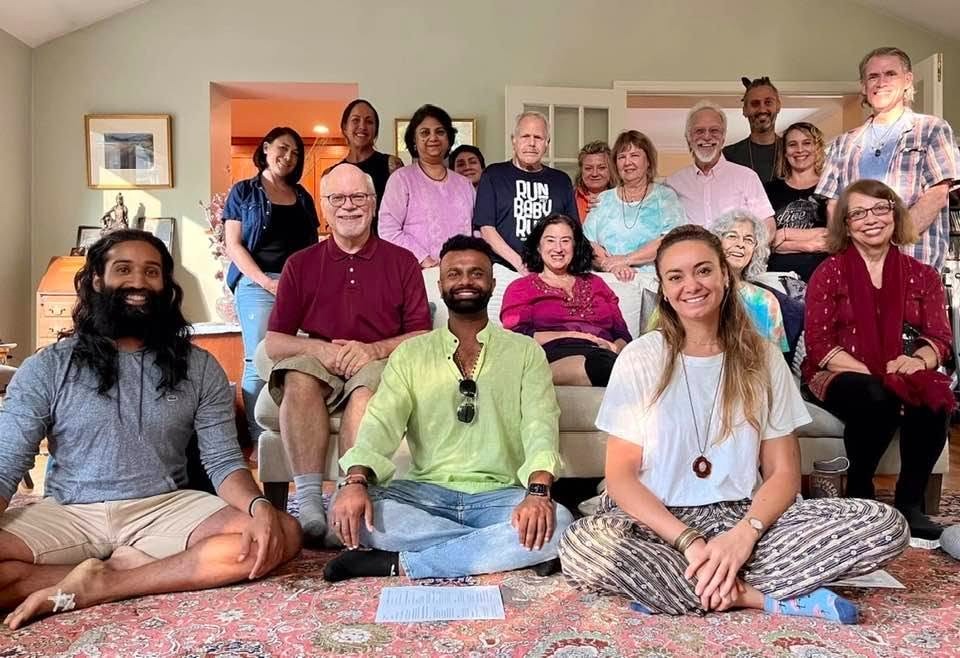
There are many pockets in Greater Washington, D.C., where people meet once or twice a week and chant Sanskrit mantras accompanied by musical instruments, such as harmonium, tabla, and dholak (drums).
A growing modern sanctuary in Greater Washington
Why is this trend gaining ground? What draws people to this age-old Indian practice in the modern, tech-savvy vibe of the US capital and its affluent suburbs?
“It is not only calming but also meditative,” says Peter Frances. He travels miles to join these groups and sometimes brings his small children too.
Peter plays drums or the mridangam during chants.
“It keeps me focused and happy,” he adds. He works as a physical therapist and spends a lot of time with patients with disabilities. “It gets tiring, and chanting puts me back in shape, mentally and physically, and my energy
back in me. It heals me in some way I can hardly describe,” he adds.
Jasmine, who works as a digital developer, feels that she has become more stable. “I was looking for some meaning in my life; chanting is what has helped me with finding direction in my life,” she says.

Healing, music, and connection: Stories from the circle
Rufus Juskus, normally a lead performer, chants the names of all Indian or Hindu deities or devas, accompanied by his electric guitar.
“Guitar” is an Indian word, he proffers. “Geet (song) and taar (string), so geettaar, or guitar,” he explains with a smile. Rufus is dedicated to his practice. He starts. with Hanuman Chalisa and then chants mantras. He worked as a mailman in Virginia and is now retired. He travels miles to chant in private homes in Bethesda and Silver Spring in Maryland, and Falls Church, Virginia. He lost his wife to cancer.
“Chanting these ancient Hindu and Buddhist mantras has kept me going.”
Rufus often takes pictures of the group that joins him and gives the photos for a small charge. He does not charge any fee.
“It’s all for good,” he says.
These chanting groups meet in private homes, where hosts provide snacks and a comfortable place to sit, lie, or just be yourself. One of them is Kay, with a beautiful mansion in Bethesda. She is a terrific host, opening her door to these chanting groups.
They have a mailing list where they share event details, but word of mouth travels and brings in new people. Anybody is welcome. They come and make themselves comfortable, imbibing the rhythm, vibration, and energy of normally two-hour-long chants.
These chanting groups bring together people of different ages, ethnic backgrounds, and levels of experience. Most are Americans, while many Indians also take part.
They celebrate festivals like Holi and Diwali.

Seeking solace in an era of rising stress
People face rising stress, along with higher grocery prices, high rents or mortgages, and job scarcity. As it becomes harder to afford the leisure activities they once enjoyed, people take solace in yoga, meditation, and chanting Sanskrit mantras. The word is spreading fast, reaching big and small cities and towns.
Kathy says it takes your mind off worries after the devotion and chanting session. “Ancient Hindu chants are wonderful, and genuine gurus do remove darkness,” she adds.
Kathy’s observation finds resonance in both Indian spiritual traditions and scientific research. Mantra chanting is associated with calming effects and may influence brain-wave patterns and mental states. Research also suggests that regular chanting may contribute to improved quality of life and has been linked to better attention, synchronized cardiovascular rhythms, and memory.
How chanting works

How does chanting mantras work? The word “mantra” is made of two Sanskrit words—manas (mind) and tra (tool or vehicle). So, it is a tool to control the mind and thoughts like an instrument. A mantra is a sacred word; its sound and rhythmic repetition have been used as a tool to focus the mind during prayers and meditation since ancient times. The word mantra is used in all Indic traditions—Hinduism, Buddhism, Jainism, and Sikhism—as a potent syllable or phrase. In Sikhism, it is called simran. OM is the best-known mantra.
Gurus believe that chanting mantras holds spiritual power and vibrational energy that connects to your higher self.
Scientists and researchers explain that chanting works through a combination of physiological, neurological, and psychological effects that calm the body and focus the mind. The physical vibrations from vocalizing sonorous sounds stimulate the vagus nerve (which runs from the brainstem to the gut) and activate the parasympathetic nervous system, which in turn lowers the heart rate and blood pressure.
Chanting deepens respiration because chanting requires controlled, steady exhales and deep diaphragmatic breathing, which oxygenates the blood and shifts the body out of Fight and Flight mode.
Besides, its cellular vibration produces sustained tones that create sound waves that physically vibrate tissues and cells throughout the body, releasing physical tension. It affects the body neurologically by shifting brainwaves. Mantra chanting, or repetitive vocalization, moves brain activity away from high-stress beta waves (busy mode) and into slower alpha.

Leave a Reply