


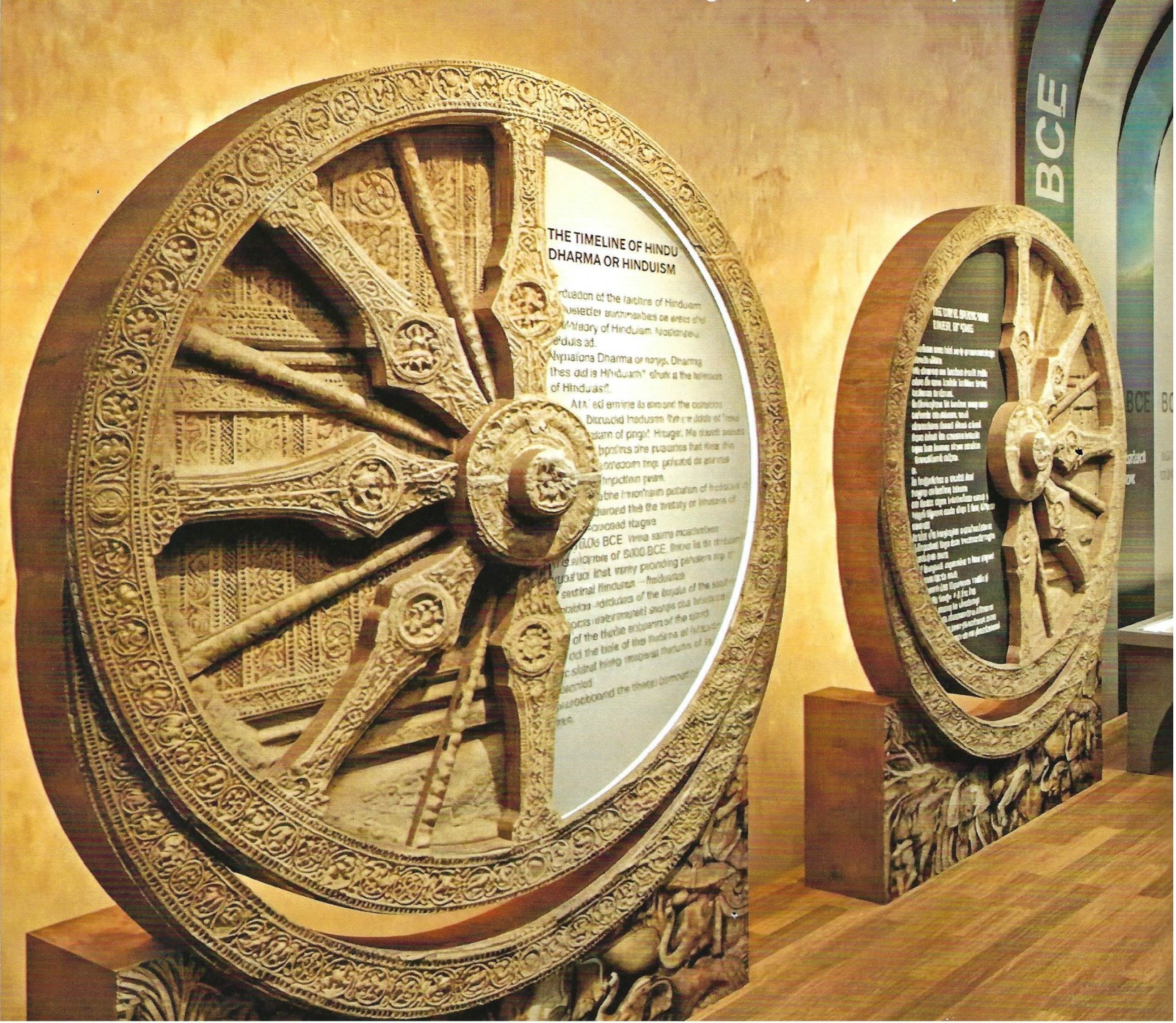
Imagine walking through India’s civilisational journey under one roof—from miniature replicas of 12 iconic architectural marvels and lifelike dioramas depicting the nation’s cultural heritage to the extraordinary story of Sushruta, the sixth-century BCE physician from Kashi hailed as the Father of Surgery and Plastic Surgery. This vision will soon come alive at the Swaminarayan Akshardham Museum at Swaminarayan Akshardham, Robbinsville.

A new Hindu cultural landmark in New Jersey
Featuring four exhibition halls and 85 immersive dioramas, the museum will celebrate India’s culture, traditions, value system, scientific contributions, and spiritual heritage. Calling it one of the most ambitious efforts to spread awareness of Sanatana Dharma, Dr. Gnanvatsal Swamiji says the project is designed to inspire visitors from across the world.
“This is the first of its kind. There will be four exhibition halls. Excellent, glorious, and depicting the values of Sanatana Hindu Dharma in the way they should be. We don’t want people to tell us stories of our culture. We want people to hear the stories of our culture from the descendants of our culture,” said Swamiji.
“The world has more than 100,000 museums. Out of them, 50,000 are in the United States. Oh. But nowhere in the world do we have a museum on Sanatana Hindu Dharma,” he added.
The museum will be part of Swaminarayan Akshardham, Robbinsville, a sprawling Hindu spiritual and cultural complex opened in 2023, after 12 years of construction. An earlier landmark on the same campus—the BAPS Shri Swaminarayan Mandir, opened in 2014—already reflects thousands of years of India’s inspiring philosophy, values, architecture, art, and culture.
Dedicated to Bhagwan Swaminarayan, whom followers of the BAPS Swaminarayan Sanstha revere as the supreme manifestation of God, the Akshardham complex serves as a celebration of India’s enduring spiritual and cultural heritage.

A home for India’s Civilizational legacy
“The museum will feature 12 architectural replicas. The rock-cut caves of Ajanta and Ellora have been recreated with their original architecture, sculptures, and intricate designs, while visitors will also experience monuments such as Odisha’s 1,200-year-old Konark Sun Temple and the stunning Rani ki Vav stepwell,” he said.
Designed as a tribute to India’s cultural heritage, the museum will highlight the country’s traditional food habits, joint family system, clothing, values, and lifestyle, offering visitors a glimpse into its enduring way of life.
Beyond its cultural exhibits, the museum will also showcase India’s ancient scientific achievements, including the legacy of Sushruta in developing surgery.
“Sushruta will be prominently featured. The museum will display the surgical instruments described in the Sushruta Samhita, showcasing his pioneering contributions to surgery and sharing his legacy with the world.”
Ancient wisdom, modern inspiration
The museum will also use immersive storytelling to introduce visitors to the moral and ethical values embedded in India’s epics and scriptures. Through 85 dioramas, it seeks to inspire younger generations with timeless lessons on duty, sacrifice, compassion, and family values.
“We have created 85 immersive dioramas to teach the value system to the next generation. One depicts Mata Sita choosing to accompany Bhagwan Ram into 14 years of exile, despite being raised as a princess—a powerful example of devotion, sacrifice, and the ideals of womanhood,” said Swamiji
“One diorama depicts Mata Sita calling herself Ardhangani—the ‘other half’ of her husband—before choosing to accompany Bhagwan Ram into 14 years of exile. It reflects the timeless values of devotion, partnership, and shared responsibility,” he added
According to Swamiji, the story of Ram and Sita is not merely mythology but a powerful lesson in commitment, mutual responsibility, and enduring relationships.
“The underlying principle is commitment in married life. If today’s generation could embrace even a fraction of the commitment shown by Mata Sita and Bhagwan Ram, many marital conflicts would disappear. Sita did not tell Ram, ‘You should have told me this before our marriage’; instead, she chose to stand by him through every circumstance.”
Swamiji says the museum’s exhibits are designed not just to inform but to inspire personal transformation. Recalling the impact of similar exhibitions at the Akshardham complexes in Delhi and Gandhinagar, he says many visitors have reconsidered life-changing decisions after experiencing the dioramas.
He recalls one couple who had decided to separate in 2006 but reunited after visiting the exhibition. “Twenty years later, they are still a happy family, blessed with a second child,” he says, adding, “Akshardham museums have the power to give people their life back.”
The museum will also feature scenes from the story of Shravan Kumar carrying his aged parents, illustrating the timeless value of selfless service to one’s parents.
“The principle is simple—serve your parents selflessly, without expectations. If this value is truly understood, many elderly parents would be cared for with dignity within their own families.”
For Swamiji, the enduring relevance of ancient Indian narratives lies in their ability to inspire people across cultures and continents.
“A story that unfolded thousands of years ago in India still has the power to inspire people thousands of miles away in America—even those with little exposure to Indian culture. If the story of Shravan can inspire them, imagine the impact it can have on those who carry the values and heritage of this civilization,” he said.

Swamiji’s call to support a landmark project
Calling the museum a landmark initiative to preserve and promote India’s civilizational heritage, Swamiji urged people to become part of the project.
“This is the first of its kind museum anywhere in the world. I appeal to every follower of Sanatana Dharma and every Indian to come forward and support this museum.”
Swamiji says the museum is envisioned not merely as a repository of history but as a living celebration of India’s heritage, designed to educate, inspire, and connect future generations with the timeless values of Sanatana Dharma.

Leave a Reply