
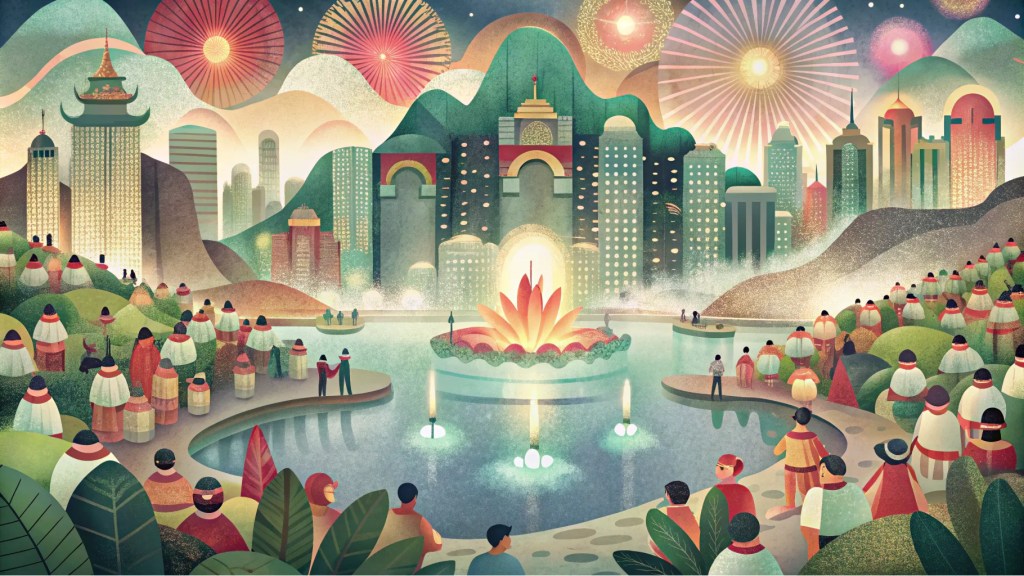

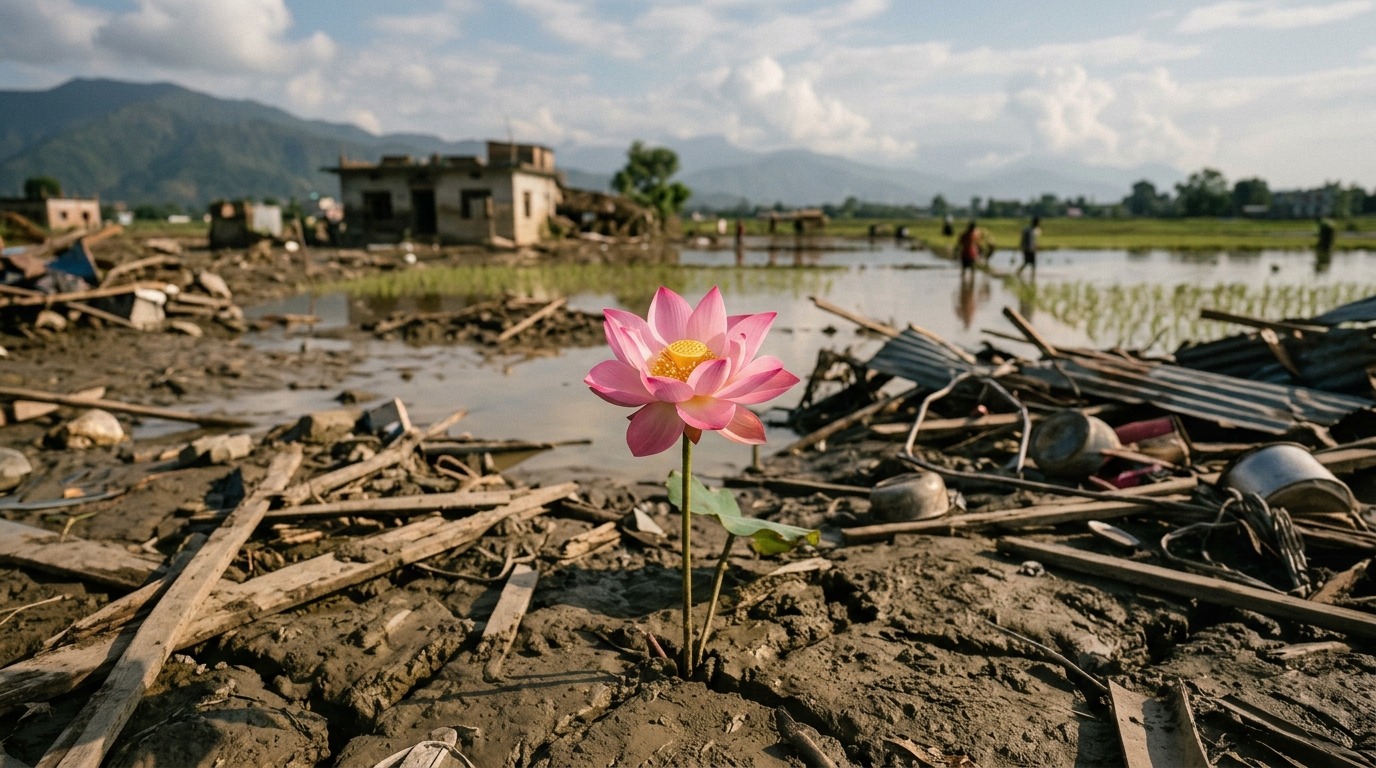
The relevance of Jain reflections (Bhāvanās) becomes particularly poignant when viewed in light of contemporary events. The recent floods in Nepal remind us how suddenly the apparent security of human life can be disrupted. Homes, possessions, roads, livelihoods, and even landscapes that appear permanent can be transformed within hours by the forces of nature. Such events bring into sharp focus a truth that Jain philosophers have contemplated for centuries: everything associated with worldly existence is subject to change and impermanence.
A particularly evocative expression of this process appears in a song composed in Apabhraṃśa, in which the poet presents the Bāraha Bhāvanās (Twelve Reflections) through vivid metaphors drawn from everyday human experience. Rather than presenting philosophical doctrines as abstract concepts, the poet makes them experiential and emotionally resonant, allowing profound Jain teachings to reach the hearts of devotees.
The song begins with a powerful reflection on the inevitability of death:
राजा राणा छत्रपति, हाथिन के असवार।
मरना सबको एक दिन, अपनी-अपनी बार॥
Even a king or sovereign who rides an elephant, surrounded by royal grandeur and protected by an umbrella, must eventually die. When one’s turn comes, death makes no distinction between king and commoner.
This opening immediately evokes Anitya Bhāvanā—the contemplation of impermanence. Worldly power, social position, physical strength, and material prosperity are all temporary. The poet uses the image of the most powerful person imaginable to make the universal nature of death immediately understandable.
The next couplet expands this reflection:
दल बल देवी देवता, मात-पिता परिवार।
मरती बिरियाँ जीव को, कोऊ न राखन हार॥
Even armies, strength, deities, parents, and family cannot ultimately protect the soul at the moment of death.
This expresses Aśaraṇa Bhāvanā, the contemplation that worldly beings and possessions cannot provide an ultimate refuge.
There is a popular song in Jainism in which the poet presents the Bāraha Bhāvanās (Twelve Reflections) through vivid metaphors drawn from everyday human experience. Rather than presenting philosophical doctrines as abstract concepts, the poet makes them experiential and emotionally resonant, allowing profound Jain teachings to reach the hearts of devotees.
The poet then turns to wealth and desire:
दाम बिना निर्धन दुखी, तृष्णा वश धनवान।
कहूँ न सुख संसार में, सब जग देख्यो छान॥
The poor suffer because they lack money, while the wealthy remain under the control of tṛṣṇā, or insatiable desire. After observing the world, the poet finds no lasting happiness in worldly existence.
Here the reflection moves toward Saṃsāra Bhāvanā: worldly existence, whether accompanied by poverty or wealth, remains bound to dissatisfaction, desire, and repeated involvement in the cycle of existence.
The poet then expresses the solitude of the soul:
आप अकेला अवतरे, मरै अकेला होय।
यो कबहूँ इस जीव को, साथी सगा न कोय॥
The soul enters existence alone and departs alone. Ultimately, no companion or relative can accompany the soul on its spiritual journey.
This expresses Ekatva Bhāvanā, the contemplation of the soul’s solitary existence and individual karmic responsibility.
The next verse develops the distinction between the soul and everything external to it:
जहाँ देह अपनी नहीं, तहाँ न अपना कोय।
घर सम्पत्ति पर प्रगट ये, पर हैं परिजन लोय॥
If the body itself cannot be regarded as the permanent possession of the soul, then neither houses, property, nor worldly relationships can truly be regarded as one’s own.

This corresponds to Anyatva Bhāvanā, the contemplation of the distinction between the soul and what is other than the soul.
The poet then turns to the physical body:
दिपै चाम-चादरमढ़ी, हाड़ पींजरा देह।
भीतर या सम जगत में, और नहीं घिन गेह॥
The body is composed of skin and a cage of bones. The purpose is to diminish attachment to physical appearance and to contemplate the body’s transient and impure nature. This corresponds to Aśuci Bhāvanā.
The imagery then changes from the body to spiritual sleep:
मोह नींद के जोर, जगवासी घूमें सदा।
कर्म चोर चहुँ ओर, सरवस लूटैं सुध नहीं॥
Under the powerful influence of Moha, or delusion and attachment, people wander through the world as though asleep. Karma is portrayed as a thief that robs them of their spiritual awareness and peace.
The imagery vividly conveys the Jain understanding of how delusion and passions contribute to karmic bondage.
This expresses the Asrava Bhāvanā.
The awakening comes through the guidance of the Satguru:
सत्गुरु देय जगाय, मोह नींद जब उपशमैं।
तब कछु बनहिं उपाय, कर्म चोर आवत रुकैं॥
When the spiritual teacher awakens the individual from the sleep of delusion, a means becomes available to prevent the further activity of the “karmic thief.”
This imagery can be associated with Saṃvara, the stopping or restraint of karmic influx.
The next verse presents knowledge and austerity as instruments of spiritual purification:
ज्ञान-दीप तप-तेल भर, घर शोधै भ्रम छोर।
या विधि बिन निकसैं नहीं, पैठे पूरबचोर॥
Knowledge is imagined as a lamp and austerity as its oil. Through knowledge, austerity, and the abandonment of delusion, the seeker searches for the true spiritual home.
The image also points toward Nirjarā, the shedding of accumulated karmas.
The poet then explicitly describes Jain spiritual discipline:
पंच महाव्रत संचरण, समिति पंच परकार।
प्रबल पंच इन्द्रिय विजय, धार निर्जरा सार॥
The five Mahāvratas, the five Samitis, and mastery over the five senses form part of the discipline through which karmic accumulation can be restrained and shed. The five Mahāvratas are Ahiṃsā, Satya, Asteya, Brahmacarya, and Aparigraha.
The poem then expands from the individual to the entire Jain cosmos:
चौदह राजु उतंग नभ, लोक पुरुष संठान।
तामें जीव अनादितैं, भरमत हैं बिन ज्ञान॥
The universe is described in terms of the Jain conception of the loka, extending across fourteen rājju and represented in the form of the Lokapuruṣa. Within this universe, souls have wandered from beginningless time because of ignorance.
This corresponds to Loka Bhāvanā, the contemplation of the nature and structure of the universe.
The poet next contrasts worldly achievements with the rarity of true knowledge:
धन कन कंचन राजसुख, सबहि सुलभ कर जान।
दुर्लभ है संसार में, एक जथारथ ज्ञान॥
Wealth, gold, and political power may be acquired, but yathārtha-jñāna, true knowledge, is exceedingly difficult to attain.
This expresses Bodhidurlabha Bhāvanā, the contemplation of the rarity of attaining true spiritual knowledge.
Finally, the poet turns toward Dharma:
जाँचे सुर-तरु देय सुख, चिन्तत चिन्ता रैन।
बिन जाँचे बिन चिन्तये, धर्म सकल सुख दैन॥
Human beings continually search for worldly pleasures and spend their days and nights thinking about how to obtain them. Dharma, by contrast, is the source of enduring spiritual happiness.
The verse directs the practitioner away from the endless pursuit of external pleasures and toward Dharma.
This highlights the Dharma Bhāvanā.
Taken together, these verses demonstrate how Jain philosophy can be transformed from doctrinal knowledge into lived reflection. The poet does not merely enumerate the twelve Bhāvanās. Instead, through images of kings, death, family, wealth, sleep, thieves, lamps, the body, the cosmos, and the rarity of knowledge, the poet invites the devotee to contemplate these truths.
The recent floods in Nepal bring these centuries-old reflections into the present with unexpected force. Within hours, homes, possessions, livelihoods, and the physical security that people spend their lives building can be swept away. The images of devastation remind us of the truth expressed in the opening line of the poem: “maranā sabko eka dina, apanī-apanī bāra”—everyone must die, each in their own turn. Impermanence is not an abstract philosophical idea; it is a condition of human existence.
The poet’s final invocation of Dharma as the giver of lasting happiness thus acquires a deeper meaning. This ancient song, composed in the language of its time, speaks to a reality that remains relevant today. The floods in Nepal remind us of what the Jain poet contemplated centuries ago: the world around us is impermanent, material security is fragile. Our true response to this reality lies not in greater attachment, but in awakening—awakening to our own vulnerability and to our responsibility toward all living beings.
In the Jain understanding, this circle of moral responsibility extends beyond humans and animals to plants and the elemental forms of life associated with earth, water, fire, and air. The recognition of this profound interconnectedness gives the Bāraha Bhāvanā a contemporary relevance: reflection becomes awareness, awareness becomes compassion, and compassion can become responsible action.
- The Swetambar Jain community is observing Paryushan this year from September 8-15. Digambars observe Das Laxan from September 15-25.
- ‘Significant Contributions of Jainism Volume I’ edited by Dhruti Ghiya Rathi was reviewed by Lotus, here the link: https://alotusinthemud.com/jain-worldview-ancient-science-modern-ethics/



Leave a Reply