


There are some lives shaped not by clear religious lines, but by crossings—by growing up in an interfaith family. Here more than one prayer is spoken, the calendar is crowded with festivals from different traditions, and faith is not inherited as a rulebook but absorbed as an atmosphere. In India and across the South Asian diaspora, many children are raised inside such homes, learning to live between religions long before they learn to name them.
Zohran Mamdani’s story offers one such window—not because of where he has arrived, but because of where he began. Raised in a household shaped by both Islam and Hinduism, his upbringing reflects a lived reality: interfaith life not as ideology, but as daily practice.
I am no expert on politics. But I do know what happens inside children who grow up at the confluence of traditions—and what interfaith homes quietly teach us about faith, belonging, and becoming.
The interfaith home as a first teacher
In interfaith families, belief is rarely abstract. It is embodied.
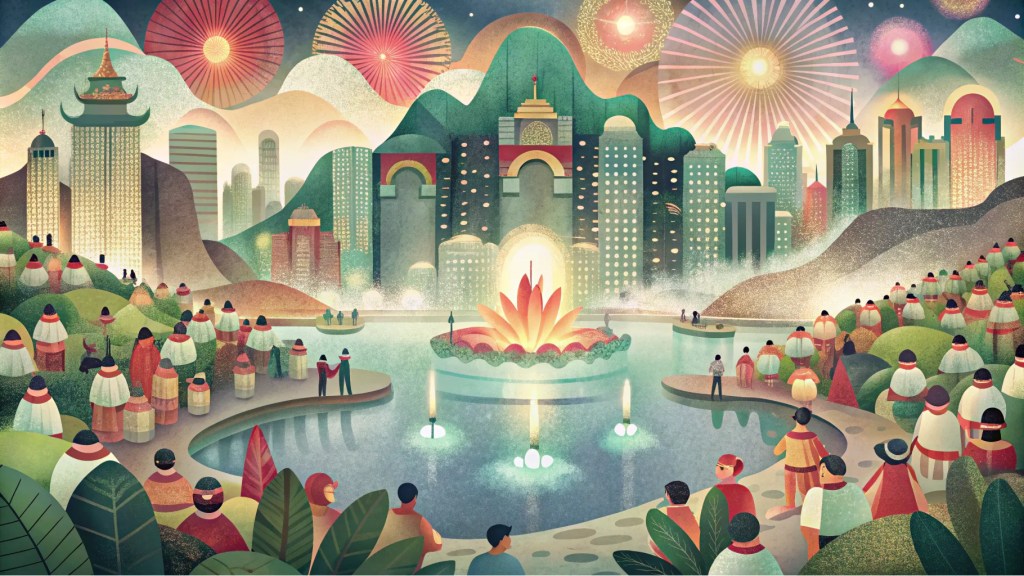
It lives in the smell of incense mingling with the sound of evening prayer. In the negotiation of calendars—Ramadan overlapping with Navaratri, Diwali lights glowing not far from Eid sweets. In the careful explanations parents offer children, not to convince them of one truth over another, but to help them understand why differences exist at all.
In India, such households are not anomalies. Despite political narratives that insist otherwise, interfaith families have existed for generations—sometimes openly, sometimes quietly, often resiliently. In these homes, children learn early that faith is not always singular and that love does not require uniformity.
What they absorb is subtle but profound: belief can coexist.
Growing up without needing to choose
Children raised in interfaith families are often asked a question they are not yet ready—or willing—to answer: Which side are you on?
But inside the home, that question often makes little sense.
For many such children, faith is not an either/or proposition. It is a both/and inheritance. One may learn to recite prayers from different traditions or participate in rituals without anxiety about contradiction. The child learns that reverence can take many shapes and that meaning does not collapse simply because it is plural.
This can be confusing at times, yes. But it is also liberating.
Rather than being handed certainty, these children are handed curiosity. Rather than being told what to believe, they are shown how belief works—how it is lived, practiced, questioned, and sometimes changed.

Faith as practice, not performance
In interfaith homes, faith is rarely performative. It is not about proving allegiance. It is about practice. You learn that prayer can be silent or sung. That devotion can be solitary or communal. That some rituals are public, others intimate. You learn that what matters is not how loudly belief is declared, but how gently it is carried.
This often results in a particular kind of spiritual temperament—one that values sincerity over symbolism, ethics over proclamation. For such children, belief is less about identity and more about orientation: How do I move through the world? How do I treat others? What do I do with suffering, joy, loss? These questions cut across religious boundaries. And interfaith homes make that visible early.
The quiet skills interfaith children develop
There are skills that interfaith children develop almost unconsciously. They learn how to translate between languages, rituals, and emotional registers. They learn how to sit in rooms where not everyone agrees. They learn that difference does not always need resolution. Sometimes it simply needs respect.
They also learn discernment. Growing up with more than one worldview nearby teaches a child that no single tradition has a monopoly on truth—or on compassion. This does not dilute faith. If anything, it deepens it.
For some, this leads to a strong commitment to one tradition later in life. For others, it results in a more eclectic spirituality. For still others, it opens a secular path grounded in ethical clarity rather than religious affiliation. None of these outcomes are failures. They are expressions of choice, something interfaith homes uniquely allow.
The emotional labor—and the gift
Despite everything I have said earlier, it would be dishonest of me to romanticize interfaith upbringing entirely. Children from such families often carry emotional labor that others do not. They may feel pulled between communities or pressured to explain themselves repeatedly. They may encounter suspicion, especially in times of social or religious polarization.
In India in particular, interfaith families—and their children—can find themselves scrutinized, politicized, or misunderstood. The home becomes a sanctuary not just from difference, but from hostility. And yet, within this complexity lies a gift.
Interfaith children often develop a deep sensitivity to context. They understand that truth can sound different depending on where you stand. They become attentive listeners. They learn to navigate nuance—an increasingly rare skill in a world that rewards certainty over understanding.
To grow up between traditions is not to live with less faith, but to learn early that belonging can be layered, and love does not require uniformity.
A quiet inheritance
I have watched how an interfaith home challenges some of our most entrenched assumptions about religion, without ever announcing that it is doing so. It has shown me that faith is not as fragile as one fears—that it does not collapse when placed beside another belief system, and that devotion need not depend on exclusion. And I have seen up close that in homes where difference is lived rather than debated, love stretches across metaphysical boundaries without tearing.
To grow up interfaith is to grow up at a threshold: not fully inside one world, not entirely outside another. It is a liminal position—uncomfortable, yes, but alive. This is where I learned that identity does not arrive fully formed. It unfolds in standing between two prayer rooms, in choosing which festival clothes to wear first, and in overhearing two different blessings before a meal.
When I look for the legacy of these homes, it is tempting to search for outcomes or conclusions. But the real inheritance is quieter. It is the ability to sit with contradiction without panic. To honor difference without fear. To recognize the sacred without needing to name it the same way each time.
In a country like India, where religious identity is increasingly politicized and simplified, interfaith families offer no manifesto. They offer something far more radical: proof that coexistence is not theoretical—it is domestic. And perhaps that is where the most enduring lessons about faith are learned—not in texts or debates, but in kitchens, living rooms, and shared celebrations, where children watch adults choose love over certainty, again and again.




Leave a Reply