


Some meetings are planned. The better ones are arranged by something else.
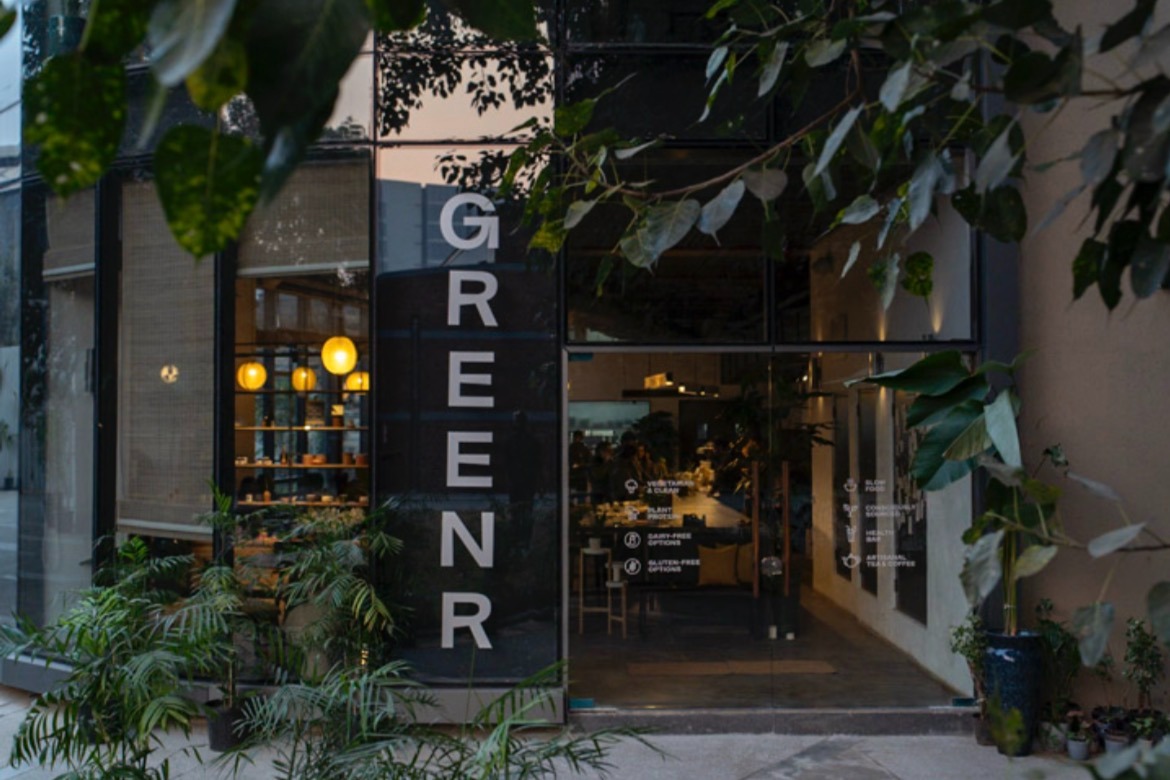
On my last visit to Swami Rama Sadhaka Grama in Rishikesh, I fell into conversation with a warm, soft-spoken woman, a long-time devotee, as was her husband. A little later I met her son. We chatted the way people do in ashrams, without hurry or agenda, and he mentioned that he had started a cafe chain called Greenr.
I nearly jumped. Greenr! I had eaten there, and it had been a delight. I visited their 32nd Avenue outlet in Gurugram and tried the Lion’s Mane Mushroom Tacos and the Truffle Mushroom Pizza, both were great. Also the Chocolate Ganache was heavenly.

And here was the man who dreamt up that menu, sitting quietly among sadhakas on the banks of the Ganga.
That is serendipity, and I was not about to waste it. Some weeks later, I sat down with Nitin for a proper conversation. What I expected was a story about food. What I got was a story about dharma.
Almost 35 per cent of Indians are vegetarian, yet outside Indian cuisine they were being served the bare minimum. So Greenr was built on a simple, stubborn question: why should meat eaters have all the fun?
The man who refused the paneer burger
Nitin has been vegetarian all his life, and he has lived that life across continents: Africa, South America and, for about 15 years, the United States. Not once, he says, did he feel deprived. “There was enough variety in every cuisine, whether Indonesian, Chinese, American or Indian.”
The deprivation began, of all places, when he came home. “I was missing my smoothies. I was missing interesting pastas, pizzas, and burgers,” he recalls. In India, continental food for vegetarians meant one thing – Paneer.
“It’s a safe play,” he says, “but if I can use the word, it’s also a lazy way of handling it. We’re not against paneer. But there are so many beans and lentils and vegetables. Why can’t you be more innovative?”
He saw a large gap. By his estimate, 30 to 35 per cent of Indians are vegetarian, yet outside Indian cuisine they were being served the bare minimum. So Greenr was built on a simple, stubborn question: why should meat eaters have all the fun?
From day one, the cafe made California-style food for vegetarians and non-vegetarians alike. And there is still no paneer burger on the menu.

Continental food, Indian soul
Nitin designs the menu with his chefs, guided by two convictions.
The first is that eating plants is kinder to a warming planet. The second, which he pursues just as deliberately, is clean eating: no processed ingredients, and as many indigenous ones as possible. Greenr does not use quinoa; it uses amaranth, its Indian cousin. Millets turn up everywhere. Plant milks and sauces are made in-house, because anything packaged needs preservatives.
Ask him for the one dish that sums up Greenr and he does not hesitate: the ragi nachos. The chips are made largely of ragi, with a little corn for familiarity. The cheese sauce is made from cashews. The spirit is what he calls Baja Mex, fresh and Californian, with protein, carbs and fibre in balance. It is entirely vegan, and entirely Indian underneath.
Then there is the story he loves to tell. In the early days, the kitchen created spaghetti with “meatballs” made of mushrooms, nearly 15 ingredients minced, smoked and rolled together. One day a customer from Kerala, a committed meat eater, wandered in unawares. He took a chance on the dish. He loved it.
“His reaction gave us a lot of hope,” says Nitin. “If someone who is a sworn meat eater could enjoy this, there was a lot of potential.”
That instinct, vegetarian food for non-vegetarians, later became the subject of a business school case study on Greenr’s blue ocean strategy, published by Canada’s Ivey Publishing. Nitin believes Greenr remains the only national brand that pairs plant-based food with clean eating, at a time when most meat substitutes on the market are heavily processed.
The conscious entrepreneur keeps greed on a leash and builds something of larger value to society while staying profitable. He believes people can tell the difference. “When they realize your intention is to support the larger good, they will support you as a business as well.”
The lean years
None of this came easily. Greenr began on the second floor in Shahpur Jat, the charming urban village in New Delhi, above a store selling sustainable clothing and home decor. The founders had imagined a whole concept store. They soon realised they were too small to do everything, and chose food.
“The numbers were good, but not that encouraging in the first year or two,” Nitin admits. “And in this business the costs are very high. I had doubts.”
The turning point was Gurgaon, a more mainstream location. “It will never be like a normal business that is also selling alcohol and meat. But could we at least survive and be profitable? Gurgaon gave us the confidence that we could.” Vasant Vihar followed in early 2019, within months.

Losing the ‘I’
Nitin trained as an engineer and worked in technology before deciding he wanted his work to give something good back to the world. Wellness, health and sustainability, he says, are different faces of the same coin, and food became his vehicle for all three.
He has also spent time in ashrams, and it shows in how he speaks about business. I asked him what building Greenr had demanded he let go of.
“Entrepreneurship is very risky. A new product, a new menu, a new market, and sometimes ahead of its time, which is the worst thing for a business,” he laughs. “It challenges your growth at many levels, because growth is about facing the unknown, embracing your fears and transcending them.”
The ashram gave him one kind of discipline. The cafe, he suggests, gave him a tougher one. “You lose that sense of yourself at some point. You have to. Otherwise it is not possible.”
And success, when it comes? “You cannot take the credit. The vision is not yours. You are just a channel. If Greenr is succeeding, it is because of the goodwill of so many people, and because the power that brings goodness into the world is also supporting you.”
Whether one calls that power God or something else, he is not fussy. What matters is the feeling that the work is bigger than the worker. “Walking that path is your dharma,” he says.

Business, but conscious
For the past 15 to 20 years, Nitin has tried to work only in what he calls conscious businesses. His definition is refreshingly unsentimental.
A conscious businessperson is simply an aware one, aware, first of all, of their own self-interest. Profit matters: there are salaries to pay and investors to answer to. “But do you let that decide everything? Or is there also a vision the business is trying to fulfil?”
The unaware entrepreneur lets greed run unchecked. The conscious one keeps it on a leash and builds something of larger value to society while staying profitable. He believes people can tell the difference. “When they realize your intention is to support the larger good, they will support you as a business as well.”
A business serving only narrow interests, he feels, can never be a force for positive change. Still, he declines to preach. “I’m not going to say what is right or wrong. We choose to be more aware, to create a positive impact, and to balance that with profit.”
The healer’s own health
How does a man who feeds others well look after himself? Not easily: the restaurant trade runs on late hours and a heavy mental load.
“With this kind of lifestyle you have to pay extra attention to your body and your mind,” he says. Eating at the cafe helps; the rest is discipline, from fixed mealtimes to fewer late nights.
He does not pretend to have mastered it. “Hopefully, when things are a little more settled, we can take a back seat and focus more on our own health. Until then, you just have to be more conscious.”

Greenr: A home, with a kitchen attached
Greenr was never meant to be only an eatery. Nitin credits his co-founder, Mohit Yadav, with building its other half: community.
“The food is the reason, or maybe the excuse,” he says. The real offering is a safe space for people who do not quite fit into a fast, aggressive, one-dimensional world. People come to meet, host events, work, or read a book. Some regulars come simply to paint. All ages and all walks of life are welcome.
“It is a small microcosm of the world we want to see,” he says. “A greener, better world.”
He is candid about where Greenr falls short. Food waste is well managed and deliveries use biodegradable packaging, but the kitchens still need some plastic for storage. Better biodegradable films are “what we are working on next.”
What he wishes for India
Nitin is hopeful about where Indian food is heading. Greenr, he says, played an enabling role, but he credits the “much smarter and more capable” entrepreneurs who followed with clean-label products. Influencers now urge people to read labels, and many do. For a country as populous as ours, he adds, a plant-based diet is simply the sensible one. His wish is modest and large at once: more vegetarianism, more clean eating, more awareness of what we put into our bodies. “It will never be complete. But we are moving in that direction. That is very clear.”
I asked what he hopes people carry with them when they walk out of Greenr. He distilled it into a line worth pinning on a kitchen wall: “Eating good, sharing what’s good, and being good.” Be good to yourself, then share that goodness with others and with the planet. Food, he says, is a beautiful way to do it.
And for those dreaming of a cafe of their own, his parting advice is bracing. “Don’t come into it for the lifestyle. Be very clear, because everything is becoming tougher now and business is not easy. Come with a clear vision of what you want to achieve, and be committed to the process.”
I came away thinking of that first conversation in Rishikesh. It no longer seems strange that I found a restaurateur in an ashram. Nitin Dixit has simply moved his sadhana into the kitchen.
So the next time a craving strikes, walk into a Greenr. Order the ragi nachos. Take along your most devoted meat-eating friend, and say nothing. Let the food do the talking.
For more details:
https://www.instagram.com/begreenr

Leave a Reply