


Food has been given an overriding importance in our collective understanding of health. Often, food means anything edible, as defined by our nutrition standards. Many also assume that regular food intake alone meets the body’s nutritional requirements.
Yet, we often overlook a vital truth: only absorbed nutrition is nutrition — the rest is a waste. Nutrients can be absorbed only when the body functions efficiently at every level. Thus, efficient functioning is the real foundation of health. Food, though essential, is merely one of several life-sustaining factors.
Today, we are bombarded every second with information about diet and nutrition — and yet, the “disease-treatment” industry continues to grow exponentially. It may be time to take a deep breath and refocus our attention on life, existence, and health itself.
The Cosmic Blueprint of the Human Body
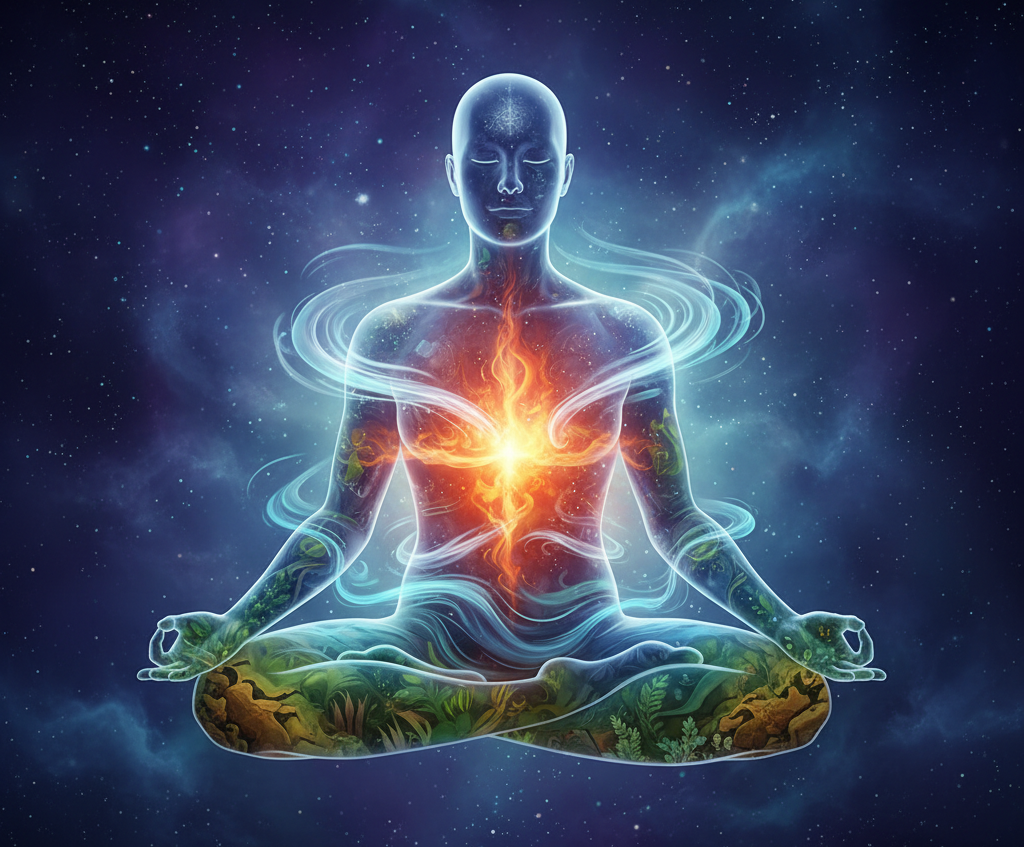
The human body is a microcosm of the universe — a tiny reflection of the infinite. The idea that ‘the same cosmic principles pervade all life forms’ is a central thread running through the Vedic, Upanishadic, Ayurvedic, Siddha, and Yogic traditions. The ancient seers did not see humans as separate from creation, but as one manifestation among countless others of the same elemental and spiritual matrix.
The Vedic and Upanishadic worldview begins with the assertion that the entire universe is Brahman — a single, conscious reality expressing itself in infinite forms. The same Panch Mahabhutas (Five Great Elements) and Prāna (life-force) permeate every form of existence — from an insect to a star.
From this understanding arose the principle of Loka-Puruṣa Sāmya, which teaches that the laws that govern the universe also govern the human being. By this principle, plants, animals, and humans are all animated by the same elemental forces — Earth gives structure, Water offers cohesion, Fire drives metabolism, Air enables movement, and Ether provides space.
Ayurveda — the Science of Life — views herbs, minerals, and all substances as living expressions of these five elemental forces. A plant’s healing power arises from its specific balance of Mahābhūtas, mirroring the body’s own.
“Every being, animate or inanimate, is born of the same elements and sustained by them.”
~ Charaka Saṃhitā, Sūtra Sthāna 26.10–12
The Siddha tradition takes this cosmic view even further. Here, all beings — human, animal, plant, and mineral — are manifestations of one consciousness (Śivam), expressed through the Five Elements.
“What is in the cosmos is in the body;
what is in the body is in every creature;
there is nothing apart from the Five Elements.”
~ Thirumandiram, Verse 1851
Thus, the Panch Mahabhutas are not unique to humans; they are the cosmic language of creation — the grammar of existence itself.
A Universal Science of Harmony
The concept of the Five Fundamental Elements (Panch Tattva) as the basis of life is not confined to India. From ancient Greece and China to Egypt and Tibet, it appears in many cultures worldwide, often at the core of their cosmology, medicine, and philosophy. Though the names and emphases may differ, nearly every ancient civilization recognized that the material world is composed of a handful of primal forces or substances deeply connected to our health and life energies.
Across time and culture, sages and scientists reached the same conclusions:
- Every life form, from microbe to mountain, is built of the same five principles.
- The difference lies only in proportion and expression, not in essence.
- Health means living in harmony — both within ourselves and with all beings.
- When we eat, breathe, and live in rhythm with nature, we restore the same balance that sustains the cosmos.
True health is not something that can be gained by logic; It must be lived instinctively and experientially. If we make just calories, proteins and vitamins — all measured in coffee spoons — the basis of our grand and complex existence, we cannot ever know health in the true sense.
Nourishment, vitality, and sustenance arise only when all five elements are balanced in our system, both physiologically and spiritually. To achieve this, we must draw energy and nourishment from all of them each day.
Sage Agasthya, revered founder of the Siddha Health System, sums it up so beautifully: “Perfect health is not the silence of disease, but the song of harmony among body, mind, and soul.”
He taught that disease originates in the mind, disturbs the pranic flow, and ultimately manifests in the body. Healing, therefore, must begin at the subtle — mental and pranic — level.
When the Five Elements are in balance, life becomes a symphony: vitality deepens, absorption improves, and well-being flows naturally. Consciously connecting with each element — or what we may call the Fivefold Food Medicine — each day enhances our life energies and improves every function of the body. This naturally improves our nutritional uptake from food.
The Five Elements and Their Balancing Practices
Ether (Ākāśa) Element
The all-pervading Akash Tattva represents expansiveness, openness, receptivity, awareness, silence, and spiritual connection. It holds all the organs and the body processes together. Being a medium for vibration, communication, and consciousness, it supports hearing, speech, and subtle perception.
We can enhance and balance the Ether Element through Meditation, silence, mantra chanting, conscious fasting, conscious breathing, and practicing stillness. Above all, tuning in by waking up before sunrise (Brahm Mahurat) expands the Ākāśic field within us, and our mind resonates with that spacious stillness.
At dawn, Prāṇa (life-force) flows more harmoniously in the atmosphere. When we breathe consciously at sunrise, the Prāṇa awakens the Ether element in the consciousness, thereby increasing lightness, alertness, and mental expansion. During this time, the veil between the inner and outer worlds is thin, sharpening perception, meditation, and intuition. It helps us in harmonizing the circadian and cosmic rhythms.
To awaken the Ether Element:
- Wake up 45–90 minutes before sunrise.
- Sit quietly or meditate before speaking or engaging with the world.
- Practice deep, slow breathing or alternate nostril breathing.
- Listen to subtle sounds — birdsong, mantra, or silence itself.
- Keep your surroundings light and uncluttered as outer space reflects inner space.

Air (Vayu) Element
Movement, rhythm, and dynamism are the essential qualities of the Vayu Tattva. It is a subtler aspect of air that enables motion, communication, and exchange — both within the body and with the outside environment. It represents movement, rhythm, and life force that permeates and operates every aspect of our existence. It governs the movement of breath, circulation, nerve impulses, thoughts, and elimination.
Vayu embodies the vital life-force (Prāṇa) in its five forms — Prāṇa, Apāna, Samāna, Vyāna, and Udāna — and the five subsidiary or secondary prānas, known as the Upa-Prānas or Upa-Vayus. At the mental level, Vayu enables creativity, inspiration, and flexibility.
We can create balance in the Air Element through
- Pranayama (conscious breathing);
- Air bath, where we allow ourselves to be surrounded by the pranic touch of the playful breeze in whatever manner possible: walking, playing, sitting, meditating.
True health is not something that can be gained by logic; It must be lived instinctively and experientially. If we make just calories, proteins and vitamins — all measured in coffee spoons — the basis of our grand and complex existence, we cannot ever know health in the true sense.
Fire (Agni) Element
The Agni Tattva is responsible for heat, light, vitality, intelligence, and transformation, and controls digestion, metabolism, and body temperature. It manifests as Agni (digestive fire) at the physical level and Tejas (radiance) at the subtle level. The fire element transforms food into energy and ignorance into understanding. That’s how the saying goes: Light (knowledge) removes the veil of darkness (ignorance).
The following will help to enhance and balance the fire element in us:
- Sunbathe in early hours; take the light and not the heat of the morning sun.
- Consume what we call Sun-cooked (directly ripened in the sun) herbs, fruits, and vegetables, as much as possible;
- Regular practice of Surynamaskar, and chanting the Surya mantra.
Water (Apa / Jal) Element
Jal Tattva’s essential quality is reflected in flow, cohesion, lubrication, and emotion. It makes up fluids such as plasma, lymph, saliva, blood, and intercellular fluids, which maintain the lubrication and smooth functioning of our organs and joints. The water element also helps in digestion by dissolving and transporting nutrients. Above all, it gives us emotional balance—compassion, love, empathy, and adaptability.
Ways to keep the water element in balance:
- Drink water from pure and natural sources. Since our bodies are 70 per cent water, it is best we keep them as pure as possible.
- Use water’s therapeutic properties through various types of baths.
- Consume fruits, vegetables, and juices from natural sources as a major portion of our daily dietary intake.

Earth (Prithvi) Element
The Earth element gives our body structure (bones, muscles, teeth, skin, and tissues), stability, endurance, and solidity, in the process providing grounding, strength, and immunity. At the mental level, it gives steadiness, patience, and confidence. In the body, it works with the Water Element to build form, and with Fire to sustain metabolism.
Ways to enhance the Earth element:
- Consume foods from pure, unadulterated soils — natural and minimally processed.
- Walk barefoot on earth or grass to absorb Mother Earth’s healing energies; they ground us and strengthen our nervous system.
- Engage in gardening or spend daily time in nature.
The principle of Loka-Puruṣa Sāmya teaches that the laws that govern the universe also govern the human being. By this principle, plants, animals, and humans are all animated by the same elemental forces — Earth gives structure, Water offers cohesion, Fire drives metabolism, Air enables movement, and Ether provides space.
Health from Elemental Awareness
Conscious living means being mindful of the omnipresence of the Five Great Elements and their influence on every aspect of life. Ayurveda’s concepts of Ritucharya (seasonal rhythm) and Dinacharya (daily rhythm) are both woven around elemental activity.When our elemental energies are balanced and harmonised, nutrition and vitality reach their highest potential, ensuring complete physical, mental, and spiritual well-being.
Though each element is most active at certain times of the day, following these principles will lead us steadily towards wholesome, natural health.


Leave a Reply