
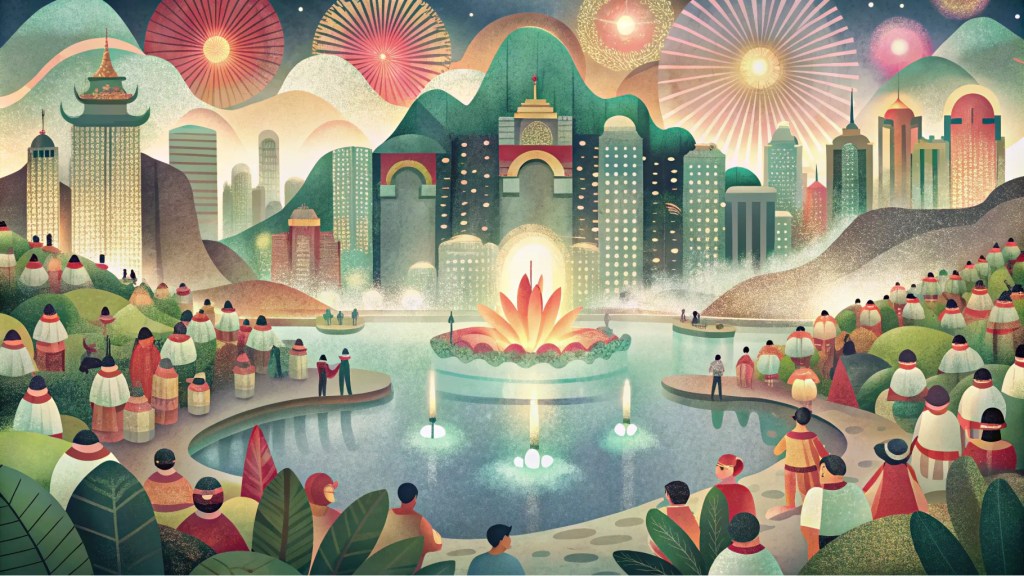

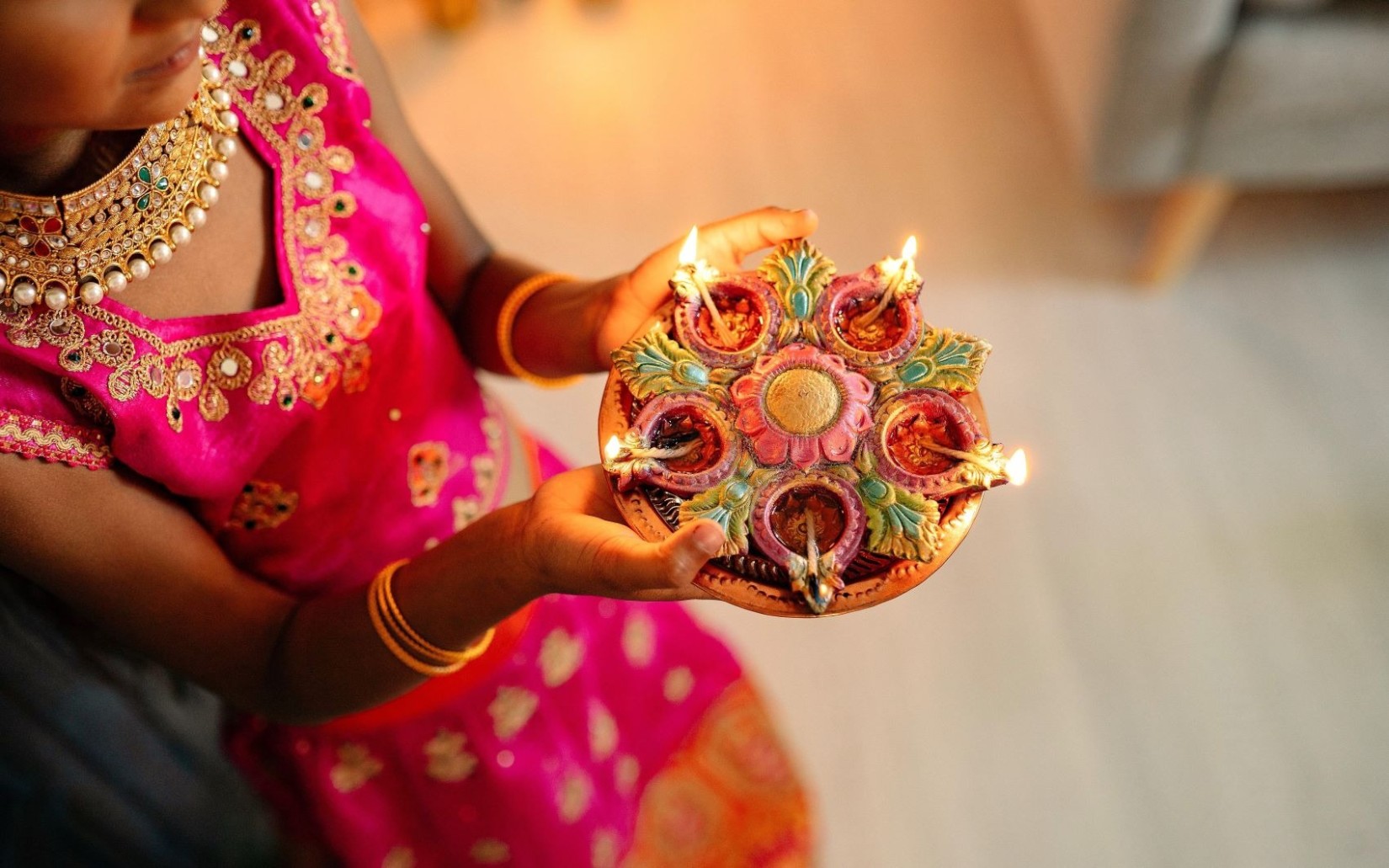
What do we do when someone dear to us returns home after a long absence? We light up our homes, illuminate our streets, and decorate our doorways. Light has long been one of humanity’s most instinctive expressions of joy, affection, and welcome. It turns an ordinary evening into an occasion and a familiar home into a place of celebration.
Few festivals capture this sentiment as vividly as Deepawali, or Diwali. According to the Ramayana, when Lord Rama returned to Ayodhya after 14 years of exile, his homecoming marked the end of an arduous journey. His years away from home had been marked by extraordinary trials: the abduction of his wife, Sita, the battle with Ravana, and the near-fatal injury to his younger brother, Lakshman. His return was celebrated as a triumph of good over evil. To welcome their beloved king, the people of Ayodhya illuminated the city with rows of earthen lamps. Thus, the celebration was called Deepawali
The name Deepawali comes from two Sanskrit words: deepa, meaning lamp, and avali, meaning row. It means a row of lights. Centuries later, the tradition endures. Across India, homes continue to glow with diyas, candles, and strings of electric lights, renewing the festival’s enduring association with hope, renewal, and the triumph of light over darkness.
But Diwali is more than a story of lamps and a homecoming. Its meaning shifts across India’s vast cultural landscape. The deities worshipped, the rituals observed, and even the foods prepared can change dramatically from one region to another. The result is a festival that is at once recognisably Indian and remarkably diverse.
The deeper symbolism of Diwali
Diwali carries layers of spiritual and cultural meaning. It celebrates the victory of good over evil, knowledge over ignorance, and light over darkness. For many, it is also an occasion to seek prosperity, invite new beginnings, and renew relationships with family and community.
At the heart of celebrations in much of North India is Lakshmi-Ganesha Puja. Homes are cleaned and decorated, rangolis adorn entrances, diyas are lit, and families exchange sweets and gifts. The rituals are not merely decorative preparations; they are also acts of welcome, intended to invite auspiciousness and abundance into the household.
Why is Goddess Lakshmi worshipped on Diwali?
Goddess Lakshmi’s association with Diwali is rooted in ancient Hindu mythology. According to the popular account of the Samudra Manthan, or the churning of the cosmic ocean, Lakshmi emerged from the Kshira Sagara during the churning on Kartik Amavasya, the new-moon night of the Hindu month of Kartik.
Her appearance is celebrated as a symbol of beauty, abundance, and prosperity. Devotees pray for wealth, well-being, and prosperity, seeking blessings not only for material comfort but also for harmony and abundance in their lives.
Why are Goddess Lakshmi and Lord Ganesha worshipped together?
There is an interesting aspect of Diwali worship: why is Goddess Lakshmi worshipped alongside Lord Ganesha rather than Lord Vishnu, whom she married?
The pairing carries a symbolic message. Goddess Lakshmi represents wealth, abundance, and prosperity, while Lord Ganesha is revered as the remover of obstacles and the bestower of wisdom and auspicious beginnings. Together, they represent the importance of bringing discernment and good judgment to the pursuit of material well-being.
According to legend, it is said that Goddess Lakshmi once expressed a desire to experience the joy of motherhood. Goddess Parvati offered her son, Ganesha, as her adopted child. In return, Lakshmi blessed him with her powers and prosperity. Since then, the two have been worshipped together during Diwali, with Ganesha invoked first to ensure that auspiciousness and wisdom accompany wealth.
The symbolism is worth reflecting on: prosperity alone does not guarantee fulfillment. Wealth acquires greater meaning when accompanied by wisdom, generosity, and the ability to use it well.

One festival, many Stories: India’s cultural diversity
India’s diversity is perhaps nowhere more apparent than in its festivals. Diwali is a case in point. Although the festival is widely celebrated across the country, its rituals and underlying stories are far from uniform.
In the National Capital Region, Diwali often unfolds on a grand scale, with illuminated markets, decorated homes, elaborate community celebrations, and fireworks.
Elsewhere, the festival may be quieter, more closely tied to agricultural life,
ancestral remembrance, or local deities. The differences are not merely in how people celebrate; they are also in what they celebrate.
In Odisha, for instance, Diwali is marked by a striking ritual of remembering ancestors. Sevashree Mohapatra, a journalist-turned-communications specialist whose roots lie in the state, recalls how her understanding of the festival changed between Delhi, where she grew up, and Odisha, to which she remains connected.
“Growing up in Delhi, Diwali meant Lakshmi Puja, crackers, and diyas. But I find Odisha’s Diwali celebration deeply fascinating. At dusk, families gather with bundles of burning jute sticks, their eyes turned to the sky, calling their ancestors home: Bada badua ho, andhaara re aasa, alua re jaa. It means come from the darkness, walk towards the light,” she told A Louts In The Mud.
“Equally special is Govardhan Puja, where agricultural tools and the earth’s bounty are honored,” says Sevashree, currently working as Director of Corporate Communications at CoinDCX.
The festival’s regional character extends to the dining table, too. While many households have embraced the familiar assortment of sweets exchanged across India, some Odia families continue to prepare traditional delicacies.
“While most people have now moved to common Indian sweets, some families still prepare traditional Odia sweets such as kakera (a crisp fried pastry filled with coconut and jaggery), manda (a steamed rice dumpling with a sweet coconut filling), chakuli (a soft rice and lentil pancake), and arisa (a fried rice-flour and jaggery cake), keeping the flavors of the past alive on the plate,” explains Sevashree.
In rural Madhya Pradesh, Diwali traditions retain a close connection with cattle and agrarian life. For farming communities, animals are not simply part of the household economy; they are also essential to the rhythms of rural existence.
“We light diyas on Diwali, feed salt to our cows and oxen, and paint their horns with a mixture of geru (red ochre) and ghee. On Parwa, the next day of Diwali, men take out a procession from a temple in the evening. They smear colors on their faces, dress in worn-out clothes, carry sticks and a bouquet of peacock feathers in hands dancing on the beats of dhol,” says Manisha Devi, a farmer from Madhya Pradesh’s Damoh district.
In Bihar’s Mithilanchal region, another distinctive ritual takes place on Diwali night. Known as Hukka-Pati, it is observed to ward off poverty and welcome Goddess Lakshmi into the household.
In this ritual, a male member of the family takes a bundle made of sunn hemp rope and dried jute stalks, known as santhi. He touches it three times to the doorframe of the puja room while chanting, “Lakshmi ghar, dariddar bahar”—Lakshmi inside, poverty outside. The bundle is then carried outside and burnt near the main entrance. According to local lore, Angaraj Karna is associated with the practice.
Another Diwali tradition in the region centers on gharondas, miniature houses made with cardboard or brick and mortar or soil and sticks and decorated by children. The custom reflects the belief that Goddess Lakshmi visits homes on Diwali night and should be welcomed into clean, beautifully adorned surroundings.
“On Diwali, Goddess Lakshmi visits homes. People clean their houses and decorate them with vibrant colors to welcome her. Children, too, participate by creating miniature homes, known as gharondas, symbolizing their future homes. They decorate these little structures in different colors, hoping to invite Goddess Lakshmi and receive her blessings.
“The gharondas are filled with tiny earthen pots containing grains and sweets and illuminated with little diyas,” says Rajkumari Sinha, a retired teacher from Chaibasa, now in Jharkhand.
The regional variations extend to the deities at the center of the celebrations.
In West Bengal, Assam, and parts of eastern India, the new-moon night of Diwali is devoted to Goddess Kali. Kali Puja, often marked by elaborate pandals, offerings, and night-long rituals, takes precedence over the Lakshmi-Ganesha worship more familiar in North India.
In South India, particularly Tamil Nadu, Karnataka, Andhra Pradesh, and Telangana, Deepavali is closely associated with Lord Krishna’s victory over the demon Narakasura. Therefore, Diwali is observed as Naraka Chaturdashi, which celebrates the destruction of evil. Celebrations often begin before sunrise with an oil bath, prayers, new clothes, and festive food.
One festival, many meanings
From the lamps of Ayodhya to the ancestral calls of Odisha, from the cattle-centered customs of rural Madhya Pradesh to the Kali Puja pandals of Bengal, Diwali reveals a country that celebrates one festival through many cultural lenses.
Perhaps that is its enduring appeal. The rituals may differ, the stories may change, and the celebrations may take different forms, but the impulse remains familiar: to welcome light, honor what sustains us, remember those who came before us, and make room for hope.
This Diwali, experience the grandeur of Ramayana: Rise of a Legend

This Diwali, immerse yourself in the spectacular world of ‘Ramayana: Rise of a Legend’, starring Ranbir Kapoor and Sai Pallavi in lead roles. Directed by Nitesh Tiwari, the film is making headlines for its staggering reported budget of Rs. 4,000 crore, cutting-edge visual effects, and grand cinematic scale.
With visual effects studios DNEG and ReDefine, led by producer Namit Malhotra, bringing the epic to life, expect breathtaking mythological kingdoms, sprawling landscapes, and spectacular battle sequences.
Adding to the film’s grandeur is its musical collaboration between Oscar-winning composer AR Rahman of Slumdog Millionaire fame and Hollywood maestro Hans Zimmer, known for scores in Gladiator, The Dark Knight, and Dune.
A visual extravaganza in the making, the film promises to bring the timeless epic to the big screen on an unprecedented scale.

Leave a Reply