

My God or deity need not be seen only in the temple or the church. Hinduism democratizes the darshan by letting you have a shrine at home, installing one or several deities. Including images or symbols from other religions is no problem, either.
An image of the divine in the home was traditionally in the form of small icons made of clay or metal. My grandmother had an alcove in her kitchen where she worshipped a blue baby Krishna (called Thakurji) sitting in a silver metal bed. At night she would cover Thakurji with a velvet cloth, and in the morning uncover the icon, bathing it.
However, the advent of print technology transformed the presence of deities in Indian homes. With the introduction of photography and chromolithography in the mid-19th century, affordable, colorful prints of gods and goddesses became accessible to ordinary households.
An exhibition at The Metropolitan Museum of Art (also called The Met) in New York City chronicles how, in the mid-19th century, first photography and then the chromolithographic press were introduced into India.
“The latter permitted the production of inexpensive prints of the Hindu gods for mass consumption. These proved immensely popular, and for the first time in India, even the humblest home could afford a colorful icon of their chosen god to display in the household shrine,” according to the exhibition introduction.
Household Gods: Hindu Devotional Prints, 1860–1930, is an ongoing exhibition at The Met of chromolithographic prints from the pioneering studio presses of Calcutta, Poona, and Bombay (to use their earlier names). These mass-produced, affordable prints became a visible expression of the Indian religious identity at a time of the first stirrings of the independence movement in the country.
The exhibition features some 120 works, including chromolithographic prints, paintings, and portable triptych shrines. They are being shown in four rotations, running till June 2027.
The prints are sometimes derisively called calendar art. However, an art historian named R. Siva Kumar points out that “Calendar art played a crucial role in democratizing access to religious imagery by presenting deities in a more accessible, humanized manner, thus fostering a sense of intimacy between the divine and the devotee.”
The roots of calendar art can be traced back to traditional Indian miniature paintings and religious iconography. In the modern era, famous painter Raja Ravi Varma (1848–1906) was a pioneer as he set up a lithographic press in the 1890s to print oleographs of his realistic portrayals of Hindu gods and goddesses. Later, major printing hubs like Sivakasi in Tamil Nadu made the transition from high-end oleographs by distributing functional, mass-market calendars and posters of deities.
Functioning as “the people’s art gallery,” calendar art deeply influenced domestic shrines, commercial spaces, and political iconography across the Indian subcontinent.
Household Gods: Hindu Devotional Prints, 1860–1930, is on view at The Met Fifth Avenue, Manhattan, in Gallery 251. Free with museum admission. The exhibition is made possible by the Florence and Herbert Irving Fund for Asian Art Exhibitions.
Here are five of the striking prints from the exhibition:

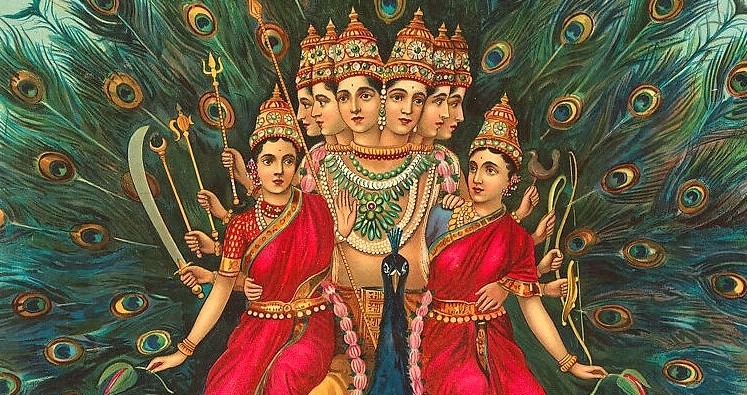
Subramanian and his wives, Mahavalli and Devasena (Shri Shanmukha Subramania Swami): The eldest son of Shiva and Parvati is Skanda, the peacock-riding god of war. Here, he is identified as Shanmukha (“Six-Faced”) Subrahmanya, a representation favored in Tamil Nadu. He is accompanied by his two wives, Devasena and Mahavalli, who hail from North and South India. Together they ride his peacock, framed by an aureole of radiant tail feathers. Skanda is much loved by female devotees. (Karla-Lonavala, Maharashtra; 1900–15)

The assembly of Rama (Uttara Rama Charitra): This scene marks the conclusion of the epic Ramayana, when Rama returns to Ayodhya to reclaim his throne after fourteen years in exile. Rama and his wife, Sita, are enthroned with their twin sons, Lava and Kusha. The throne has an elaborately carved base of lions amid lotus blossoms and acanthus leaves, a hybrid of European and Indian architectural elements much favored by print artists in Kolkata. Copied after an 1886 print by the Chitrapriyaprakesh Press, this version achieves a remarkable degree of naturalism while preserving the hieratic authority of the ensemble. (Karla-Lonavala, Maharashtra; 1910)

Dhumavati & Matangi: Dhumavati and Matangi are two of the ten Mahavidyas, tantric aspects of the great goddess Devi. This print belongs to the Calcutta Art Studio’s first series, double images intended for separation at sale. Dhumavati, embodying all that is considered inauspicious, is depicted as an aged widow with ragged clothing and unbound hair, holding a winnowing basket. Unencumbered by societal expectations, she represents a pathway to spiritual liberation. Matangi takes the form of a beautiful young woman with a blue complexion. She sits on a throne and holds an elephant goad, a sword, a club, and a noose. Matangi is a ferocious goddess whose followers call upon her to control their enemies and bestow higher knowledge. (Kolkata, West Bengal, 1885–90)

Vishnu Narayana on the divine serpent Shesha (Shri Sheshanarayana): Vishnu is seen here stirring from his slumber on the entwined coils of the primordial sea snake Shesha. Vishnu listens to his devotee Narada (modeled after a pre-eminent Bengali Vaishnava saint, Chaitanya) playing the veena, while his consort, Lakshmi, massages his legs. Vishnu holds aloft a lotus bloom from which Brahma is born. Other attendants include the kneeling Garuda; the loyal monkey-general Hanuman; and the horse-headed Hayagriva, the embodiment of knowledge. This conflation of figures reflects the distinctly Bengali perspective at which artists from Kolkata were so adept. (Mumbai, Maharashtra; 1886)

Krishna (Shri Shri Gauranga Avatara): Krishna, seen here in his six-armed form and standing on a lotus, is depicted in his flute-playing aspect. The setting is a Victorian-era theater, with drawn curtains and receding floor tiles. The painted backdrop mimics a Bengali rural landscape, with rivercraft, temples, and dwellings in a wooded setting. Krishna’s title, “Gauranga,” refers to his golden complexion. Gauranga typically appears in Puranic literature and in the context of Bengali devotionalism that references the 16th-century Bengali guru Chaitanya Mahaprabhu. Chaitanya founded Gaudiya Vaishnavism and, over time, came to be venerated as an incarnation of Krishna himself. He emphasized worship through exuberant singing and dance. (Kolkata, West Bengal, 1895)
Leave a Reply