


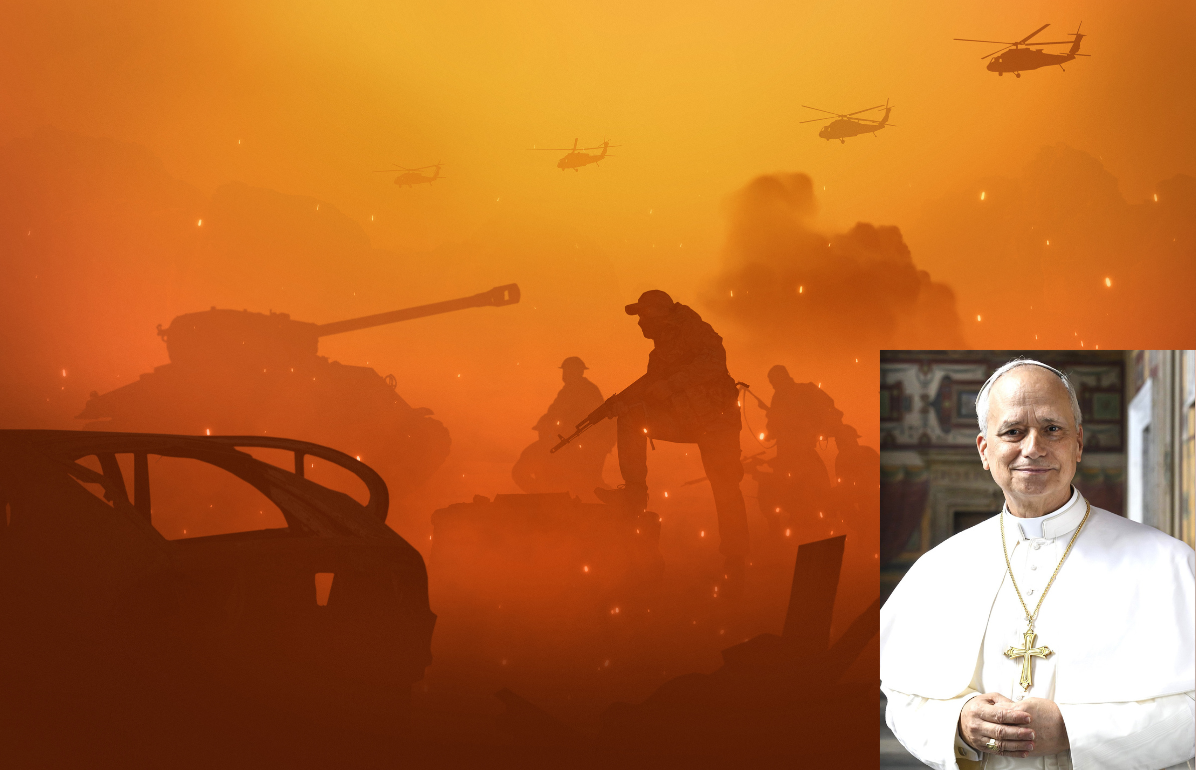
As the world watches the escalating tension between the US-Israel alliance and Iran, an old moral debate around war, justice, and peace has once again returned to the forefront. While political leaders continue to defend military action in terms of security and deterrence, religious and spiritual traditions spanning centuries have offered diverse perspectives on the ethics of war.
From the Bhagavad Gita’s call for disciplined and detached warfare to Jesus Christ’s message of radical non-violence and forgiveness, faith traditions have long wrestled with the question: Can war ever truly be just?
Now, Pope Leo has reignited that debate with a forceful rejection of the centuries-old “Just War” doctrine. In his encyclical “Magnifica Humanitas” (Magnificent Humanity), the Pope declared that the war theory “has all too often been used to justify any kind of war” and is now outdated in a world that possesses “far more effective and capable tools” such as dialogue, diplomacy, and forgiveness.
His remarks arrive at a moment when escalating military strikes and retaliatory threats in West Asia are raising fears of a wider regional conflict. Against this volatile backdrop, the Pope’s appeal revives a long-running moral debate within Christianity itself—between pacifist teachings that reject violence altogether and the classical Just War tradition developed by theologians such as Saint Augustine and Thomas Aquinas.
Jesus as Prince of Peace
For Christian pacifists, the response to conflict is rooted in the life and teachings of Jesus Christ, who urged his followers to “love your enemies,” “turn the other cheek,” and reject retaliation.
They see Jesus not as a military liberator but as a messenger of peace whose life exemplified forgiveness, compassion, and non-violence. This is reinforced by the prophecy in Isaiah 9:6, which foretells the coming of the Messiah and describes him as the “Prince of Peace”—a title that continues to shape Christian pacifist thought and its rejection of war as a means of resolving conflict.
Just War Theory
While the early Church largely embraced a tradition of non-violence inspired by the teachings of Jesus, the development of the Just War doctrine by theologians such as Saint Augustine and Thomas Aquinas led to the acceptance that the use of force could, under exceptional circumstances, be morally justified.
The theory sought to reconcile the sanctity of human life with a state’s duty to protect its citizens, uphold justice, and defend the innocent.
Consequently, while pacifist denominations continue to reject violence altogether, many Christians maintain that military action may be ethically permissible in cases of self-defense, the protection of vulnerable populations, or the restoration of peace.

War and Bhagavad Gita
Interestingly, similar ethical questions around war and restraint also emerge in the Bhagavad Gita (Chapter 2, Verse 38), where Lord Krishna urges Arjuna to rise above emotions such as hatred, revenge, triumph, and personal gain before entering battle. While the text does not reject war outright, it insists that warfare must be governed by discipline, self-restraint, and moral responsibility rather than vengeance or domination.
This intersects closely with the principles of Just War theory developed by Christian thinkers, who argued that even when war becomes unavoidable, it must be fought with “right intention” and within ethical limits.
Modern world views on war
Modern Just War theorists and International Humanitarian Law stress proportionality, civilian protection, and restraint in conflict.
However, modern views on Christian non-violence vary. While peace churches still strictly hold to pacifism, other Christians argue that the use of force is sometimes a necessary and moral requirement to protect vulnerable individuals from aggressors.
While Just War theorists argued that war could be morally permissible under limited circumstances—such as self-defense, protection of innocents, and restoration of peace—they also insisted that it must be guided by restraint, proportionality, and right intention.
Pope Leo’s rejection of the doctrine reflects growing concern that in modern conflicts, those moral boundaries have increasingly blurred, with civilian casualties, mass displacement, and retaliatory cycles exposing how easily the language of “just war” can be used to legitimize prolonged violence.
Conclusion
Against the backdrop of the ongoing US-Israel confrontation with Iran—justified largely on grounds of deterrence and security—these religious and philosophical teachings raise uncomfortable moral questions: Is war being waged out of necessity and justice, or has strategic interest and retaliatory politics overtaken ethical restraint?
Both the Gita and Christian pacifist thought, despite their differences, ultimately caution against warfare driven by ego, revenge, and the dehumanization of the enemy.

Leave a Reply