


I am an Indian immigrant and wish well for both the US and India. I strongly believe that inculcating the wisdom of the Bhagavad Gita in young minds can help both countries.
America today stands divided to an extent I have never seen in my 60-plus years here. Gita can point a pathway to bridge the national divide, which will also postpone the decline of the world’s number one country.
In the case of India, after a decade of decline, it is now rising again. I had predicted the rise of India in the 1990s (see my article, On the Cyclical Nature of Excellence). The lessons of the Bhagavad Gita will accelerate India’s rise to a developed nation and potentially make it a Vishwa Guru.
In India, of course, introducing the study of Gita in schools and colleges has been debated, but not correctly understood.
The Profound Wisdom of Bhagavad Gita
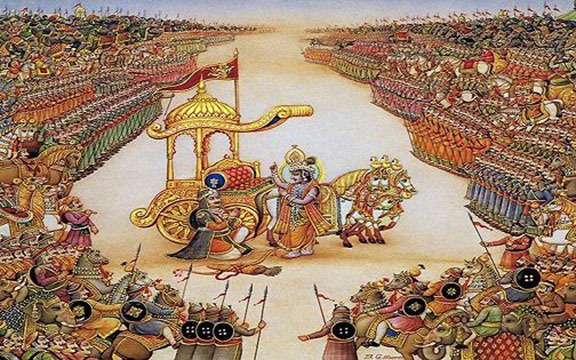
The Bhagavad Gita is set in the midst of the great war, Mahabharata. Arjuna is despondent upon seeing his loved ones and the respected elders on the enemy side and refuses to fight. Sri Krishna urges Arjuna to engage in battle, following his dharma.
Metaphorically, the loved ones across the enemy side represent negative emotions, and Sri Krishna’s advice to engage in battle implies cultivating positive emotions for a higher level of emotional excellence.
Sri Krishna tells us that human nature is determined by three gunas: Sattvic (S), Rajasic (R), and Tamasic (T). The S, R, and T components are strongly and positively correlated with human emotions, whether positive or negative. Krishna posits that the S, R, T components in societies undergo transformation, inducing the rise and decline of civilizations over millennia. As the S component of a society increases, society rises, but S cannot increase indefinitely. When it reaches its peak, the T component takes over, and the society begins to decline. Just as in the yin-yang dynamic diagram, the T component cannot increase indefinitely either, and when it reaches its peak, the S component takes over and the society begins to rise again. There are no exceptions to this rule. This suggests that it may be possible to accelerate the rise of nations and civilizations, or postpone their decline, by cultivating higher levels of positive emotions.
That is why the Bhagavad Gita devotes several chapters where Sri Krishna explains how to achieve this transformation.

Shifting from negative emotions to positive emotions
Sri Krishna prescribes several yoga paths to achieve this transformation.
The shift from negative emotions to positive emotions, that is, from excessive R and T components to predominantly S component, is not an intellectual exercise. The required positive changes must come from within. Try it, and a self-assessment after a month will convince you of this assertion.
The path forward for progress is prayer if the feelings of shraddha (faith), bhakti (devotion), vishwas (trust), and samarpan (surrender) come naturally to you.
For most of us, the path forward is meditation, or more broadly, yoga. Meditation is typically preceded by postures (asanas) and breathing exercises (pranayama, which involves controlling the prana or life force).
Embracing the wisdom of the Bhagavad Gita should enable India to emerge as a developed nation more quickly, while it will also allow the United States to postpone its decline and remain the preeminent global power for decades to come.
Seton Hall University has made the study of the Bhagavad Gita mandatory
Seton Hall University (SHU) is a Roman Catholic institution affiliated with the Archdiocese of Newark, New Jersey. Founded by Bishop James Roosevelt Bayley in 1856, the university was named after Mother Elizabeth Ann Seton, the first American-born saint. It has about 10,000 students, of whom 6,000 are undergraduates. SHU welcomes students from all backgrounds and affirms that “our diversity stimulates innovative teaching and learning, and … prepares our students to live and work in a global society.”
After much deliberation, in 2008 Seton Hall introduced the study of the Bhagavad Gita in their Core 1101 course, titled “Journey of Transformation”, emerging as the first and only university in America, and maybe in the world, to make the study of Bhagavad Gita mandatory for all undergraduates. This course can serve as a model for all universities worldwide in the quest for a better and more peaceful world.
Students in the Core 1101 also study the Holy Bible and the Quran Sharif. “Journey of Transformation” is indeed an apt name for the core course. These are not just religious scriptures, but also vehicles for transformation.
As part of Seton Hall’s Contemplative Community Week, the Institute for Communication and Religion (ICR) hosted Meditation and Mindful Breathing Workshops, featuring me as guest speaker. On September 17, at Seton Hall’s Interprofessional Health Science Campus in Nutley, NJ, I guided students through meditation and mindful breathing exercises designed to encourage them to reconnect with their bodies and release stress. On September 18, at the South Orange campus, I taught COMM students about managing anxiety through meditation and then recorded a podcast, “Meditation and the Bhagavad Gita,” with ICR Director Jon Radwan and Dr. A.D. Amar, Professor of Management at SHU’s Stillman College of Business. The podcast is available on ICR’s PodBean.

Leave a Reply