


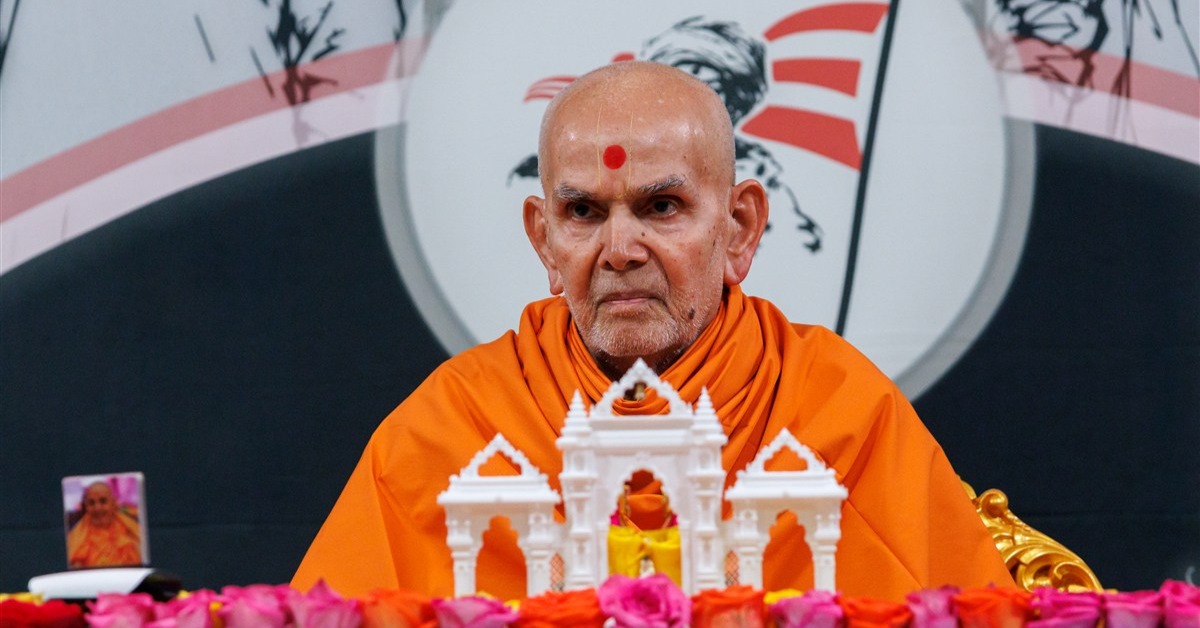
A gathering by monks of the Bochasanwasi Akshar Purushottam Swaminarayan Sanstha (BAPS) on September 5 at the Eiffel Tower triggered a controversy. But a subsequent investigation by the General Inspectorate of the City of Paris found no explicit request from BAPS to remove or exclude female staff.
The probe found that the original request concerned avoiding physical contact between the religious figures and women, but that the message was distorted as it passed through the Eiffel Tower’s management, eventually resulting in some female employees being sidelined. The investigation described the episode as a “collective dysfunction.”
A lack of understanding about the BAPS community only added fuel to the fire.
Bhakti Mamtora, Assistant Professor of Religious Studies, University of Arizona, took a deeper look at the episode in an article published by The Conversation, exploring how unfamiliar religious practices can quickly become flashpoints. It raises a larger question: How should we react to news or controversy without first understanding the depth and context of the issue?
The controversy intensified when Eiffel Tower workers staged a one-day strike after tower management allegedly replaced some women employees for the duration of a 20-minute visit by monks from BAPS.
Bhakti, a scholar of South Asian religions, studied the Swaminarayan Sampradaya, a religious community founded in India in 1801, for nearly a decade. BAPS is one of several denominations within the group. She argues that at the heart of the controversy are differing reactions to brahmacharya, a long-standing Hindu religious practice observed by monks of the Swaminarayan Sampradaya.
While it is often translated as “celibacy,” the practice is aimed at developing inner control over one’s senses to attain spiritual perfection and immerse oneself in God.

What is ‘brahmacharya’?
Bhakti writes that brahmacharya is described in many premodern Indian texts, including the Yoga Sutra, dating to the early centuries C.E. This text outlines eight successive stages of yoga aimed at reaching mental tranquillity through focus on God. Progress toward higher stages of yogic practice starts with the steadfast observance of yama, a code of conduct that includes avoiding violence, dishonesty, theft, and greed and cultivating brahmacharya.
She explained that brahmacharya involves physical and mental practices that are observed differently by lay and monastic members of Hindu, Buddhist, and Jain religious communities. Lay disciples typically uphold the vow of brahmacharya by maintaining fidelity toward their spouse. For monks and nuns, it often takes the form of absolute celibacy.
From ancient times, various monastic orders have followed a more expansive form of brahmacharya, one that restricts eight types of engagement with the opposite gender. This includes not only physical and verbal but also mental contact, where “mental” means sustained, deliberate thought. Through this practice, monastics endeavor to lead a life that is focused on God.
Brahmacharya involves physical and mental practices that are observed differently by lay and monastic members of Hindu, Buddhist, and Jain religious communities. Lay disciples typically uphold the vow of brahmacharya by maintaining fidelity toward their spouse. For monks and nuns, it often takes the form of absolute celibacy.
Textual explanation and practice
Brahmacharya is an important practice in the Swāmīnī Vāto, a foundational text explaining the teachings of Swaminarayan (1781–1830), revered as God in the Swaminarayan community.
The text places brahmacharya among the five vows Swaminarayan monks take upon initiation: overcoming desire, greed, taste, attachments, and ego. Monks who follow its eightfold practice see it as a means of eradicating desire and remaining focused solely on God.
By giving up marital relationships and family ties, Swaminarayan monks say they reduce personal claims on their time and attention, allowing greater focus on devotion, spiritual counseling, and social work. They travel between temples, meet devotees, conduct rituals, and address congregations of men and women.
In public spaces, they avoid direct eye contact with women, viewing it as a form of connection, while women are not required to alter their presence or behavior.
According to BAPS theologians and textual traditions, brahmacharya is an individual choice, not a moral critique of others. While monks have relinquished family life for themselves, they recognize and support the family as central to people’s lives and practices.
Eightfold brahmacharya follows a similar logic: Monks adopt the discipline of focusing on their own attention, desires, and conduct, but they do not expect this of others. The discipline does not judge the worth of women. This ideal is made explicit in BAPS texts that affirm women’s equal spiritual standing and entitlement to religious practice and liberation.
Coming back to the controversy
The current spiritual leader of BAPS, Mahant Swami Maharaj, consecrated a new Swaminarayan Hindu temple in Bussy-Saint-Georges, a suburb of Paris, on Sept. 6, 2026. Leading up to the consecration celebrations, the community’s delegation of 100 monks visited the Eiffel Tower. Following the visit, their centuries-old monastic vows became the center of controversy.
BAPS has stated that it requested an early morning visit to minimize disruption for visitors or staff, given the size of their group. Moreover, in a comment to CNN, BAPS Paris noted, “It was never, at any point, intended as a request rooted in gender, and any suggestion to the contrary does not reflect the spirit or values of our fellowship or the delegation.”
A small area of the observation deck was sectioned off, which is a common practice for large groups, but BAPS categorically denies requesting the removal of women employees.
The Eiffel Tower Operating Company, Société d’Exploitation de la tour Eiffel (SETE), claimed that the delegation had requested a visit that would limit “interactions with women,” according to CNN affiliate BFMTV. The BBC reported that Ariel Weil, president of SETE, “blamed its managers for being ‘a bit overzealous’ in complying with the request without questioning whether it was ‘inappropriate.’”
According to Bhakti, the issue appears to stem from a disconnect between what BAPS requested and what SETE asked of its employees. Understanding the practice of brahmacharya helps explain BAPS’s request: an early-morning visit would likely have limited the monks’ interactions with large crowds, including women.
BAPS monks’ practices have typically gone unnoticed because they observe them as personal religious disciplines, without imposing them on others—even in crowded spaces where women are present.

Leave a Reply