


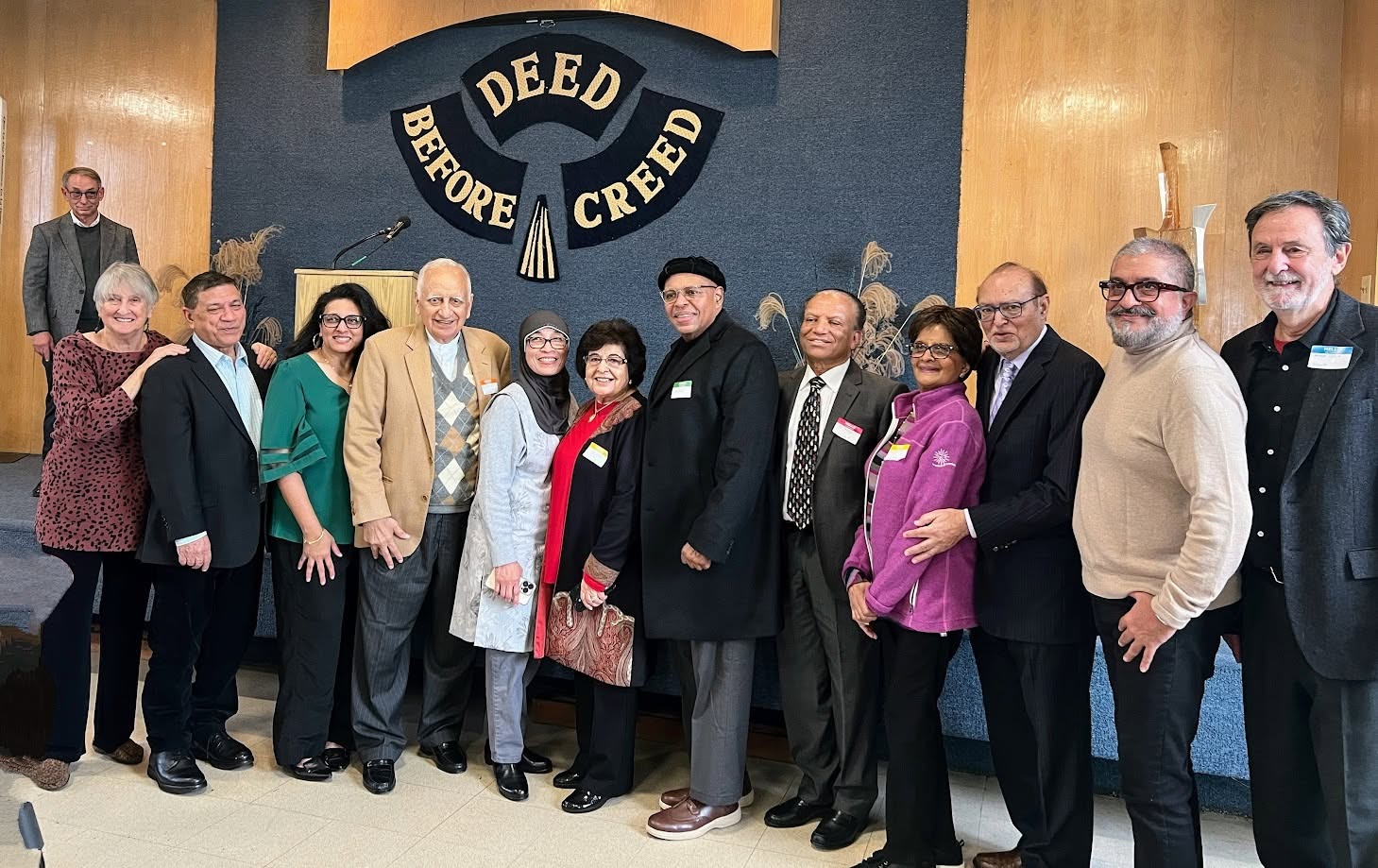
In a polarized climate where opinions outpace facts and prejudice takes root before reason, questions of belief and goodness carry renewed urgency. Does a good life require God—or can goodness itself be a spiritual pursuit?
In this interview with Arpana, Deputy Editor of A Lotus In The Mud, New York-based author and ethicist Arthur Dobrin—Leader Emeritus of the Ethical Humanist Society of Long Island and Professor Emeritus at Hofstra University—reverses the traditional link between religion and morality, placing ethics ahead of theology. Echoing Felix Adler, who founded the Ethical Culture movement in 1876, Dobrin argues that making ethics our greatest concern turns everyday living into a spiritual quest.
That philosophy anchors Dobrin’s work across more than 20 authored, co-authored, and edited books—ranging from ethics to children’s literature—which he frames not as arguments for atheism, but as practical guides to leading a good life.
The title of Dobrin’s book ‘Spelling God With Two O’s’ comes from an anecdote told by Felix Adler, the founder of Ethical Culture in 1876. When asked whether he believed in God, he answered, “I do. And I spell it with two o’s.”
Excerpts from the Interview
Arpana: At a time when religious identity fuels conflict and division across the world, does doing good without the promise of divine reward offer a more universal basis for moral responsibility?
Arthur Dobrin: There are many conflicts that are fueled by religious divisions, just as there are countless atrocities caused by conflicts over resources or even the egos of those in power that have nothing to do with religion.
The promise of a divine reward leads some to live a good life, but for others that same promise leads to the slaying of innocents in the promise of heaven.
Culture also plays a role in teaching right from wrong, although mostly these are social conventions, such as whether to eat with your hands, chopsticks, or cutlery. It really makes no difference.
It isn’t religion or the lack of one that leads to moral responsibility. It is having a good heart and a clear mind. Educating people for empathy, benevolence, responsibility, and humility—all universally held values—creates the framework for a good life.
Religion addresses theological matters first and ethical matters secondarily. People everywhere have the same needs to get along with one another as a practical matter. Humanism turns the order of things around, making ethics the most important concern.

Can humanity agree on a common moral foundation without invoking God?
Arthur Dobrin: Humanity agrees on a common moral foundation since it is a trait rooted in human nature. How else to explain that every religion and ethical philosophy expresses at its core some variation of “Do unto others as you would have them do unto you” wherever in the world it is found?
Here are universal human traits that provide the foundation for ethics:
- Babies are innately sociable, and toddlers are naturally helpful to others
- Cooperation emerged in human evolution
- Humans have an instinct for fairness and an evolved capacity to detect inequalities
- Morality evolved to allow larger groups to live together
- Precursors to morality can be found in some form among other primates, such as sympathy, friendship, reciprocity, and punishing one who threatens the group.
Evidence for all of the above can be found in many disciplines, from biology to sociology.

What inspired you to write ‘Spelling God With Two O’s’? From the title, it seems you are saying God is good or belief in God is good. Or are you saying “good” is “God”?
Arthur Dobrin: For more than 40 years, I have been leading a weekly program in self-cultivation for members of Ethical Humanist/Culture Societies. Each week a different ethical value is presented, and participants respond to what that value means to them in their personal lives. I decided to put the material used in the group into a book format to make it publicly available. The third revised and expanded edition will be available online beginning in the spring of 2027.
The title comes from an anecdote told by Felix Adler, the founder of Ethical Culture in 1876. When asked whether he believed in God, he answered, “I do. And I spell it with two o’s.” His point was that when we take ethics as our greatest concern, it becomes a spiritual quest. In that way, trying to lead a good life is equivalent to trying to lead a godly one.
Please share a couple of salient points from your book, ‘Ethics for Everyone: How to Improve Your Moral Intelligence’.
Arthur Dobrin: Living an ethical life is more than articulating ethical principles. It requires four components as they are applied to a given situation. They are being aware that there is an ethical decision to be made, caring enough to want to do something about it, judging, and doing.
Humanity agrees on a common moral foundation since it is a trait rooted in human nature.
What misconceptions about morality and atheism have you most wanted to challenge in your books?
Arthur Dobrin: My books aren’t arguments for atheism. The books are guides for living a good life. Anyone may find them useful to think about the importance of ethics and how to think through ethical problems. They don’t address theological or metaphysical issues. They are books of applied ethics—that is, they address the everyday concerns that people face, such as love and respect, loss and wonder. Three other books of mine address these matters: Teaching Right from Wrong: 40 Things You Can Do to Raise a Moral Child; The Lost Art of Happiness; and a children’s picture book, Love Your Neighbor.
A misconception is that morality is the same as social conventions. It is not. Another misconception is that all ethical questions can be settled as a matter of principle. They cannot. Context matters. Just as a physician can know all that is in a medical textbook, they still have an individual patient in front of them and sometimes need to make a choice to treat one illness while neglecting another.
Ethical conflicts arise for two main reasons. One is that while humans have the instinct for cooperation, they also have the instinct for self-preservation. This is the conflict between altruism and selfishness. The second is that some ethical principles may conflict with one another, such as that between justice and mercy.

You call yourself a humanist; please share some salient points about humanism. Also, are you an atheist or agnostic?
Arthur Dobrin: Humanism comes in many varieties, as does any religion, philosophy, or ideology. Fundamentally, humanism puts human welfare as its central concern.
The form of humanism I subscribe to is Ethical Humanism/Culture. Ethical Humanism is the congregational expression of a humanist philosophy. Built on the idea of human worth and dignity, where each person is unique, we believe that we are part of the human community, and our goal is to make life less difficult for one another. This is a religion of relationships, where personal and social values are central to creating a better world.
Humanists may or may not be atheists. An atheist says there is no God. An agnostic says I don’t know if there is a God or not. Personally, I fall into the category of agnostic. Many humanists would say they are atheists, while some profess a belief in a higher power. Whatever position humanists take on the reality of God, it is a personal matter. The focus of humanists remains this: this is the life we know we have for sure, and we must take our ethical responsibilities seriously.
Why are atheists and agnostics often stereotyped as selfish or lacking a moral compass? What fuels this prejudice?
Arthur Dobrin: A religion forms boundaries regarding who belongs and who doesn’t—insiders and outsiders. This often means that religions reinforce the idea that their members are better than others, that they have the right knowledge and others are ignorant. Such attitudes can go very wrong, as we see historically and to this day, when the outsider is demonized.
It isn’t surprising that many of those who strongly identify with their religion as the only truth see those who are different as bad. Since humanists bracket a concern for God and live their lives without looking for supernatural guidance and support, religious fundamentalists see this as corrupt, bad, or even evil. True believers conclude that anyone who doesn’t believe as they do, without the rules they accept, must be lacking a moral compass.
John Lovejoy Elliott, an early 20th-century Ethical Culture leader, wrote, “I’ve known good people who believe in God and good people who don’t, but I’ve never known good people who didn’t believe in people.”
This has been my experience as well. I’ve encountered awful people who were believers, those who were atheists, and those who didn’t give this question any thought. And I’ve known wonderful people who were pillars of their church, those who were as sure that there is no God as those who are certain there is, and those who find the question about God’s existence as irrelevant.
The decent, kind, generous, responsible, and humble people I’ve known all believe in people.
Arthur Dobrin is the Leader Emeritus of the Ethical Humanist Society of Long Island; contact: https://ehsli.org

Leave a Reply