


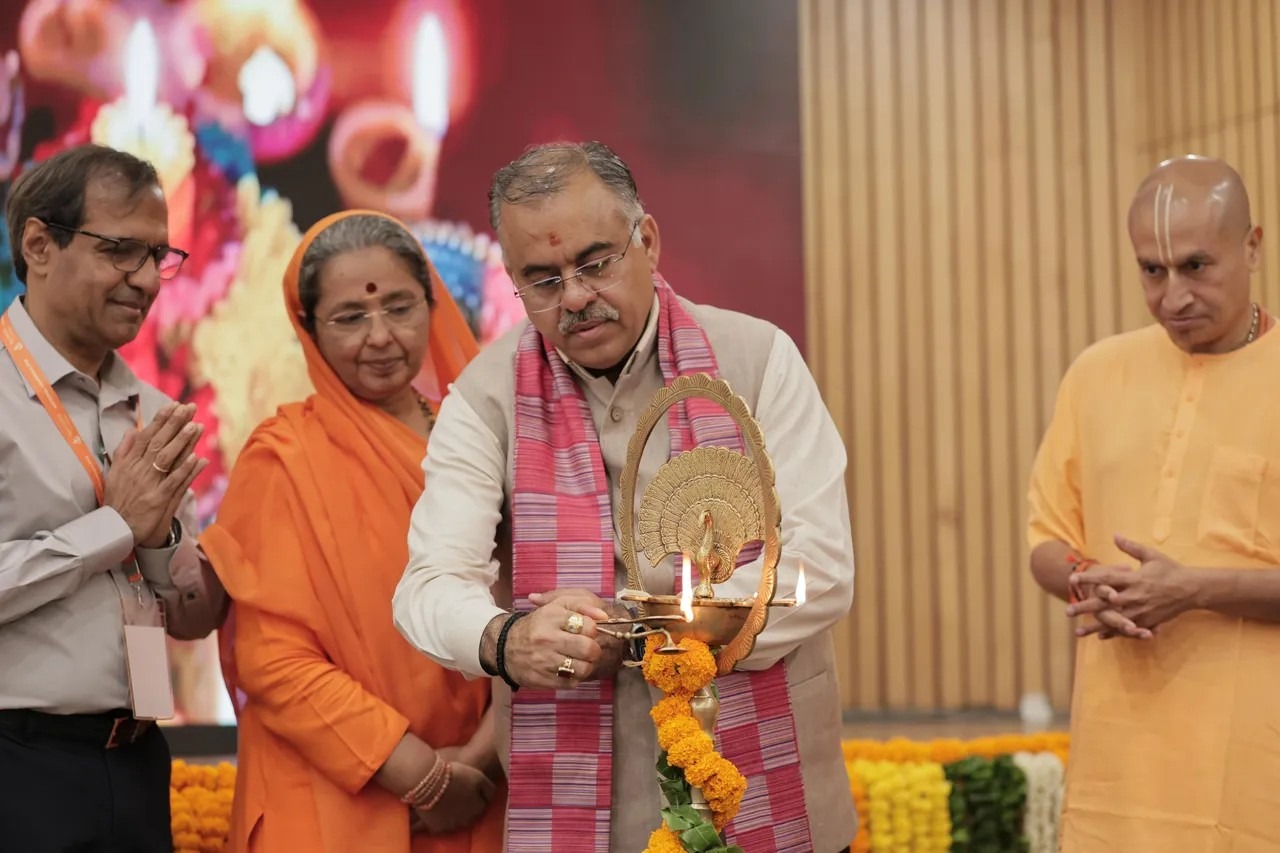
Educators, spiritual leaders, and policymakers at the first National Conference on Spirituality in Schools 2026 called for integrating principles of India’s ancient holistic learning traditions into modern education, arguing that rising student anxiety, emotional distress, and cultural disconnection require schools to move beyond academic achievement toward more balanced human development.
The conference, organized by Adi Vidya Foundation in New Delhi on April 27, 2026 at India International Center, focused on incorporating Indian spiritual and values-based learning into contemporary classrooms through practical and age-appropriate methods.
Adi Vidya Foundation also unveiled the country’s first spiritual science curriculum at the event, aimed at promoting structured and policy-driven conversation around inner development and spirituality in modern school education.
Modern educational stress turns to Indian system for solutions
The conference was inaugurated by Tarun Chugh, National General Secretary of the ruling Bharatiya Janata Party.
Addressign the cofnerence, Gauranga Prabhu Das, Governing Body Commissioner, ISKCON and Director of Govardhan Ecovillage said, “The modern education system is focused too much on sadhan and samarthya – too much on getting success based on resources – whereas the Bhagavad Gita describes that the definition of success is based on your sankalpa and sadhana. How to inculcate an experiential learning centered around spirituality for students across the length and breadth of the country, so that inevitably, as they continue going through the challenges in life, and life will keep throwing them prosperity and adversity. Life will definitely put them in situations where they feel totally, utterly helpless. But even if they become helpless, they do not become hopeless. Without hope nothing can be done. If you have no assets but hope, you can potentially do everything. We are teaching children when they grow up how to deal with FILE but not with LIFE.”
Addressing the conference, Swamini Pramananda, also known as Ammaji, a Vedānta teacher, Sanskrit scholar, and the spiritual leader of Purna Vidya Foundation, based in Coimbatore, said the current educational crisis was “civilizational” in nature, describing modern children as intelligent and capable but increasingly anxious, distracted, and emotionally vulnerable.
She linked these trends to excessive digital exposure, overprotective parenting, and mounting pressures on teachers and students alike.
“The question is no longer whether ancient wisdom should be brought into education, but how society can sustain itself without it,” she said, urging taking inspiration from Indian civilizational heritage rather than approaching it with nostalgia.
Explaining the philosophical foundations of this approach, Ammaji referred to the Vedic principle of Isha Vasyam Idam Sarvam, describing the universe as a conscious and interconnected reality.

She said that education should cultivate reverence, gratitude, and connectedness alongside intellectual growth. She also highlighted the distinction between paravidya and aparavidya—inner knowledge of the self and external worldly knowledge—saying modern schooling disproportionately privileges the latter.
Referring to the Purna Vidya Curriculum, developed over the past three decades, Ammaji said India was now ready for educational reform rooted in cultural and spiritual heritage. She proposed practical classroom interventions such as beginning lessons with moments of silence and focused attention to build concentration and emotional balance.
Gauranga Prabhu Das, Governing Body Commissioner, ISKCON and Director of Govardhan Ecovillage said, “The modern education system is focused too much on sadhan and samarthya – too much on getting success based on resources – whereas the Bhagavad Gita describes that the definition of success is based on your sankalpa and sadhana. How to inculcate an experiential learning centered around spirituality for students across the length and breadth of the country, so that inevitably, as they continue going through the challenges in life, and life will keep throwing them prosperity and adversity. Life will definitely put them in situations where they feel totally, utterly helpless. But even if they become helpless, they do not become hopeless. Without hope nothing can be done. If you have no assets but hope, you can potentially do everything. We are teaching children when they grow up how to deal with FILE but not with LIFE.”
Focus on values-based and spiritually rooted learning
Another spiritual leader, VaishnavAcharya Pundrik Goswami Ji Maharaj, who belongs to the lineage of the Six Goswamis of Vrindavan, questioned whether education should merely prepare students for careers or also help them discover “the fuel of life”—inner spiritual strength. Using the analogy of a car, he argued that modern systems teach students how to operate external mechanisms while neglecting their inner development.
He stressed the importance of values such as truthfulness, discipline, humility, and gratitude, saying spirituality in schools must be reflected through everyday conduct rather than theoretical instruction.
He also highlighted the expansion of the NIMAI Pathshala platform, which he said currently reaches over 500,000 students through online learning and free shloka education, with plans to expand internationally.

A panel discussion at the conference brought together scholars and public intellectuals who examined spirituality’s place in Indian education and society from civilizational, cultural, and contemporary perspectives.
Ram Nath Jha, a Sanskrit scholar and professor at Jawaharlal Nehru University, described India as a knowledge-based civilization and emphasized that spirituality represented the manifestation of truth in diverse forms. He also linked spiritual thinking with environmental consciousness and underscored the historical role of women in shaping Indian knowledge traditions.
Spirituality, once the basis of India’s ancient education system, has disappeared from modern educational institutions.
Bharat Gupt, a scholar of Indian aesthetics, theater, and classical traditions, warned that excessive focus on outward migration and technological careers can lead to cultural dislocation. He said that arts, music, literature, and crafts could be used as tools for transmitting Indian values and traditions, referring to the Natyashastra as the Pancham Veda or Fifth Veda.
Raghava Krishna stressed the need for high-quality digital content capable of communicating spiritual ideas to younger generations through films, YouTube, and contemporary media platforms. Founder of Brhat Culture Creative LLP, a cultural-intellectual platform advancing India’s civilizational knowledge systems, he also cited examples from Yerwada Jail, where meditation and Bhagavad Gita study reportedly contributed to behavioral transformation among inmates.
The panelists stressed that spirituality in education was not an optional addition but essential to any meaningful educational renewal in India. Suggestions included producing films on the guru-shishya tradition, introducing literature about saints into curricula, and increasing institutional support for preserving Indian knowledge systems.
Teacher wellness and mindfulness emerge as a key reform
One of the suggestions was to focus on the well-being of the teachers. Himanshu Gupta, an IAS officer who currently serves as Secretary of the Central Board of Secondary Education (CBSE), said that teacher well-being is the foundation of educational transformation. He emphasized that emotionally balanced and mindful teachers create healthier learning environments and advocated simple daily practices such as pranayama, breathing exercises, and meditation for them.
Referring to regulated breathing techniques such as the 4-7-8 and 4-4-4 methods, Gupta said even a brief daily practice could reduce stress and anxiety among educators and students. He also connected positive affirmations and thought patterns to neuroscience concepts and the placebo effect, suggesting that emotional well-being must become central to school culture.
Meanwhile, Shanti Krishnamurthy, Director of Academics at Central Chinmaya Mission Trust, argued that spirituality was not a separate subject but an integral dimension of education itself. Drawing on the educational philosophy of Swami Chinmayananda, she said schools should aim not only to produce academically successful students but also “good human beings.”
Krishnamurthy advocated integrating spirituality into daily school life through simple practices such as breathing exercises, moments of stillness, and reflective activities. She argued that children naturally respond to such practices and that spiritual awareness should be nurtured early in age-appropriate ways.
The conference reiterated a common concern: that modern education systems have become overly focused on information, competition, and employability while neglecting emotional resilience, ethical grounding, and inner awareness. Across sessions, speakers called for an educational framework that combines academic excellence with values, mindfulness, cultural rootedness, and spiritual understanding.
For more info about the Gurgaon, Indian-based organiser of the conference, https://www.adividyafoundation.org/about-us

Leave a Reply