

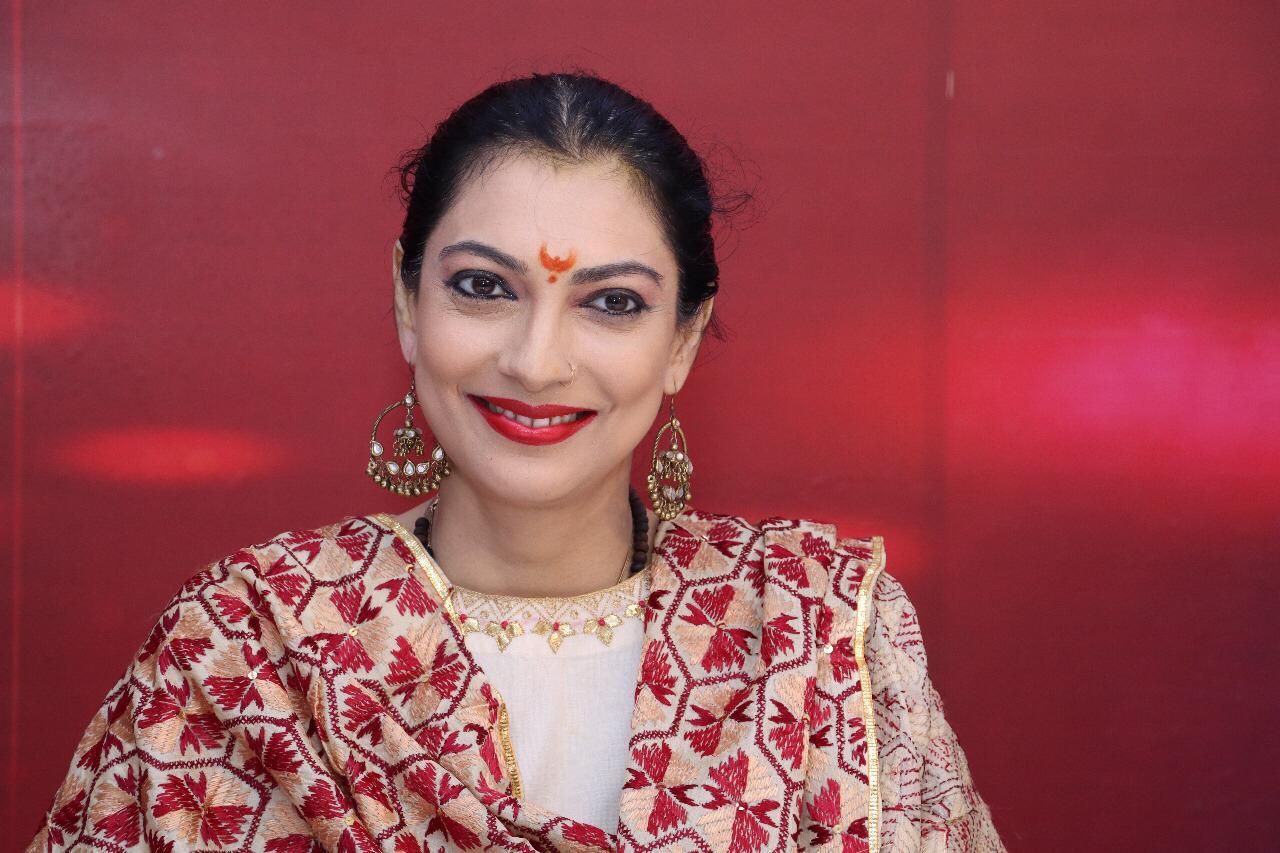
Since being crowned Miss World 1999, Yukta Mookhey’s life has spanned fame, films, marriage, and motherhood. Born and raised in Mumbai, her Sindhi family traces its roots to Multan—now in Pakistan. Today, her journey has taken a deeper turn toward spirituality and promoting Vedic wisdom. In this exclusive interview with Arpana, Deputy Editor of A Lotus In The Mud, Yukta speaks about Dharma, raising conscious children, and why she believes women are naturally aligned with the cosmic intelligence that governs the universe.

Arpana: You say that spirituality has been part of your life since childhood. How has your spiritual journey evolved from those early experiences to where you are today?
Yukta Mookhey: I was introduced to my Shree Guru, Gurumayi Chidvilasananda (siddhayoga.org), as a teen. I had confusion about who I was and which direction I should take. Attending satsang (a spiritual congregation) was part of the process of getting nurtured. However, most vital for my growth were the spiritual practices of meditation, being in silence, mantra chanting, and sewa (selfless service).
When we study the Guru’s teachings, we align with Dharma. The power of the Guru’s tapasya (austerity) is imbued in those divine sutras (principles). When that consciousness awakens, and we understand how to move forward in our thoughts and actions, we can implement those teachings by assimilating them into every aspect of our lives.
From that starting point to understanding how critical it is for young children and teens to have a stable mind that can regulate emotions and make them self-reliant, we can raise a generation of leaders and visionaries devoted not only to upholding the highest principles but also to contributing to society and empowering others.
This is crucial in today’s age when the youth lack right morality or guidance. They are being misled through consumerism, influenced by culture portrayed in movies, advertisements, and the fashion industry. The worst is social media, which gives them a false sense of self-identity.
The only way out of this mess is to know thyself—to recognize the divine within. It’s with the power of divine intellect that they can realize that happiness lies within, not in products, people, places, or events.
Your life journey has taken you from the glitz and glamour of the film industry to the calm and introspective world of spirituality. What prompted this shift?
Yukta Mookhey: My life journey began with serving in my guru’s ashram (in Ganeshpuri, Maharashtra), and it’s only with my Shree Guru’s grace and blessings that I was able to rise to global recognition at a young age.
The sharpening of my mind and personality during those formative years helped me develop a stable mental attitude through the various ups and downs of life. So when I won the Miss World crown in 1999, I was very clear about my intentions as a public figure. That focus and dedication helped me draw boundaries about where my energy and attention should go.
I have always had a spiritual heart. What truly matters to me is interconnectedness with people and commitment to humanitarian causes.
So I do not see myself leaving glitz and glamor. Rather, I see myself returning to my roots and anchoring in my truth from that core foundation where true greatness can radiate.
Looking back at your life today, what do you believe is your deeper purpose?
Yukta Mookhey: It’s hard to define my soul purpose in a few sentences. Its essence lies in the experiences I have gone through and the events in life that have pulled me in different directions, allowing me to explore the missing links in society and see where our lack of understanding is leading the next generation.
I am more convinced today that I am here to contribute to the awakening of future generations by bringing Vedic wisdom back to the forefront of our culture!
The crisis in modern society stems from immaturity in understanding the wealth of knowledge created by our ancestors. We come from a land of guru-shishya parampara. There can be no higher truth, and nothing compares to this ideal.

Tell us about your guru. What role she has played in shaping your spiritual journey?
Yukta Mookhey: I have been extremely fortunate to meet my Shree Guru (Gurumayi Chidvilasananda) at a young age, when I could fully dedicate myself to her guidance, her mission, and her vision. It would not be enough to say that everything I am is because of her grace and love.
Everything I have faced in life is because of the courage and strength she has given me. Without her, I would not have survived the toughest battles of my life. My salutations are at her lotus feet.
Gurumayi is the spiritual master of the Siddha Yoga lineage.
What does your daily spiritual practice look like?
Yukta Mookhey: My daily spiritual practices include chanting mantras, meditation, and contemplation. On some days, depending on the tithi (lunar date), I perform certain rituals like puja (worshipping) and havan.
What helps me stay centered is my faith in my Guru and the divine power of the universe.
In your experience, how does spirituality contribute to a woman’s sense of empowerment and inner strength?
Yukta Mookhey: Spirituality is something a woman is naturally born with—those qualities and virtues are already within her. She does not need to become another version of herself to please the world or feel accepted by society.
The entire universe is created, sustained, and eventually renewed through the power of Mother Nature. This happens through the force of Adi Shakti—the eternal energy that has been creating and sustaining the universe since the beginning of time, however we may understand that concept.
This shakti is considered feminine in nature. Shakti knows when to act and what needs to be done. This same innate ability exists in women. When women give birth, nurture children, and care for their families, they naturally understand what is needed—not only for their children and families, but also for society.
That is why spirituality is not something women need to chase or pursue as a separate goal. In many ways, women are biologically and intuitively aligned with the cosmic wisdom that governs the universe. What we need is to recognize this truth and begin to respect and honor it.
That is how we should address this issue of self-worth and self-esteem, and the pattern of self-sabotage, where women keep giving to others while neglecting their own needs.
A woman’s inner strength only needs space to grow. If only people would stop misinterpreting her power as aggression and see it as Devi Shakti, the whole perspective of how we raise our girls would change. And this would mark a turning point in history.

Yukta Mookhey’s Filmography include films like Pyaasa (2002), KatPuttli (2006), Memsahab (2008)
In your understanding, what does spirituality truly mean?
Yukta Mookhey: For me, spirituality means recognizing that the entire world and every aspect of existence is infused with divine consciousness. Nothing on this planet exists without that spark of divinity.
I would also recommend reading the work of Sinu Joseph. Her books on Ritu Vidya, Varna Vidya, and Stri Dharma Paddhati are deeply insightful. I am currently studying one of her books and am part of a study group as well. I strongly recommend these works to anyone—especially young girls and women—who want to understand themselves better and learn how to remain rooted in their inner strength without needing to display it outwardly.
The ancient tradition of garbha sanskar, which focuses on conscious pregnancy and the emotional and spiritual environment of the unborn child, is receiving renewed attention today. As a mother, did you explore or follow this practice?
Yukta Mookhey: My journey as a mother led me to reflect on where we are going wrong as parents. Why is there so much disconnect and conflict between parents and children? Why do we feel that our children are developing a completely different way of thinking?
My intuition, my gut feeling, and my inner voice did not align with the narrative that has been imposed by the Western world, which I believe has gradually weakened Indian culture. What felt true to me as a mother was that our culture has always supported and promoted a philosophy in which children, when born into a family, should follow those customs and traditions.
However, our current education system takes children away from their cultural roots and turns them into robots. It molds them into adults who often become distant from their own families, disconnected from the needs of society, and misaligned with dharmic principles. They are not raised with the spirit of service or with a deeper orientation toward life.
I believe it is important that we return to our Vedic roots, to the wisdom of our ancestors, our traditions, and our Indian knowledge systems. To reconnect with our core philosophy of Sanatana Dharma, we must develop the courage to question and redefine the current education system. Parents need to set clear boundaries. Women, especially, have a crucial role because a mother is a child’s first teacher—the first guru. Mothers must trust their intuition when making choices about education, health, and overall well-being.
Over time, as I explored these ideas while raising my child, I felt drawn toward more sustainable and conscious ways of living. My journey eventually led me to become a prenatal educator. I pursued extensive study, research, and training, and I became involved with organizations that focus on ancient traditions such as garbh sanskar, conscious pregnancy, and creating a nurturing emotional and spiritual environment for the unborn child.
Today, this has become an important area of work for me.
You are also a film director. Do you see cinema as a medium to communicate deeper spiritual ideas or social themes?
Yukta Mookhey: Surely! Movies can communicate and inspire people towards spiritual content, but unfortunately it won’t get that level of funding or support because it’s unlikely to be sensational. We have seen a lot of TV shows depicting the great epics like the Mahabharata and Ramayana. Surely they do set a trend for good work, but it cannot become entertainment.
These can strengthen society by instilling values in young minds—the target audience influenced by stories and characters of our divine gods.
This must happen through family structure and social fabric through plays, theater, and other forms, such as the Gurukul education system. This is crucial if our system shifts and reconnects with our roots and culture.
What are your current engagements?
Yukta Mookhey: At this stage of my life, I am advocating for transforming the education system by reviving Vedic gurukulam methods and the benefits of Sanskrit mantra chanting in learning. As a single mother, I am also raising my son to become self-reliant and rooted in Bharatiya knowledge systems. I am also studying and practicing the Stri Dharma Paddhati to stay grounded in our cultural values.
How do you balance your personal responsibilities with your spiritual journey?
Yukta Mookhey: I have always been spiritually oriented and believe that the only way to move forward in life is by following the principles of dharma. Whenever I face a challenge—as a mother or as a daughter—I turn to my guru’s teachings and to my inner truth. I listen to my inner voice and instincts, and that has been my guiding force and saving grace.
It has helped me remain authentic in my relationships and has also allowed me to see more clearly and sensitively where I need to grow further—as a mother, a daughter, a daughter of India, and as a woman.
We all evolve through different stages of life, and with that our spiritual and emotional understanding deepens. Our perspectives change, and the questions we ask ourselves also shift.
I have found that a strong spiritual foundation sustains me, guides me, and constantly nurtures me.
As a mother, as a woman, and as a daughter of this nation, my work now focuses on creating awareness about Vedic education, protecting early childhood development, and strengthening the bond between mother and child. I advocate for natural conception, conscious pregnancy, healthy lifestyles, and spiritual practices that nurture both the mother and the child.

Leave a Reply