


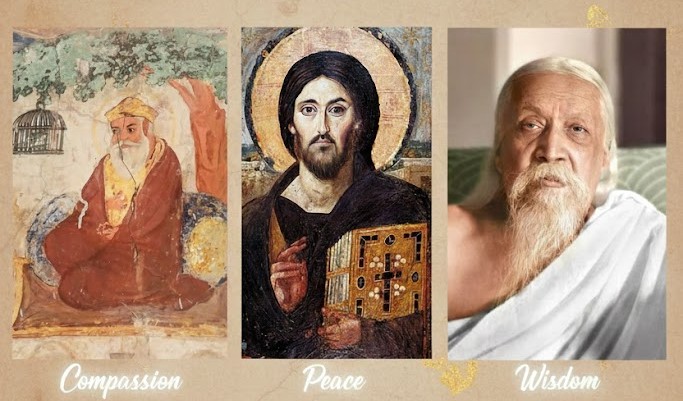
In an increasingly fragmented world, love is often spoken of as an emotion—fleeting, conditional, personal. Yet the great sages across time and cultures have spoken of love not as sentiment, but as a way of being. A way of seeing. A way of serving.
Strip away the layers of doctrine, ritual, and cultural expression, and one begins to notice a quiet, luminous truth: the core teaching of every awakened being is remarkably similar. Whether it is Christ speaking of loving one’s neighbor, the Buddha pointing to compassion as the highest virtue, Guru Nanak dissolving the illusion of the ‘other,’ or Sri Aurobindo envisioning a divinised humanity, the message is consistent and clear—love is universal, and it is transformative.
This is not the love that seeks possession or validation. It is not transactional, nor is it sentimental. It is love as consciousness. Love as action. Love as responsibility.
Love as service and sacrifice
At the heart of Christ’s teachings lies an uncompromising call to love. “Love thy neighbor as thyself,” he says—an instruction so simple that it often escapes deeper contemplation. Who is my neighbor? The one who looks like me? Thinks like me? Worships like me?
Christ expands the circle radically. He speaks of loving the stranger, forgiving the enemy, and turning the other cheek. In doing so, he dismantles the ego’s most cherished defences. Love, in his vision, is not comfort; it is courage.
What is striking is that Christ does not speak of love merely as an inner state. He embodies it through service—washing the feet of his disciples, feeding the hungry, healing the sick, and standing with the outcast. Love, here, is inseparable from action. To love is to serve. To serve is to recognize the divine in the other.
In this sense, Christ’s life becomes the message. Love is not preached; it is lived. And lived so fully that it demands sacrifice—not for martyrdom’s sake, but because love that is universal cannot protect the self at the cost of the whole.
“Love your enemies and pray for those who persecute you.”
— Matthew 5:44
Compassion without attachment
Where Christ speaks in the language of devotion, the Buddha speaks in the language of awareness. Yet the destination is the same.
For the Buddha, suffering arises from separation—separation created by craving, aversion, and ignorance. Compassion, or karuna, is the natural response of an awakened heart that sees no separation. When one realizes that all beings seek happiness and wish to avoid suffering, compassion ceases to be a moral obligation; it becomes an instinct.
The Buddha’s love is quiet, spacious, and deeply non-attached. It does not cling, judge, or interfere. It simply understands. In the practice of metta—loving-kindness meditation—the practitioner is asked to extend goodwill not only to loved ones but also to strangers, difficult people, and eventually, to all beings without exception.
This universality is crucial. Compassion that is selective is still bound by ego. True compassion flows freely, without preference. It does not ask, “Do you deserve this?” It asks only, “Can I reduce suffering?”
In this, the Buddha offers a profound correction to our modern misunderstandings of love. Love is not emotional dependency. It is clarity. It is the courage to stay present with suffering—one’s own and another’s—without turning away.
Oneness beyond all divisions
If Christ emphasizes love through service and the Buddha reveals compassion through awareness, Guru Nanak dissolves the very foundation on which exclusion stands.
Nanak’s revolutionary insight was radical in its simplicity: Ik Onkar—There is One. One reality, one consciousness, one source. When this truth is realized, divisions of religion, caste, gender, and status collapse. Love is no longer something we extend; it is something we recognize.
“There is no Hindu, there is no Muslim; we are all children of the One Creator.”
— Teaching attributed to Guru Nanak Dev Ji, expressing the oneness of humanity
In Guru Nanak’s vision, to love another is not an act of generosity; it is an act of truth. How can one harm another when there is no ‘other’?
Love as an evolutionary force
Sri Aurobindo takes this timeless wisdom and places it within the arc of human evolution. For him, love is not merely a virtue; it is a force shaping consciousness itself.
Aurobindo envisioned humanity as a work in progress—moving from mental consciousness toward a higher, supramental awareness. In this unfolding, love plays a central role. Not romantic love, nor emotional attachment, but a vast, impersonal love that recognizes the Divine in all forms.
This love does not reject the world; it transforms it. Aurobindo speaks of a spirituality that embraces life fully—politics, work, relationships, creativity—infusing each with higher awareness. Universal love, in this framework, is not an escape from the world but a responsibility toward it.
He writes of unity-consciousness, where the boundaries between self and other soften, not through denial, but through integration. In such a state, service arises naturally, compassion becomes effortless, and action flows from inner alignment rather than moral compulsion.
In a time of global crisis—ecological, social, spiritual—Aurobindo’s vision feels especially urgent. The world does not need more belief systems; it needs a shift in consciousness. And love, he suggests, is the bridge.
One river, many streams
When viewed together, the teachings of Christ, the Buddha, Guru Nanak, and Sri Aurobindo reveal not contradiction, but complementarity. Different languages, different contexts, different temperaments—yet one shared truth.
All point toward a love that is inclusive, expansive, and transformative. A love that dissolves the illusion of separateness. A love that expresses itself through service, compassion, justice, and conscious action.
What differs is not the essence, but the emphasis. Christ speaks to the heart, the Buddha to the mind, Nanak to the social soul, and Aurobindo to humanity’s future. Together, they offer a holistic map of what it means to love universally.
Living universal love today
The question, then, is not whether universal love exists in spiritual texts. It clearly does. The real question is, how do we live it?
In everyday life, universal love may look far less dramatic than scripture suggests. It may look like listening without interrupting. Choosing kindness over certainty. Holding space for views different from our own. Consuming less so others may have more. Acting with awareness in how we treat the earth, animals, and each other.
Universal love is not passive. It asks us to examine our prejudices, question our comforts, and recognize where we exclude—consciously or unconsciously. It invites us to move from “me and mine” to “us and ours.”
Most importantly, it begins within. As all sages remind us in different ways, one cannot offer love outwardly without cultivating it inwardly. Self-compassion, self-awareness, and inner honesty are not indulgences; they are prerequisites.
Returning to the heart
In a world increasingly fractured by ideology, identity, and fear, the sages offer us neither escapism nor dogma. They offer remembrance—a gentle but radical remembering that beneath our many differences lies the same human longing: to belong, to be seen, to live without fear. Universal love does not flatten diversity; it holds it within a wider embrace of unity. Perhaps this is the true invitation of our times—not to choose one spiritual path over another, but to listen deeply to the wisdom echoing through all of them and to recognize that truth, like love, is not owned by any single tradition.
In this light, the message of Christmas becomes profoundly universal. The birth of Christ is the birth of a living reminder that divine love can take human form—walking among the poor, the rejected, and the forgotten. His call to love even one’s enemies finds a powerful resonance in Guru Nanak’s vision of a world in which no one stands outside the circle of the One, where every being is held in a single, compassionate gaze.
To honor Christmas, then, is not merely to remember a sacred story but to renew our commitment to the shared essence of all the sages: to recognize the Divine in every face, to let compassion shape our choices, and to allow love to become consciousness in action—in our homes, our communities, and across our wounded world.
And when we do, we may discover that the lotus has always been rising from the mud—not as one solitary bloom, but as many, rooted in the same silent, nourishing ground.

Leave a Reply