


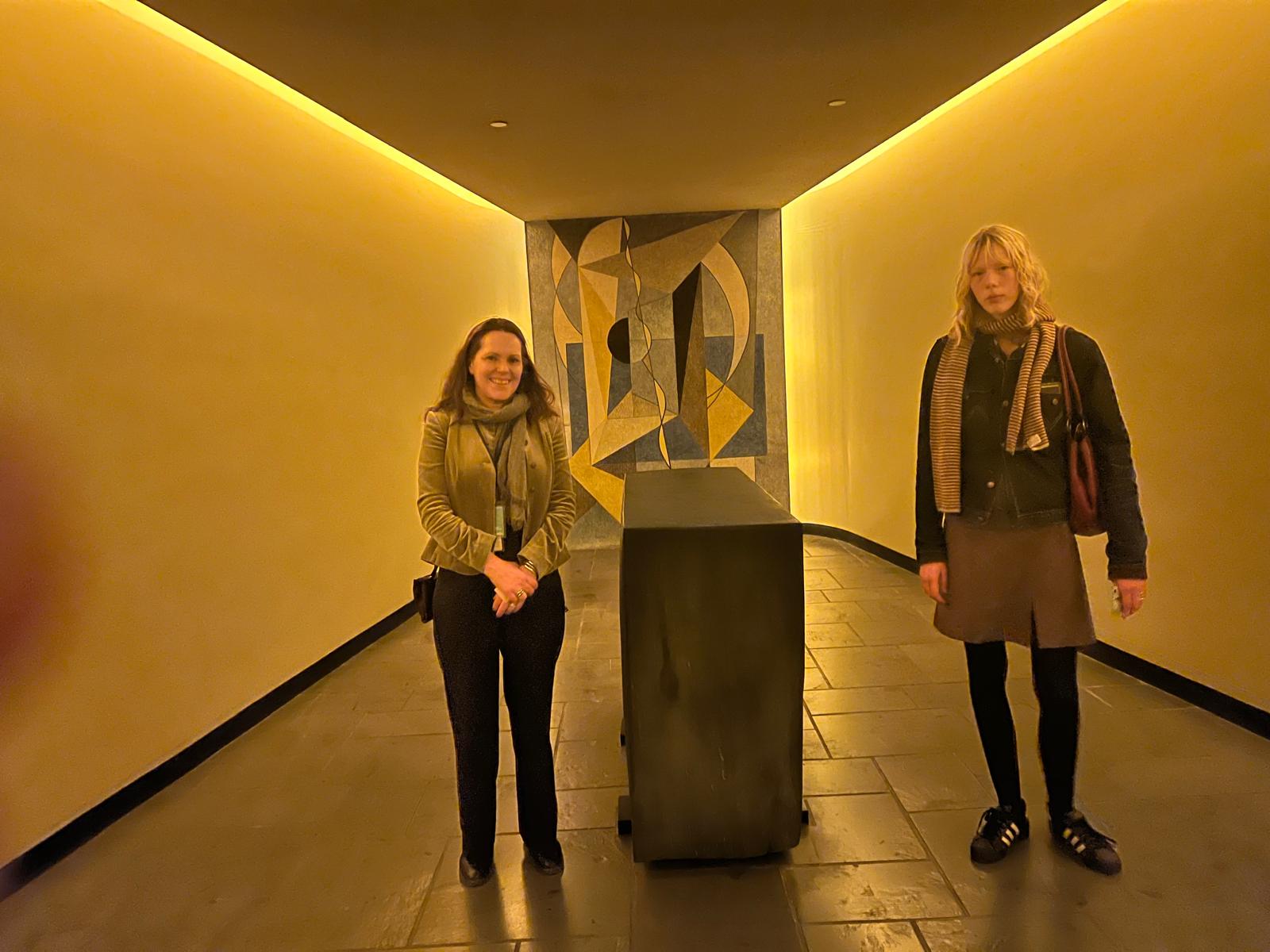
In the bustling heart of New York City, within the glass-and-steel hive of the United Nations headquarters, there is a place where the noise of global diplomacy simply… stops. I was there for some conference, when I came across the Meditation Room on the first floor but hidden from view from the foyer.
Known officially as “A Room of Quiet,” the space was championed by the 2nd UN Secretary-General Dag Hammarskjöld. Stepping inside, the first thing that struck me was the deliberate lack of religious iconography. There are no crosses, no crescents, no statues. As Hammarskjöld famously said at its 1957 reopening, “None of the symbols to which we are accustomed in our meditation could be used.” Instead, the room relies on the raw language of light, stone, and geometry to speak to the soul.
Six-ton block of iron as altar!
Dominating the center of the room is a massive, six-ton block of iron ore. A gift from Sweden, the slab feels impossibly heavy and permanent in a world that often feels fragile. I learned that it was placed there to represent an altar dedicated to “the God whom man worships under many names.” It’s a striking metaphor: iron can be forged into swords or into ploughshares. Standing before it, I felt the weight of that choice—the eternal human struggle between destruction and construction.
The room’s design is a masterclass in modernist simplicity. At the far end of the inverted V-shaped space stands a stunning abstract mural by Bo Beskow, a close friend of Hammarskjöld. The fresco – 9 feet high and 6-1/2 feet wide – covering the wall is a composition of blue, white, yellow, and grey geometric forms. It draws your eyes to a single black half-circle—a “point of rest” that seems to anchor the entire room. Beskow’s work represents the light of the skies reaching down to the earth, and in the dim light of the sanctuary, it creates an atmosphere of ethereal calm. The abstract design was decided upon to align with the room’s inter-faith purposes where people could withdraw into themselves, regardless of their faith, creed, or religion.
As I sat on one of the twelve benches—masterpieces of Swedish craftsmanship and minimalism designed by Carl Malmsten—I noticed I wasn’t alone. Despite the room’s tucked-away location, a steady trickle of visitors drifted in.
“We have within us a centre of stillness surrounded by silence.”
~ Dag Hammarskjöld, 2nd UN Secretary-General – 1953-61 at the reopening of the Meditation Room in 1957
What brings people to the quaintest Meditation Room
I spoke briefly with a woman named Maria, a regular visitor who works in the UN complex. From Kosovo, she was accompanied by a friend. “I come here at least twice a week,” she told me, her voice barely a whisper. “In a building where people argue about the fate of the world, this is the only place where you can actually hear yourself think. It’s my anchor.”
Then two young boys entered and promptly said their Namaz facing the left wall – must have figured out the direction of Mecca. They turned out to be from Turkey. I made a video of them praying.
Another visitor, a young man from the Netherlands, mentioned he makes a point to visit every time he is in New York. “There’s a sense of permanence here,” he said, gesturing to the iron altar. “The world changes, politics change, but this room stays the same. It feels like the one place where we are all just humans, regardless of where our passports are from.”

(Photo courtesy: United Nations Visitors Centre)
That sense of continuity is literal. In 2021, the Permanent Mission of Sweden replaced the original furniture with 12 new benches, identical to the 1952 originals. They were crafted by the same company using the same traditional techniques, ensuring that the vision Hammarskjöld had decades ago remains physically intact today.
The Meditation Room is dedicated to peace and is a gathering point for regular events to acknowledge those that have dedicated themselves to the pursuit of peace.
In the brochure which was distributed at the opening of the Meditation Room in 1957, the visionary UN Secretary General Dag Hammarskjöld said: “We have within us a center of stillness surrounded by silence. This house (the UN), dedicated to work and debate in the service of peace, should have one room that is dedicated to silence in the outward sense and stillness in the inner sense.”
World Meditation Day
At the United Nations, meditation holds a special place, as this quaint room symbolizes the essential role of silence and introspection in achieving global harmony. It is all the more so now after the institution of the World Meditation Day (December 21) since 2024.
A page on the UN website reads: “In times of global challenges, such as armed conflicts, climate crises, and rapid technological advancements, meditation offers a powerful means to cultivate peace, unity, and compassion. World Meditation Day reminds us of the importance of nurturing human consciousness to address these issues and create harmony within ourselves and our communities. By fostering inner peace through meditation, individuals contribute to building a more resilient and sustainable world for current and future generations.”
Leaving the room and stepping back into the hum of the UN lobby, I felt a lightness I hadn’t arrived with. The Meditation Room serves as a vital reminder that for any work of peace to succeed in the “outward sense,” there must first be a foundation of stillness in the “inner sense.” It is a room where only thoughts should speak—and in the silence, I found they have quite a lot to say.

Leave a Reply to PS Wasu Cancel reply