


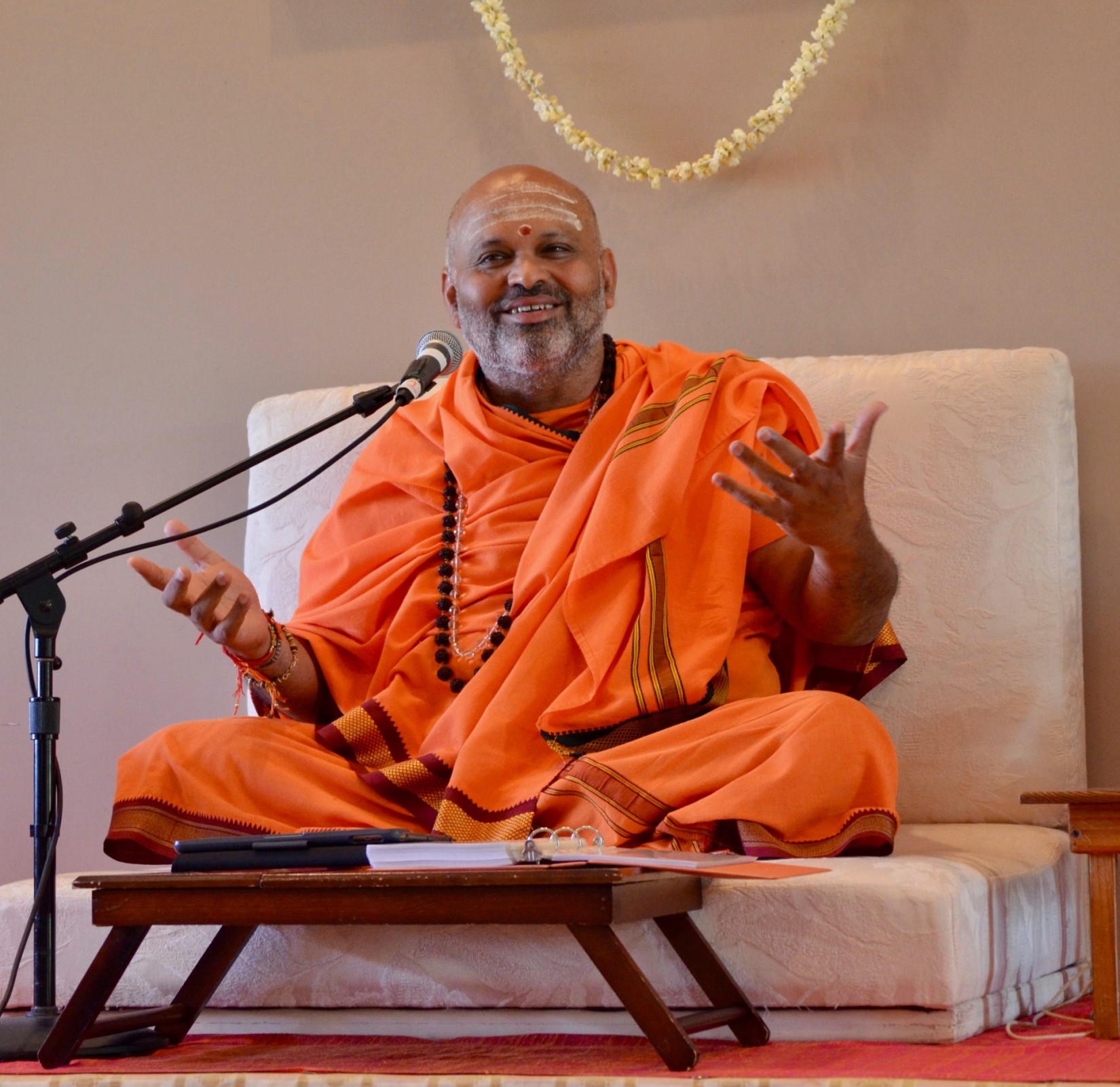
In a world driven by ambition, accumulation, and relentless forward momentum, the concept of sudden, absolute surrender is foreign to most. We try to map out our lives—choosing the right schools, the right degrees, and the right career paths. But what happens when the universe, speaking through the voice of a spiritual master, asks you to abandon the usual blueprint?
In a conversation with Ashok Vyas – founder of Heramba Studio – Swami Nityananda, currently sojourning in his Shanti Mandir ashram in Walden, New York, talks about his extraordinary journey. Now approaching five decades of monastic life, he reflects on his transformation from a science-obsessed teenager in Mumbai, determined to become a mechanical engineer, into a globally recognized spiritual leader.
His story is not just a biographical account; it is a masterclass in faith, the nature of true happiness, and the profound social responsibilities of the modern ascetic.
Ashok Vyas, host of his Wide Angle show on ITVGold, covers a wide range of topics—from Swamiji’s formative years to profound insight on the guru-shishya relationship and the social commitment of mystics.
The mechanical engineer’s blueprint
To understand the magnitude of Swami Nityananda’s pivot, one must first understand his initial trajectory. Growing up in Mumbai in the 1970s, he was like any other bright, ambitious youth. He was technically inclined, highly logical, and aimed to study mechanical engineering at the prestigious Indian Institute of Technology (IIT).
His parents were deeply devoted to the revered saints in the Siddha Yoga tradition, Bhagavan Nityananda and Baba Muktananda, so he spent his weekends and holidays in the Ganeshpuri ashram in Maharashtra, though his worldly goals remained intact. In March 1977, at age 14, he met Baba Muktananda, who was recovering from a heart attack in Juhu neighbor hood of Mumbai. Standing a respectful 10 feet away—filled with a mix of love, respect, and awe—he laid out his meticulously crafted plan: physics, chemistry, mathematics, and ultimately, IIT.
Baba Muktananda listened, seemingly approved, and offered his blessing. For 13 months, the young student stayed the course. He even took extra tuition to ensure his brilliance in the sciences would not falter. He was, by all accounts, on track.
The day the compass shifted
The definitive turning point of his life arrived on April 24, 1978. What was meant to be a simple meeting to receive blessings for his upcoming engineering entrance exams turned into a 180 degree redirection.
Baba Muktananda looked at the boy and asked a question that would shatter his worldly blueprints: “What use will you be to me as an engineer?You should study philosophy.”
The teenager was flabbergasted. In ordinary circumstances, a fifteen-year-old might rebel, demand counseling, or insist on consulting his parents. But his mother had always instilled a singular truth in him: We come here for Baba Muktananda. Driven by that deeply ingrained devotion, he simply said, “Okay.”
He immediately went to the principal of his college to switch from science to the arts track, only to be told he had to wait until August. When he reported this delay back to his guru, Baba Muktananda simply told him to stay at the ashram. By the very next morning, a completely new curriculum had been arranged for him: English classes with an American swami, Vedanta with a South Indian master, and Sanskrit with another resident scholar.
Looking back, Swami Nityananda realizes the sheer magnitude of this transition. There was no internal conflict, no longing for the life he left behind, and no dramatic farewells to his school friends. His path was reset overnight, and he walked it without looking back.

Taking the spiritual stage: The phenomenon of Shaktipat
Shortly after this profound life shift, Baba Muktananda informed him to get his passport ready. It was time to travel the world.
For a teenager whose universe had largely been confined to Mumbai and the local ashram, flying Lufthansa to Raffles Hotel in Singapore was a jarring introduction to the global stage. As they traveled from Singapore to Melbourne and eventually to the United States—hosting massive programs at venues like Carnegie Hall—the young monk-in-training became an observer of the human condition.
He watched as wealthy, powerful Westerners—politicians, movie stars, and affluent businesspeople—approached Baba Muktananda in search of something their money could not buy. He recalls a young man in Australia who repeatedly tried to surrender his entire wallet to the guru, only for Baba to gently return it, saying, “Please take your wallet back. I don’t need it; you need it to live your life.” He witnessed people spontaneously giving up alcohol, drugs, and worldly vices simply by sitting in the master’s presence.
This era was defined by Baba Muktananda’s unique spiritual tool: Shaktipat, the transmission of divine energy. During two-day intensive workshops designed to give seekers a direct experience of the divine, Baba would walk among thousands of people, touching them with peacock feathers. The resulting experiences were visceral and immediate. People would go into deep trances, travel to inner worlds, and awaken to a spiritual reality they never knew existed.
As a translator and close aide, the young Swami absorbed these moments, pondering a crucial question: What is it that this sadhu has that these powerful people want?
Through his grounded humility, and his commitment to social upliftment, Swami Nityananda proves that true enlightenment is not an escape from the world but a deeper, more compassionate engagement with it. He stands as a living reminder that the happiness we search for in the external world is within us, requiring us to sit still, turn inward, and just be.
Demystifying Ananda: The search for true joy
The answer to the question he asked himself lies in the very name bestowed upon him: Nityananda, which translates to “Eternal Bliss.”
In his conversation, Swami Nityananda eloquently breaks down the fundamental misunderstanding humanity has about happiness. We often confuse sensual or worldly pleasure with true joy. Worldly pleasure, he explains, is highly conditional. It depends on an object, a person, a specific environment, or a bank balance. Because these external factors are subject to change, the pleasure they bring is inherently fragile.
To illustrate this, he shares a profound teaching from his guru regarding sleep. At the end of the day, even a person who possesses the most fabulous luxuries in the world must go to sleep. They willingly abandon their worldly pleasures for six to eight hours. Why? Because the deep rest, relaxation, and peace they feel upon waking do not come from their possessions, these come from within.
“If the world is what gave you the ananda, you would not take those six to eight hours to sleep… What is it that is within me that I wake up the next morning and say, ‘I feel so good’? The actual pleasure you are seeking is not there outside; it’s inside.”
To further ground this philosophy, he recounts a story of Swami Chinmayananda, a well-known Vedanta teacher. When a young boy claimed he could not believe in God because he could not see him, the Swami pinched the boy. When the boy cried out in pain, the Swami asked to see the pain. The boy argued that pain cannot be seen, only felt. “Just like I cannot see the pain, but you can feel it,” the Swami replied. “You cannot see God with physical eyes, but you can feel him.”
True Ananda is the ability to remain anchored in that internal divinity, regardless of external circumstances. The Swami likens the ideal spiritual state to a Jewish rabbi who, upon losing his entire fortune in the stock market, remained perfectly calm. When his disciples asked if he was worried, he replied, “Yes, for a moment.” The mastery is not in avoiding worldly worry, but in the ability to acknowledge it and immediately let it go, remaining like a rock over which the waters of life flow without penetrating the stone.

The weight of the garland: Embracing the succession
The culmination of his early training occurred in July 1981, when he was privately informed that he would be named Baba Muktananda’s successor. In May 1982, during a massive Pattabhishekam (anointment) ceremony, Baba placed a garland around his neck, officially transferring the spiritual mantle.
Initially, the sheer weight of this responsibility felt crushing. How could he possibly step into the shoes of a spiritual giant? But as he bowed to his guru, a profound realization washed over him, instantly making the heavy garland feel remarkably light:
“Why am I worried? He is the guru; it’s his job. I simply have to be the instrument.”
This deep-seated humility has defined his leadership over the last four decades. Even while managing his 4 ashrams across the globe, he visits the temple daily to bow before the statues of his lineage. He actively rejects the ego trap of thinking, “I am capable,” constantly reminding himself that any success or spiritual power flowing through him is entirely the grace of his teachers.
The modern ashram: Where spirit meets society
One common misconception regarding ascetics (sannyasis) is that they detach completely from societal responsibilities. Swami Nityananda shatters this myth, demonstrating that profound inner peace naturally overflows into active social service.
Under his guidance, the Shanti Mandir ashrams have evolved into vital hubs of education and community support. Recognizing the importance of preserving ancient wisdom, they established a residential Sanskrit school (Gurukul) that now houses hundreds of students. These students study from the sixth grade through to Ph.D., many going on to become professors and esteemed scholars.
Furthermore, recognizing the need to bridge ancient wisdom with modern society, they opened an English-medium school that integrates Indian Knowledge Systems (IKS) into its curriculum. Beyond education, the ashram operates mobile medical vans for rural women, Ayurvedic clinics, and crucially, provides counseling services.
Swami Nityananda strongly advocates that ashrams must be places of active listening and mental health support. He acknowledges that despite India’s deep spiritual roots, modern society—across all socioeconomic classes—faces intense psychological and social struggles. His aim for the ashrams is to shape cultured individuals who will improve their communities, not just learn philosophy.

Confronting the final illusion: Death
As the interview draws to a close, the conversation turns to the ultimate fear that haunts humanity: the fear of death.
Drawing upon the wisdom of the Bhagavad Gita, Swami Nityananda offers a profoundly comforting perspective. The fear of death is entirely rooted in our false identification with our physical bodies. Through dedicated daily practice (sadhana), a seeker slowly untangles their core identity—the Atman or soul—from their physical vessel.
He offers a simple, practical shift in language to begin this detachment: instead of saying, “I am sick,” we should train ourselves to say, “The body is sick.” By consistently reinforcing the idea that the body is merely a temporary garment, the fear of losing it dissipates. “Who dies? Just the body. I’m going to live. I’m going to be reborn… The Atman sheds the body because it is torn, just like we shed old clothes.” Once a person experiences that spark of internal divinity—that they are the observer, not the observed—the illusion of death breaks, and true freedom begins.
Just be
Swami Nityananda’s life is a testament to the power of unwavering faith and the beauty of a surrendered life. He may have abandoned his plans to build physical machines as a mechanical engineer, but over the last 50 years, he has dedicated himself to something far more complex: understanding and elevating the human spirit.
Through his daily discipline, his grounded humility, and his commitment to social upliftment, he proves that true enlightenment is not an escape from the world but a deeper, more compassionate engagement with it. He stands as a living reminder that the joy we search for in the external world is within us, requiring nothing more than our willingness to sit still, turn inward, and just be.
Swami Nityananda has three ashrams in India, including the main one in Magod, Gujarat, and one in Upstate New York. Details about meditation intensive sessions, Indian classical music programs and scripture specific events can be found at ShantiMandir.com https://www.shantimandir.com


Leave a Reply