


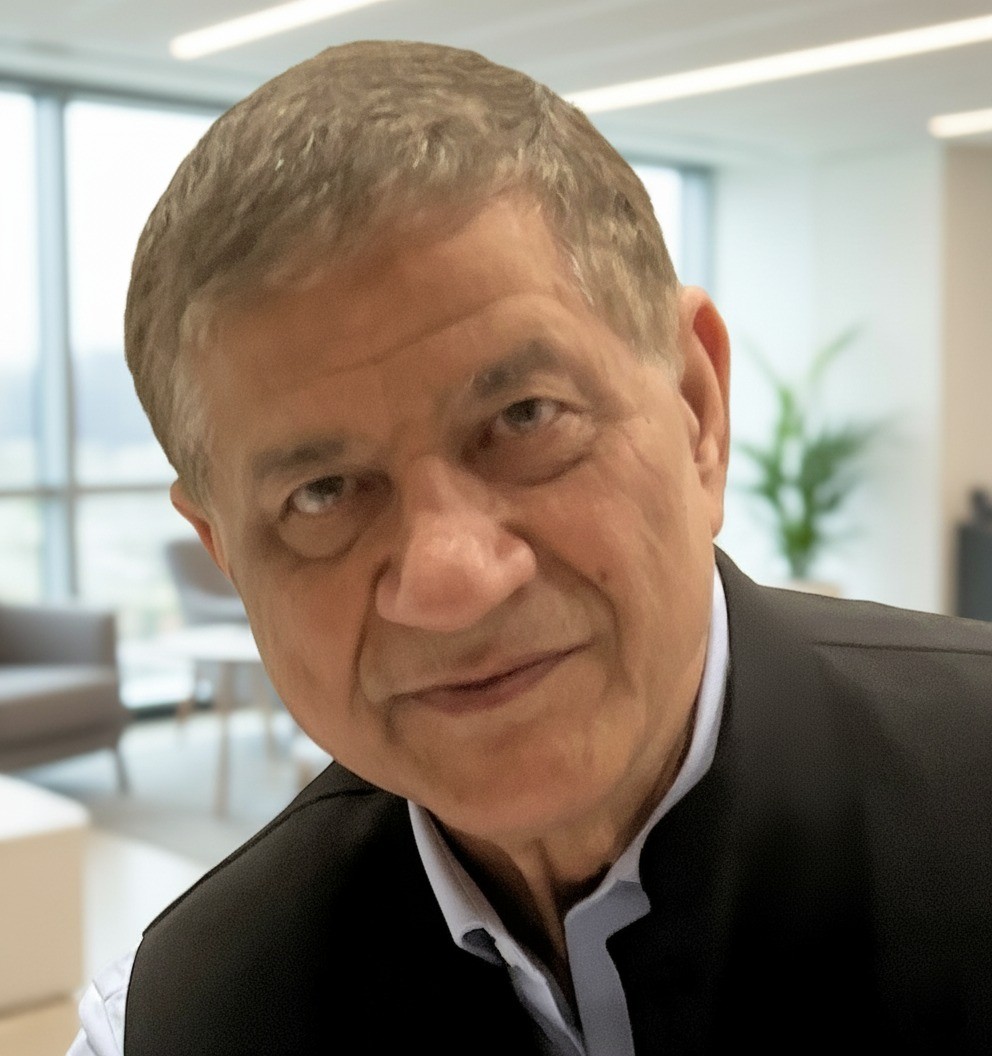
New York-based artist, collector, and spiritual seeker Nayan Kisnadwala’s creative journey began not in an art school but with a spontaneous visit to an art store in London that reignited a childhood love for painting. A finance executive, he has created more than 400 artworks already under the artist name of Nayanmitra, and held exhibitions across London, New York, and Mumbai, transforming his spiritually inspired paintings into prints, scarves, and rugs in the last 12 years.
Nayan is deeply influenced by sacred geometry, color therapy, numerology, and the teachings of GuruMaa, referred to by her followers with the exalted name of Her Holiness Anand Sri Vibhushit Pratham Parvatyachatya Sri Sri GuruMaa Jyotishanand Saraswati. She founded Vedic Heritage Inc and its Hanuman Mandir, the first Sanatani temple on Long Island. Nayan sees art as a medium for healing, meditation, and positive energy. Encounters with legendary artists like S.H. Raza further shaped his vision, blending spirituality, symbolism, and universal humanity into his work.
In this conversation with Parveen Chopra, Founding Editor of A Lotus In the Mud, he reflects on his unconventional artistic journey, the mentors who transformed him, and his aspiration to make art a bridge between culture, consciousness, and compassion. Excerpts from the interview conducted in the Hanuman Mandir in Hempstead, NY, of which he is Trustee and President, and his Garden City home, which is a veritable museum of art – choc-a-bloc with paintings, sculptures and artefacts he has collected from different parts of the world over the years.

Parveen Chopra: How did your journey as an artist begin?
Nayan Kisnadwala: I never had formal art training, but I loved art from childhood and was very good at it. I was also good with numbers, and eventually, numbers became my career while art was left behind. About 12 years ago, while walking in Soho, London, I passed an art supply store, walked in impulsively, bought paints and paper, and began painting again. Even before completing my first artwork, I decided I would hold an exhibition exactly one year later and booked the Nehru Centre in Mayfair, London. I completed 35 works for that show, and half of them sold within 24 hours.
How extensive is your body of work today?
Nayan Kisnadwala: Over the last 12 years, I have created more than 400 artworks, and around half of them have been sold. I have held a dozen public exhibitions across London, New York, Mumbai, and Long Island. Besides public shows, I also host private exhibitions at home for select friends and family. I also digitalize all my works so I can create prints in different sizes and make art more affordable. Around 350 artworks are currently on my website, with 50 more on its way. https://www.nayanmitra.com/).
What inspires your artistic philosophy and style?
Nayan Kisnadwala: My work combines sacred geometry, color therapy, numerology, and spiritual symbolism. Many of my paintings are based on yantras, geometric forms, and repeating sacred patterns. I believe colors and symbols create vibrations, and my intention is for my artworks to radiate positivity and healing energy. I’m fascinated by how spirituality, nature, architecture, stained glass, temple iconography, and ancient symbols influence consciousness. Much of my work is imaginative and spiritually inspired rather than purely technical.

“For me, art is not limited to canvas; it is a way of expressing spirituality, beauty, and positive energy in every form.“~Nayan Kisnadwala/Nayanmitra
What role has charity played in your art career?
Nayan Kisnadwala: Charity has always been central to my art journey. My first London exhibition sold artworks to support charitable causes. Over the years, I have supported organizations like Vedic Heritage Inc, the Nelson Mandela Children’s Fund in South Africa, and Shishur Sevay, an orphanage for impaired girls in Kolkata, where I also serve as president of the trust. Much of my art has been created with the intention of raising money for humanitarian and spiritual causes.
How have you expanded your art beyond paintings?
Nayan Kisnadwala: I’ve transformed some of my paintings into wearable art, especially scarves inspired by luxury Western-style silk scarves, as well as rugs. I hope to expand further into wearables and textile-based creations in the future. I also see possibilities for my art in hotels and large spaces through affordable digital prints, because hotels can buy hundreds of prints more easily than original paintings.

Did you have any mentors or people who influenced your artistic development?
Nayan Kisnadwala: Yes. GuruMaa played a very important role in awakening creativity within me and teaching me aesthetics, design, and symbolism. She gave me the name Nayanmitra. Later, in London, I met the artist David Cranswick and took a few sessions with him. Though brief, those sessions were transformative, and he helped “open the channel” creatively for me. He also introduced me to natural pigments made from plants and minerals, which I continue to admire for their richness and durability.
S.H. Raza has been my greatest artistic influence. I once spent half a day alone with him in his Paris studio, where he explained his philosophy and artwork in depth. Though a Muslim, his art was deeply inspired by Vedic philosophy and universal spirituality. His studio contained a Ganesha idol, the Quran, and a Cross, which reflected his belief in unity across religions — something I deeply connected with. I also admire artists like Vaikuntam from Hyderabad, whose vibrant paintings radiate positivity, and G.R. Santosh, whose work is rooted in Vedic and tantric symbolism.
How did you develop your techniques without formal training?
Nayan Kisnadwala: I learned through experimentation and instinct. I began with watercolors and gradually explored gouache, acrylics, pastels, alcohol inks, and different surfaces such as paper and canvas. My next frontier is oil painting. I constantly study, observe, and teach myself through practice, travel, books, museums, galleries, and conversations with artists around the world.

How important is travel and collecting art in your creative life?
Nayan Kisnadwala: Travel is deeply connected to my spiritual and artistic journey. Whenever I visit a country, I seek out artists, galleries, museums, and spiritual spaces. I’ve met artists in Bhutan, Sri Lanka, Myanmar, Paris, Rajasthan, and many other places. Every journey becomes an exploration of that culture’s artistic and spiritual traditions. I also collect art seriously and own works by several renowned Asian artists.
What are your plans as an artist?
Nayan Kisnadwala: I hope to eventually publish a book explaining my artwork, artistic philosophy, sacred geometry, numerology, symbolism, colors, flowers, and spiritual meanings in a simple way for future generations. I also want to expand into more wearable art, rugs, and large-scale print projects. Alongside painting, I practice Ikebana—Japanese floral arrangement—blending it with Indian and French influences to create floral installations. For me, art is not limited to canvas; it is a way of expressing spirituality, beauty, and positive energy in every form.
Here are some details about the Lotus’ Yoga Day event on June 16, where Nayan is a speaker and where some of his artworks will be auctioned for charity: https://alotusinthemud.com/immerse-yourself-in-devotional-spiritual-yoga/
From finance to faith: Nayan Kisnadwala’s journey with Vedic Heritage Inc

For Nayan Kisnadwala, the journey from being a Chartered Accountant in Mumbai, India, to becoming a finance professional in the United States – currently Chief Financial Officer of Fidem Financial – eventually led him to his spiritual journey. In the land of opportunities, he not only built a successful career in banking and finance but also discovered his spiritual side through a chance meeting with his guru, GuruMaa Jyotishanand Saraswati, the founder of Vedic Heritage Inc. Established in 1979, the organization flourished under GuruMaa’s leadership as a center for promoting “the heritage of our Vedas in the West,” with the Sri Hanuman temple in Long Island becoming its spiritual heart—a legacy Nayan now helps lead and preserve.
A chance meeting that changed his life

Nayan recalls first encountering GuruMaa soon after securing an MBA in Finance from NYU. Having bought his first home on Long Island, he began searching for a nearby temple for a puja and was directed to GuruMaa through Professor Anand Mohan. “Since then I’ve not stopped, literally,” he says. What struck him most was GuruMaa’s immediate confidence in him. “The first time she met me, she told Anand Mohan… ‘He will do a lot for this temple’,” says Nayan.
Over the years, the relationship evolved far beyond that of a devotee and spiritual teacher. Nayan became deeply involved in managing the organization and accompanying GuruMaa on pilgrimages. “I’ve been under her wings ever since,” he says. “My motive was how can I help GuruMaa spread the message of Hanumanji and Vedic Heritage throughout… It’s not about me.”
GuruMaa not only helped him discover his spiritual side; her teachings also shaped his daily discipline and way of life. Nayan still follows the meditation techniques she taught him, waking up at 4 a.m. each day for “puja, meditation, and physical exercise.” He now teaches meditation classes himself at the temple, passing on what he calls the “seven steps” taught by GuruMaa, including pranayam, positive visualization, and Om chanting.
Custodian of GuruMaa’s legacy

The organization continues to preserve GuruMaa’s vision in both the US and India. Alongside the Long Island temple, Vedic Heritage maintains a property in Lonavala, near Mumbai, where GuruMaa had planned an ashram spread across 10 acres in the hills. “There are amazing positive vibrations from that land,” Nayan says, describing the unfinished project as part of a continuing spiritual legacy.
Nayan continues to oversee temple activities, fundraising, renovations, and community outreach while also helping sustain GuruMaa’s vision of expanding Vedic learning among Indians and non-Indians alike.
When asked about his role in the organization, which has 11 trustees, he describes himself not as a leader but as the temple’s “chief sevak (worker).”
Even while balancing a career, family life, temple management, and philanthropy, he says humility remains central to GuruMaa’s teachings. “This temple is run with public money for the public,” he says. “I have a huge responsibility to ensure that we are taking good care of the mandir, which belongs to the people.”
For Nayan, caring for the temple is ultimately a continuation of his mentor’s work. “It’s been done to continue the teachings of the Vedas, Hanumanji, and GuruMaa,” he says.
Contact: https://vedicheritagetemple.org/

Leave a Reply