


Does anyone here have a mixed relationship with money? Have you ever wondered how to turn ‘apna sapna money money’ (our dream is money money) into ‘apna reality money money’ (our reality is money money)? I have always had one big mental block that those who pursue Saraswati may not be blessed with Laxmi, and vice versa. Does anyone else feel the same way?
If yes, stay with me till the very end. This time, I am exploring the fascinating dimension of financial abundance through the lens of our scriptures. Yes, you read that right; our scriptures, the Vedas and Puranas, laid down the foundation for our understanding of life and prosperity. Yet, somewhere along the way, we started seeking answers in technology when some answers were right in front of us—in mythology.
Let us begin by exploring different stories and understanding how we can absorb them.
Building wealth requires sustained efforts
When the Devas lost their fortune, strength, and energy, the Asuras grew powerful and began wreaking havoc across the worlds. To restore cosmic balance, the Devas sought Lord Vishnu’s help. He advised them that the only way to regain their power was through Amrit, the nectar of immortality.
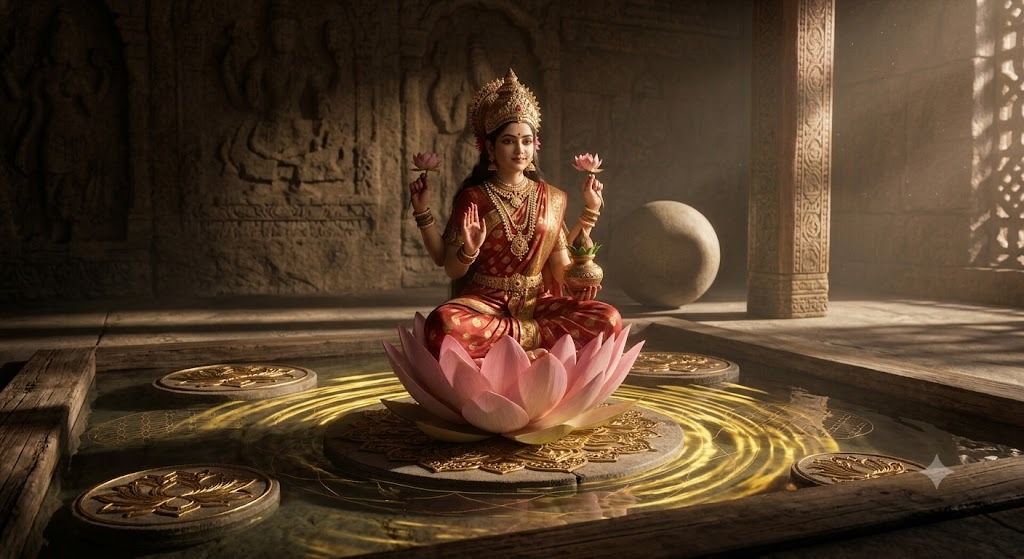
Thus began the Samudra Manthan—the churning of the Kshira Sagar (the Ocean of Milk), undertaken jointly by the Devas and the Asuras. During the Samudra Manthan, Mount Mandara served as the churning rod, while the serpent Vasuki served as the rope. The Devas and Asuras churned the ocean for ages. Among the divine treasures that emerged was Maa Laxmi, the goddess of wealth.
The lesson? Wealth rarely comes without effort.
Just as the ocean’s churning required sustained effort, creating financial abundance also takes patience, perseverance, and dedication.
Wealth is fickle. It is always accompanied by misfortune. But hey! you can prevent that too.
If you have ever noticed, Maa Lakshmi is often depicted standing, symbolizing her restless, playful, and ever-moving nature. It is also said that her elder sister is Alakshmi, who represents misfortune and poverty. Alakshmi is believed to enjoy darkness, negativity, discord, and conflict.
Somewhere along the way, we began interpreting this belief literally, hanging lemons and chillies outside our homes to ward off Alakshmi and prevent misfortune.
But perhaps we have missed the deeper message. What we should really keep at bay is negativity in our hearts—grudges, jealousy, and resentment, as well as constant quarrels and unclean surroundings. After all, these are hardly conducive to enjoying peace and prosperity. And if Maa Lakshmi is as playful and restless as our scriptures portray her, perhaps she will not stay long in a home dominated by negative energy!
Striking a balance and upward growth
Ironically, it’s also believed (erroneously) that Maa Lakshmi and Maa Saraswati cannot coexist. Maa Saraswati is the Goddess of knowledge, speech, and wisdom. This has been the most confusing part for me: I somehow began taking this belief literally, wondering whether too much knowledge might mean less wealth! Is there any silly child like me here?
Well, life is all about balance and harmony. Life cannot be about extremes: desiring knowledge alone, being satisfied with acquiring it without converting it into wisdom, or using it for the greater good, and thereby leading to stagnation. On the other hand, desiring materialistic abundance alone without purity of intent or a clear vision may foster ego and arrogance, ultimately leading us to lose it all.
My beloved Guru Mahatria explained it to me in simple words: “Life is all about this and that.” It’s also said that Lord Ganesha, who represents pure intellect, sits between Maa Lakshmi and Maa Saraswati. It’s through our power of intellect, or buddhi, that we can strike a balance between the pursuit of wealth and wisdom.
Ravana in the Ramayana and the Kauravas in the Mahabharata illustrate how even those who possess immense power and wealth can lose everything. Ravana, driven by his lust and breeding anger, lost his ‘sone ki Lanka.’ Similarly, had the Kauravas accepted the offer of giving just 5 villages to Pandavas, the entire Kurukshetra war might have been averted, and their prosperous kingdom—Hastinapur—would have been preserved.

To those who have, more will be given
According to our scriptures, Maa Lakshmi gains energy from joy, happiness, gratitude, and a giving attitude. The more we share knowledge, the more we absorb and convert it into wisdom. By contrast, Maa Alakshmi thrives on bitterness, negativity, and jealousy. Therefore, the more resourcefully we think, the more happiness we radiate, and the more likely we are to attract Maa Lakshmi.
Daanveer Karna of the Mahabharata earned this epithet through his innate generosity, giving freely to all who sought his help, without discrimination. Like his father, Surya, the Sun God, who shines on everyone without distinction, Karna gave without holding back. Despite being regarded as a sutputra (a person born to parents belonging to the lower caste), he continued to attract material abundance.
And here I am, trying to make sense of all this wisdom, absorbing it as I write this piece, and cultivating an attitude of working towards wealth from a place of happiness—literally celebrating wealth in my life and in the lives of those around me who attract abundance.
One significant attitudinal shift I have embraced is celebrating not just the money that flows into my life but also flows out of my life. Whether I am investing funds or in a course, shopping, paying for a service or an Uber driver, or anything else, in my heart I wish for that money to multiply in the recipients’ lives. I can hardly put into words the energy shift I feel—I wish you tried it too.
As I write this, I realize these hacks are so simple, yet we often overlook simple truths of life and miss implementing them—just like that sunset or this abundance hack.

Leave a Reply