


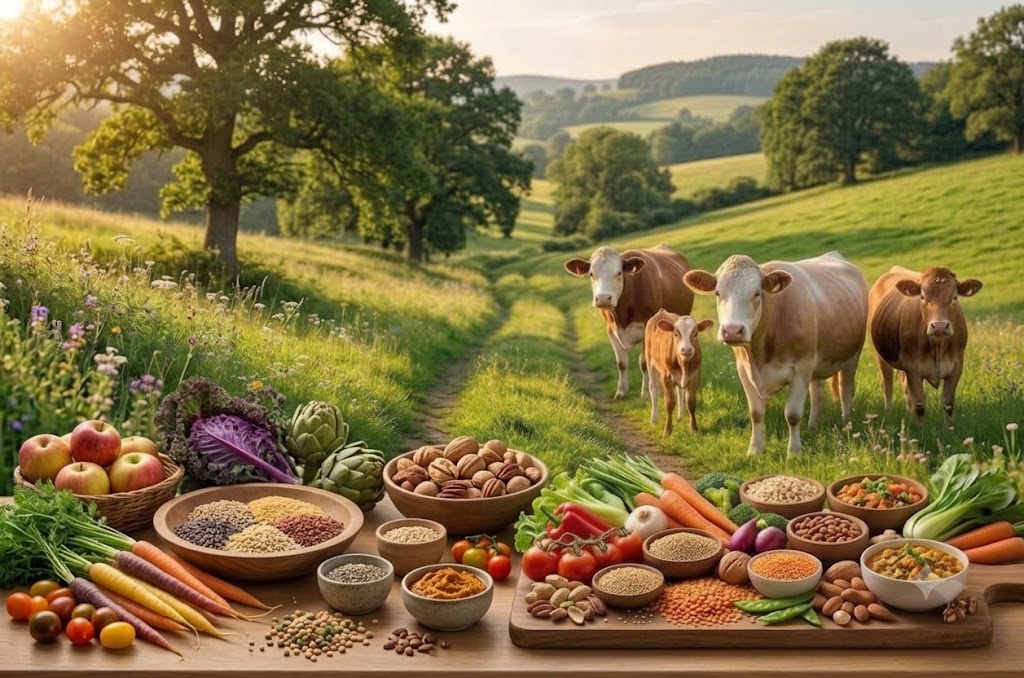
Ahimsa—non-violence toward every living being—is the most beautiful word spoken by humans. It transcends politics, race, religion, species, and every other division, guiding our character, teaching us to oppose violence and cultivate compassion for all life.
Over 2,500 years ago, Bhagwan Mahavir taught that every soul deserves respect and the right to live. Long before modern concepts of human rights, sustainability, or animal rights, Jainism had defined this path.
Ahimsa is in the DNA of Jains. And there are 5 million (50 lakhs of us)!
Imagine the extraordinary impact if every Jain chose to follow a plant-based diet for just one year by avoiding all dairy products: milk, cheese, yogurt, ghee, butter, buttermilk, and the many foods made from them.
Such a decision could become one of the greatest collective acts of compassion ever undertaken by any religious community.
Why this matters
Modern dairy farming is closely and directly linked to the meat industry. Cows and buffalos must repeatedly become pregnant to produce milk. Male calves (bull calves) have no use, are considered economically unprofitable, and are commonly slaughtered for beef, veal, and pet food. Female calves frequently enter the same dairy cycle. When cows and buffaloes can no longer produce milk economically, they too are sent for slaughter.
There is no gentle version of this anywhere in the world. The buildings look different in Wisconsin, USA, and in Uttar Pradesh, India, but the arithmetic is identical: a mother must lose her child so that we can drink what was meant for him.
Despite all the vegetarians in the world, slaughter is rising. More animals are killed today than were killed yesterday or the year before. Meat, egg, and dairy consumption and exports are climbing globally – in the United States, and in India. According to a new UN-OECD report, the output of meat, dairy, and eggs is expected to grow by 17%, while total livestock inventories are expected to grow by 7%. Good intentions held quietly have not slowed this down by a single day.
By choosing plant-based alternatives, Jains would significantly reduce the demand that drives this cycle and give practical expression to the principle of Ahimsa.
A global impact beyond the Jain community
This movement’s impact would reach far beyond five million people. As governments, researchers, and global media recognize this as a landmark compassion initiative, it will trigger a ripple effect, encouraging schools, businesses, and other faiths to shift toward plant-based choices. History shows that significant change doesn’t require vast numbers. Though five million is a fraction of the world’s eight billion, this community has long shaped global ethics and sustained the philosophy of non-violence. Small, determined groups have always been the true catalysts for change.

A historic opportunity
Every generation has the chance to leave a lasting legacy. While our ancestors built magnificent temples and institutions, our era offers a new, urgent opportunity. We can transform Ahimsa from a philosophical ideal into a practical solution for today’s ethical and environmental crises. Jain greatness is measured by values, not numbers; our collective compassion can ignite global change. Our greatest contribution is in building a Temple of Compassion in the hearts of humanity. This begins with a simple decision: to live in a way that spares animals, conserves resources, and allows the Earth—and Ahimsa—to flourish.
Imagine newspapers around the world carrying headlines such as:
“Five million Jains unite for a global year of Ahimsa.”
“The world’s Jain community leads a historic compassion movement.”
What a remarkable tribute this would be to Bhagwan Mahavir and his timeless message of universal compassion.
What one year would actually achieve?
Compassion is not usually something you can put a number on. This time we can. Below is what five million Jains would accomplish in a single year, calculated on a deliberately conservative assumption.
The assumption in the calculation: 350 ml of all dairy products per person per day, measured as liquid milk equivalent. That is about one and a half steel glasses of milk, or roughly the weight of one can of soda. (350 mL/day) x (365 days) x (five million people) equals about 438 million liters of milk that would be saved.
Note: Real consumption in most Jain households is considerably higher, so every figure below should be read as a floor, not a ceiling.
Here is the IMPACT TABLE/BENEFITS

Far-reaching imapct
In addition, such a collective decision by 5 million Jains would bring many other significant benefits—not only for animals, but also for human health, the environment, ecology, and the conservation of our precious natural resources. It would help reduce greenhouse gas emissions and conserve the scarce water and land resources needed to feed a growing world population—without relying on a non-vegetarian diet.
If five million Jains were to choose this path—completely giving up dairy products in every form for just one year, or even beginning with one month—history may remember it as one of the most beautiful and powerful expressions of Ahimsa ever witnessed.
Paryushan and Das Lakshan Parvas are just around the corner. What more auspicious time could there be to make such a commitment? Let us take this step—not merely as a change in diet, but as a collective expression of our deepest Jain values of Ahimsa, compassion, and respect for all life.
You decide!





Leave a Reply