


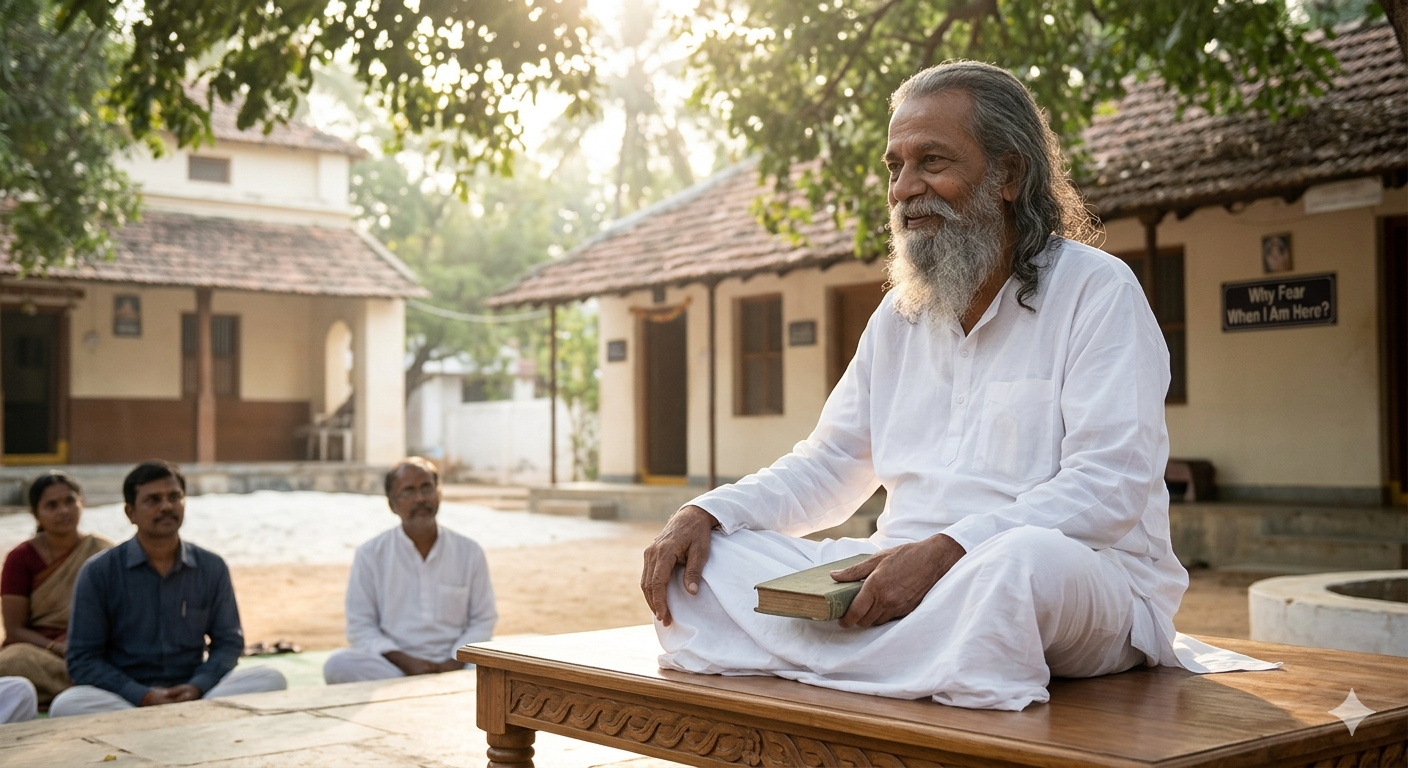
I grew up with Shirdi Sai Baba as a familiar presence, thanks to my spiritual parents who insisted we make an annual pilgrimage to his village in Maharashtra, India.
Back then, Shirdi did not even have motorable roads, let alone an airport! So we would take a train to Kopargaon and then a bullock-cart ride to the Shirdi village (yes, really!). For lodging, there was only the temple’s dharmashala (guest house). My mum and I even clicked a picture with Lakshmibai, a tireless devotee known for walking miles through the woods to bring food to Sai in deep meditation.
Those visits were a cherished part of my childhood.

The stranger who came home and his predictions
This prologue is perhaps the key to an unusual blessing our family received once, after we had returned from Shirdi.
It was mid-morning on a Sunday when the doorbell rang. I rushed to open it and found a tall, swarthy man dressed exactly like the Saint of Shirdi—except his ‘kafni’ (headgear) was open and not tied the way Baba is usually shown in the pictures.
Before I could say anything, he turned to my mum, who had come up behind me, and asked rather roughly, “When did you last visit Shirdi?”
“We went for Nagpanchami!” my mum replied as if it were the most normal thing in the world for a rustic-looking stranger to knock on our apartment door in Mumbai and demand details of our last trip to Shirdi.
The most peculiar aspect of that half-hour visit was that nothing felt peculiar at that time. It did not seem odd at all to invite him in when he asked if he could do aarti of the Shirdi Baba portrait hanging on the wall (this was the ‘clincher clue,’ if I may call it that), except when he reached into his kurta pocket, pulled out a handful of coins, and randomly handed them to each one of us: my Mamaji (maternal uncle), my masi (maternal aunt), my mum, and I.
And just like that, the doorbell rang again.
It was my dad who had stepped out on some errands and had just returned. As he bent down to lift the visitor’s heavy black leather slippers, perhaps to place them on our shoe rack, the old fakir growled, “Don’t you know only Lakshmi can touch those slippers?” he snapped in Hindi.
Flabbergasted, my dad hurriedly put them down and vanished into the washroom. That’s when the stranger raised his right hand and, with a single finger, gestured towards my skeptical Mamaji, who was standing off to the side, staring out of the window, to come closer.
Reluctantly, dragging his feet, Mamaji, a dashing Air Force guy, walked over to Baba’s chair. “You will go back with a promotion,” the stranger said, holding his shoulders and making him smile politely.
Then he called me.
Barely into my teens and exploding with inexhaustible verve, I rushed over to the table placed in front of him. “Listen,” he said, and then, using his forefinger, drew two imaginary rectangles on the tabletop, one inside the other.
He then looked searchingly into my puzzled eyes. Pointing to the rectangle inside, he said, “Aisa ghar hoga aur aisa aangan hoga (indicating the outer rectangle)…Aur, tere haath ke neeche do-do!”
Roughly translated, this is how your house will be; this is your courtyard, under your thumb (authority), there will be two more.
I bounced away without even saying thank you. At that impertinent age, I couldn’t make head or tail of what he had said.
Then he turned to my mum and said, “Will you give me a rough cloth to cover the samadhi?” That very morning, my mum had bought some coarse, cream-colored cloth used for lining curtains. She brought it and offered it to him.
He rose, raised his hands in blessing, and walked towards the door. I rushed, curious to see where he was going. But then he turned sharply. “Close that door!” he commanded in a fierce tone
Much later I read that Shirdi Sai often spoke gruffly, as if to drive home a point.
I obeyed, shut the door, and reopened it in a trice. He was nowhere in sight. I ran down the passage into the compound, then to the main gate, scanning the street. But no, there was no one…
When the predictions came true
Just as the stranger had predicted, my Mamaji returned to Bengaluru and discovered he had been promoted to Air Commodore.
And almost a decade later, I married a man who had an independent rectangular bungalow surrounded by a garden. My husband had younger twin brothers, and when they got married, I suddenly found myself with the ‘haath ke neeche do-do’ he had spoken about—two co-sisters-in-law under my wing!
“Of course that was Sai Baba,” my friend Gautam Sachdeva later told me with complete conviction. Gautam, who runs Yogi Impressions, a publishing house dedicated to spiritual books, has recently written ‘Living With Faith and Patience’, an absorbing compilation of conversations between him and spiritual seeker and cinematographer Nikhil Kripalani. The book demystifies Shirdi Sai Baba’s unique way of functioning as a spiritual mentor.
Searching for a living guru
In 2002, during a visit to Shirdi, I stood in the sanctum sanctorum
and told Baba I was done with one-sided conversations. I said now I need a living guru who could correct me in person and help me move forward on my spiritual path.
And then, in early 2003, I met the master who gave me mantra deeksha and helped me fine-tune my spiritual sensibility.
But about that, a bit later…

First, let me share something fascinating about His Holiness Parijnanashram Swamiji III. He was the 10th Mathadhipati (spiritual mentor and head) of the Shri Chitrapur Math, Shirali, a tiny hamlet in Karnataka, India.
A visionary and progressive in outlook, he bewildered the closed-minded locals. Eventually, he relinquished his position as the spiritual head and settled in Karla, Maharashtra, where his Sanjeevani Samadhi continues to draw thousands of devotees who speak of extraordinary miracles and powerful spiritual experiences. The deeply charged energy of his spiritual shrine is further enhanced by an enchanting idol of Devi Durga Parameshwari consecrated within the shrine.
The meaning of 73 and 88
The reason I mention this master is that, even today, devotees continue to share uncanny experiences of how he appeared, sometimes in physical form, to help them through moments of crisis.
Swamiji was also an enthusiastic ham radio operator. Once, when a devotee asked how she would continue to feel his presence after he shed his mortal coil, he gave her an interesting reply. Borrowing from the codes used in ham radio communication, he said, “Whenever you see the number 73, know that I am wishing you ‘All the Best’.” And when you see 88, know that I am sending you ‘All my Love.’”
The very next morning, after my dear friend in Bengaluru had shared this interesting story with me, I hired a car to visit Mysore. As my eyes fell on the number plate, I was amazed. It had only two digits on it, and yes, they were 88!
“Are you a devotee of Parijnan Swamiji?” I immediately asked the bewildered driver. He shook his head to say “no.”
But that was only the beginning.
Over the years, whenever I have been deeply upset, returning home late at night, or simply thinking about Him, I have often noticed a white car with the number plate 88 appearing right in front of me. As though announcing his presence in the simplest way possible
Twice, en route to his samadhi at Karla, I had just finished telling a fellow traveler about Swamiji’s 73 and 88 messages when, as we turned into the temple lane, both of us spotted a white car ahead of us with the number plate 7388!
At some point, coincidences stop feeling like coincidences.
The forgotten manuscript that fell from the wardrobe
But the cherry on top moment was the eve of my proposed lunch meeting with my publisher, Gautam Sachdeva, who wanted to discuss a podcast project with me. Parijnan Swami’s portrait is just next to my wardrobe. As I was opening it to decide what to wear for the lunch, I looked at Swamiji’s portrait and silently requested, “Can you really send me a prize assignment to work on with Gautam?”
And then, absolutely on cue, a bag from the top shelf of the wardrobe came crashing onto my head. When I opened it, I found inside only one typed manuscript: the final draft of my biography of reputed bhajan singer Hari Om Sharan.
The manuscript had been lying forgotten for years. A gentleman in the US had once planned to publish it, but after suffering a huge financial setback, the project had been shelved indefinitely.
But how did that particular bag land on my head that evening, carrying the manuscript I had completely forgotten about?
Honestly, I really, really don’t know.
But something—call it a sixth sense or intuition—told me to carry it with me. Don’t ask me why. So I carried it. And then, in the course of the meal, Gautam suddenly asked, “Hey, whatever happened to your book on Hari Om Sharan?” To his utter astonishment, I simply smiled and fished out the manuscript from my bag. He said he would revert after reading just one chapter.
He did.
Today, the book titled ‘A Song of Surrender’ is available on Amazon. It has received glowing 5-star reviews, and a Hindi edition is in the pipeline.
All I can say is this: humbled, grateful, and quietly amazed—” Thank you, Parijnan Swamiji.
Durga Saptashati that arrived on its own
I met this amazing saint only twice—once during his initiation ceremony when I was just nine years old and later, when I was to graduate. But believe me, even today, I draw immense strength and reassurance from the twinkle in his searchlight gaze and the tenderness of his smile.

“I will see that you get it,” His Holiness Sadyojat Shankarashram Swamiji told me gently.
Swamiji is the successor to Parijnan Swami and the 11th living mentor of Shri Chitrapur Math, which has a spiritual lineage, or guru parampara, that stretches back more than 300 years.
He was referring to the Durga Saptashati, a sacred compilation of 700 verses that recounts the many wondrous tales of how the mighty Devi Durga defeated seemingly invincible demons like Shumbh-Nishumbh, Raktabeej, and the dreaded Mahishasura.
He said this after giving me ‘mantra-deeksha,’ the formal initiation ceremony in which a spiritual mentor gives a secret mantra to the shishya, or disciple, to chant every day using a japamala, a string of 108 ‘rudraksha’ beads.
His promise to get me that book came right after I admitted I had never read it. I had barely reached home when I got a call from my Masi (my mum’s younger sister). “Murthy just bought a book and told me to give it to you before he reads it,” she said.
Now, Murthy, her husband, whom she had married over a decade ago, had never done anything remotely like this.
“I will drop by tomorrow and pick it up,’ I said, deliberately ending the call quickly.
The truth was, I wanted to enjoy that delicious excitement of ‘not knowing’ for more time because I was almost certain it was the same book Swamiji had promised to give me.
And I was right.
The next day, my masi handed over that slim yellow volume published by that legendary publishing house of Hindu religious books—Gorakhpur Press.
As I held the book in my hand, I could not stop wondering why Murthy Mausa ji, a devoted follower of Sathya Sai Baba, had suddenly decided to buy the Saptashati and even more strangely, decided to lend it to me before reading it himself!
When faith begins to mature
I have experienced many such inexplicable miraculous experiences in my interactions with Swamiji over the last two decades. But somewhere along the way, I have also grown inwardly enough to understand the profound meaning behind one of Shirdi Sai’s powerful statements: “I give you what you want so that you learn to want what I really want to give you!”
For Part I of this story, go to

Leave a Reply