


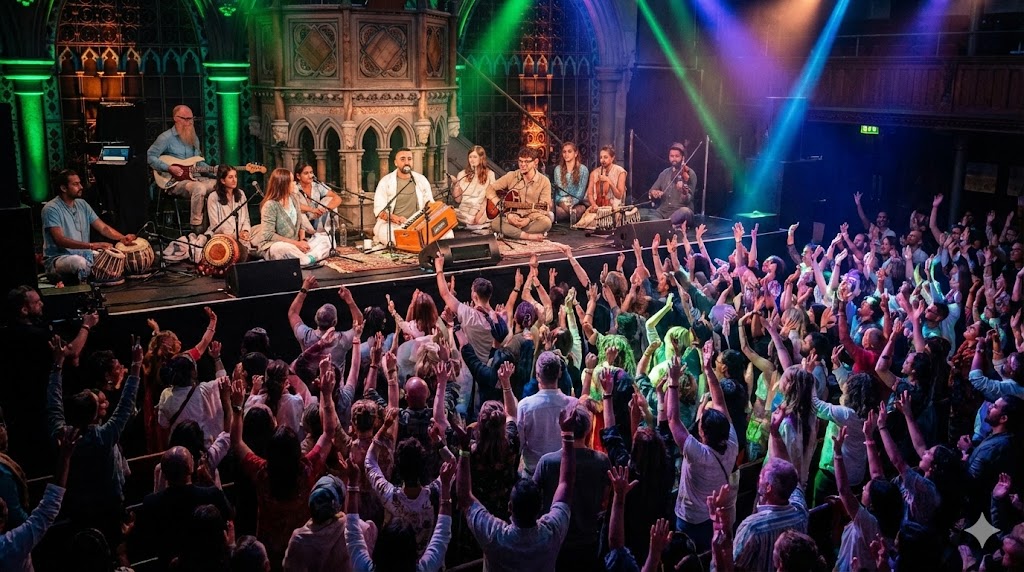
There is a moment, somewhere between the first chant and the hundredth repetition, when something shifts. The mind loosens its grip. The body sways without instruction. Voices around you rise, fall, and merge. You are no longer singing to the divine; you are singing with everyone else, inside a shared pulse of sound and silence. This is not a nightclub, nor a temple in the traditional sense. And yet, it feels deeply sacred.
Welcome to the world of Bhajan Clubbing, a growing cultural movement where bhajan and kirtan are reimagined as immersive, collective, high-energy experiences. Here, devotion does not whisper politely from the margins; it fills the room, vibrates through the chest, and reminds us that bhakti was never meant to be quiet or contained.
From temple floors to contemporary spaces
Bhajan clubbing is not about turning devotion into spectacle. It is about returning it to the body. Historically, bhajans and kirtans were always communal—sung together in temples, homes, village streets, and ashrams. They were participatory rather than performative, designed to dissolve the individual into rhythm, repetition, and remembrance. Over time, however, devotional music came to be associated with stillness, solemnity, or nostalgia. Something reserved for the elderly, the religiously observant, or the spiritually inclined. Bhajan clubbing gently and joyfully breaks that assumption.
These gatherings feel closer to music concerts than prayer meetings. There are microphones, musicians, professional sound systems, and sometimes atmospheric lighting. People stand, sway, clap, chant, cry, and dance. And yet, at its core, nothing fundamental has changed. The intention remains the same: to remember, to surrender, to connect.
What has changed is the context. Devotional music has stepped out of exclusively sacred architecture and into contemporary venues—auditoriums, cultural centers, festival grounds—meeting a generation hungry for meaning but wary of rigidity.
As one U.S.-based seeker put it candidly on Reddit, “Music is how I feel my religion — I would love to go to these but I doubt there is any in my Midwest midsize American city.” That sense of longing—for spiritual community without institutional pressure—is precisely what bhajan clubbing is beginning to address across the diaspora.
A global bhakti renaissance
Once largely confined to temples and ashrams, bhajan and kirtan are now finding new life across India, the UK, and the United States. From packed auditoriums in Mumbai to intimate yet growing gatherings in London, New York, and New Jersey, bhajan clubbing reflects a broader cultural shift: a generation seeking spiritual depth without inherited obligation.
These events are often alcohol-free, intentionally inclusive, and deeply participatory. They blur the boundaries between concert, prayer, and community gathering, offering what many attendees describe as a “clean high”—an elevated state generated not through substances, but through sound, breath, and collective presence.
At the heart of this movement are artists who understand that devotion does not need dilution to remain relevant. They are not performing for an audience; they are holding space with one.
The voices shaping contemporary bhakti
Among the most influential figures in the global kirtan and bhajan landscape is Krishna Das, whose gravel-soft voice has introduced millions to chanting as a living practice. His concerts feel less like performances and more like long, unhurried conversations with the divine. Deeply shaped by his years in India with Neem Karoli Baba, tracks like Om Namah Shivaya have become global anthems, often circling back to the Indian ashrams and festivals that shaped his spiritual foundation.

Radhika Das, rooted in the UK, brings sincerity, simplicity, and musical depth to his gatherings. Even in packed halls, his kirtans feel intimate. His widely loved Govinda Jaya Jaya reflects both his Western upbringing and his immersion in Bhakti traditions during extended time in India—a bridge between cultures rather than a dilution of either.
Jahnavi Harrison, trained in Carnatic music and shaped by years of devotional practice in Vrindavan, carries temple culture into modern spiritual spaces with quiet confidence. Her album Like a River to the Sea is gentle yet unwavering, deeply traditional yet effortlessly contemporary.
Representing a younger generation is Rishabh Rikhiram Sharma, the great-grandson of Pandit Ravi Shankar. His reinterpretations, such as Shiv Kailashon Ke Wasi, draw on India’s classical lineage while speaking fluently to global, digital-age audiences through rhythm, accessibility, and emotional immediacy.
Meanwhile, Nirvaan Birla brings a softer, approachable devotional tone to a generation often intimidated by orthodoxy. His widely shared Shri Ram Jai Ram reflects a conscious effort to keep bhakti welcoming rather than prescriptive.
Together, these artists remind us that bhakti is not frozen in time. It breathes, evolves, and meets us where we are.

Bhajan clubbing finds a home in the diaspora
This hunger for embodied devotion is no longer theoretical. It is taking shape in real, organized spaces across the diaspora.
A significant milestone came with New Jersey’s first-ever Bhajan Clubbing Night, a concept solely curated by Jyotsna Sharma—Co-Founder of Cultivate Talents Unlimited LLC, a New Jersey–based Women Minority Business Enterprise. Sharma, who is also an IT professional, freelance TV producer, anchor, journalist, and correspondent with South Asian media in the U.S., envisioned the event not as a performance, but as a participatory spiritual experience.
Her initiative reflects a broader movement among second-generation South Asians and Western spiritual seekers alike: reclaiming bhakti not as inherited ritual, but as lived, contemporary practice. These spaces answer a quiet but persistent call—for devotion without dogma, for community without constraint, and for spirituality that feels as alive as the lives being lived.
As one London-based attendee observed, “Growing up here, faith felt like something reserved for elders. Kirtan nights like these make devotion feel lived, not inherited.”
Why bhakti feels so alive here
What distinguishes bhajan clubbing from a typical concert is not sound, but intention. People do not attend to be impressed. They come to feel, to release, and to remember something essential that modern life relentlessly distracts us from.
There is laughter alongside tears. Stillness alongside movement. A sense of being held by sound rather than overwhelmed by it. For many, these gatherings become their first meaningful encounter with devotional music—not as obligation, but as experience.
Somewhere along the way, devotion was branded as old-fashioned, rigid, or irrelevant. Bhajan clubbing quietly dismantles that narrative. Look around these gatherings and you will see young professionals, artists, homemakers, seekers, and skeptics alike—many attending for the first time. There is no dress code. No theological test. Just rhythm, repetition, and reverence.
“Across India, the UK, and the US, bhakti is being reclaimed not as ritual, but as experience.”
In many ways, bhajan clubbing reveals something quietly radical: the structures of modern music culture—call-and-response, emotional build-ups, collective release—have always mirrored ancient devotional forms. The movement simply reconnects them to their spiritual roots.
When the sacred takes center stage again
What feels especially significant about this moment is that the sacred is no longer waiting politely on the margins of contemporary life. Devotional music is moving into modern spaces not because tradition is being reinvented, but because it is being remembered.
Young people are drawn to these gatherings not out of obligation, but out of longing—for collective chanting, shared silence, and experiences that feel real in an age of constant noise. What unfolds is not performance, but participation; not spectacle, but community-led devotion.
The sacred, it turns out, has not vanished from modern life. It has simply found new forms of expression. And when voices rise together, when rhythm carries prayer, when bhakti feels both contemporary and timeless, we are reminded of something essential:
Devotion was always meant to be lived aloud.

Leave a Reply