


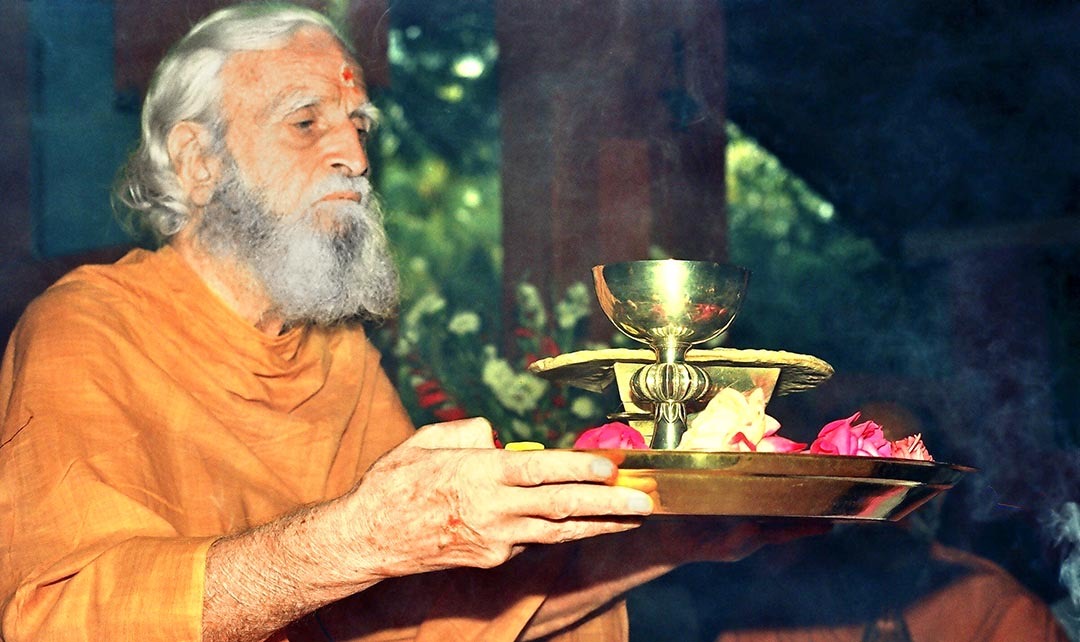
A British monk who turned to Indian spirituality. A man who wore saffron robes, read the Vedas and the Upanishads and preached about Christ. A Benedictine monk who lived in India for nearly forty years and was one of the pioneers of interfaith spirituality. Bede Griffiths was all this and more.
A meditator and a mystic, an author and lecturer on a Christianity, a bridge between Eastern and Western religious traditions, a purveyor of a lifestyle that returned to nature and an embodiment of peace himself, Bede Griffiths always sought to live in accordance with the ‘dharma’, in accordance with God’s will.
From Alan Griffiths to spiritual seeker
He was born Alan Richard Griffiths, at home on Walton-at-Thames in 1906 in a British middle-class family, youngest of three. He had a sister and a brother. Soon after his birth, Alan’s dad lost his business, cheated by a partner to the last penny. Mr Griffiths lost face and never regained his role or place in the family. Alan’s mother, who then became parents to the children had to move to less comfortable surroundings and had to go to work and manage her own housecleaning.
At the age of 12, Alan was enrolled in a public school for poor boys known as Christ’s Hospital. This tall, lean, poor boy ranked first in his exams and went on to receive a scholarship to Oxford. Alan studied English literature and philosophy from Magdalen College at Oxford from 1925 to 1929. It was during his third year at Oxford that the famous writer, poet and Anglican lay theologian C.S. Lewis became his tutor. The two went on to become great friends, with Lewis functioning as a mentor to him. Alan later graduated in journalism which would prepare him well for the 12 books he would later author, not to mention the multitudinous articles and conferences that would emerge in later life.
Conversion and Benedictine formation
After intense searching, Griffiths converted to Catholic Christianity in 1931 at the age of 25 and soon joined a Benedictine monastery in England. Monastic life was to give him discipline, prayer practice, the appreciation of silence and spiritual structure. Yet, over time, he felt Western Christianity lacked something he sensed in ancient spirituality – deeper contemplative roots. His turning point was to come over two decades later, in 1955, when he followed an inner calling to travel to India in search of Eastern spirituality.
Move to India
In 1955, he moved permanently to India – a radical decision at the time for a Western monk. He joined Western pioneers attempting to live Christian monasticism in Indian cultural forms. Eventually, he became head of Saccidananda Ashram (or Shantivanam) in Tamil Nadu in 1968, where his vision fully matured. He wore saffron robes, adopted Indian liturgical forms, integrated Vedanta philosophy into Christian teachings, practiced meditation alongside Christian prayer, and welcomed seekers from all religions to his ashram. In short, he stopped trying to adapt India to Christianity and instead allowed Christianity to grow organically on Indian soil. Shantivanam was to subsequently become a global meeting place for interfaith dialogue.
Global Influence and major works
From the 1970s onward, Griffiths gained international recognition. He travelled extensively in Europe and the United States, lecturing on interfaith spirituality and consciousness.
In 1979, the Benedictine Sisters of Perpetual Adoration founded Osage Monastery in Oklahoma, inspired by Shantivanam, and invited Griffiths as a roving lecturer. Many of these lectures later became The Cosmic Revelation.
In 1981, he delivered keynote addresses in Kansas at a conference titled Formation and Transformation from an Eastern Perspective. These talks became the audio series Riches from the East.

Meanwhile, back in India, he continued daily teachings on the Vedas, delivered homilies at Eucharist and Vespers, and worked on significant publications like The Marriage of East and West (1952), Rivers of Compassion (1987), his commentary on the Bhagavad Gita, and The New Vision of Reality (1989). The publication The Marriage of East and West was translated into multiple languages and became foundational to modern interfaith theology.
Illness, inner transformation and mahasamadhi (1990–1993)
At age eighty-four, Griffiths suffered a stroke. Yet he described the period that followed as one of profound interior awakening. He spoke of entering deeper states of unity consciousness and religious reconciliation.
Despite frailty, he continued traveling in 1991 and 1992, lecturing across the United States, England, Germany, and Australia. In Australia, he met His Holiness Dalai Lama, later remarking with gentle humor, “I do believe he liked me!”
He returned to Shantivanam in October 1992. An Australian film team completed A Human Search just days before his final stroke on 20 December 1992. On 13 May 1993, he entered what his followers described as Mahasamadhi at his hut in Shantivanam.
Inner struggles: Obedience, vocation and cultural in-betweenness
Griffiths’ journey was not without tension. As a Benedictine in England, he once faced possible assignment to urban social ministry. Torn between obedience to monastic superiors and his inner contemplative calling, he underwent a profound spiritual crisis. During a retreat marked by fasting and prayer, he experienced a breakthrough, later writing: “I was no longer the center of my own life.”
He wrestled with guilt — was his resistance ego or vocation? Ultimately, circumstances allowed him to pursue contemplative theology and Eastern spirituality rather than social ministry.
When he moved to India, new tensions emerged. He later admitted to feeling culturally uprooted — belonging fully neither to East nor West. Some Christians accused him of diluting Christianity. Some Hindus viewed him as still Western. His life became an experiment in inhabiting the space between traditions.
Like many monks, he also confronted the psychological demands of celibacy. He wrote candidly about transforming emotional and sexual energy into universal love — a discipline requiring lifelong vigilance.
You must be ready to give up everything, not only material attachments but also human attachments – father, mother, wife, children – everything that you have. But the one thing you have to abandon unconditionally is your self.
~ Bede Griffiths
The experience of sitting with him
Visitors arriving at Shantivanam often came burdened with emotional pain, religious confusion, crisis, or doubt. They expected a scholar. They encountered presence.
Griffiths rarely offered complex theological answers. He listened — slowly, attentively, without judgement. Many later said: “He made you feel accepted exactly as you were.”
Conversations felt spacious. Silence was comfortable. Anxiety softened. Some compared sitting with him to meditation — without being told to meditate. His authority emerged from stillness rather than charisma.
Legacy: East-West synthesis and modern spirituality
The man who influenced global interfaith thought lived in a mud-floored ashram with minimal comfort. Long before yoga and meditation became fashionable in the West, Griffiths travelled to India to live these disciplines daily. He anticipated movements we now see everywhere: Spiritual but not religious seekers, Meditation beyond dogma, Interfaith dialogue, Consciousness transformation, and East-West synthesis.
His legacy did not eliminate religious conflict or create universal spiritual unity. But it opened dialogue, inspired thousands, modeled humility. And it showed traditions can meet without fear.
For modern seekers who feel culturally in-between or drawn to multiple traditions, Bede Griffiths offers a viable spiritual pathway — contemplative, rooted, and integrative. He planted seeds for a global spirituality that would flower decades later.
For information about Bede Griffiths and his legacy, visit https://www.shantivanamashram.com/

Leave a Reply