


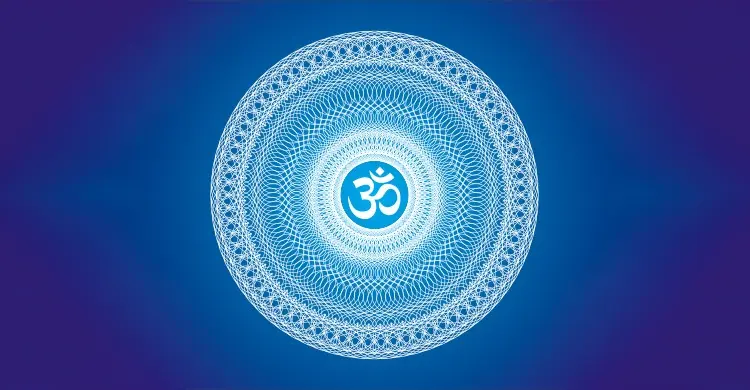
There are sounds that inform, and then there are sounds that transform. Among the most sacred and potent of these is Om – a primordial vibration, not born of language, but from the very silence out of which creation arose. It is not merely a syllable to be uttered but an experience to be entered, a resonance that transcends time, space, and form.
In the Indian spiritual tradition, Om is considered the original sound from which the universe emanated – the eternal hum of existence, the breath of the Divine. Revered as the sonic embodiment of Brahman, the ultimate reality, and Atman, the inner self, Om is not a concept to be understood intellectually alone, but a gateway to direct inner knowing.
This sacred vibration has traveled across civilizations, spiritual schools, and disciplines – chanted by sages in the forests of ancient India, invoked in yoga studios across the world, and echoed in the hearts of seekers longing to return home to themselves. Its presence in scriptures, rituals, meditative practices, and visual symbolism reveals a profound truth: Om is both the path and the destination. Besides Hinduism, this sacred syllable is deeply rooted in Indian spiritual traditions of Buddhism and Jainism also, and is used at the beginning and end of prayers, chants, and meditation.
Let us explore the mystical origins, layered meanings, visual symbolism, meditative practices, and universal relevance of Om – not just as an object of reverence, but as an invitation to stillness, presence, and divine remembrance.

The spiritual power of Omkara arrests the fluctuations of the mind. It draws the seeker inward, anchoring awareness in Brahman.
~ Yogi Brahma Vidya Chaitanyaji
Sound of the infinite
Before there was language, there was vibration. And at the root of that vibration lies Om – the eternal syllable that holds the universe within its sound. In the profound landscape of Sanatana Dharma, few symbols embody the entirety of existence as completely and concisely as the syllable Om.
Rajesh Sengamedu, a dedicated spiritual seeker and author, rooted in the Advaita Vedanta tradition of Arsha Vidya Gurukulam, offers a compelling exploration of this primal sound that reverberates at the heart of Vedic wisdom. He begins by illuminating the very origin of Om, tracing it to the Sanskrit verbal root av, which means “to protect.” From this root, Om becomes more than a sound – it becomes a sacred name of Ishwara, the Lord who protects and sustains all of creation. “When one chants Om with the understanding that it is a name for the Lord,” he explains, “one is not merely uttering a syllable but invoking the divine presence, offering a prayer for protection, and aligning with auspiciousness itself.”
Om, Sengamedu elaborates, is linguistically and spiritually complete. In the oral Sanskrit tradition, the syllable is composed of three parts:
A (अ), U (उ), and M (म्).
These are not merely phonetic components but carriers of layered meanings that mirror the totality of human experience. “A stands for the entire physical world and the experiences within it – the one who experiences, the experience itself, and the object of that experience,” Sengamedu notes. U symbolizes the thought world, encompassing imagination, memory, dreams, and the mental space distinct from the physical. And M stands for the unmanifest – the deep sleep state, the primordial silence from which creation emerges and to which it returns. “The sleeper and the sleep experience, the dreamer and the dream, the waker and the waking experience – all of these together make up everything that is,” he says, emphasizing that these three states and their experiencers are not separate from the divine but part of the indivisible whole that Om signifies. Thus, Om becomes a comprehensive symbol and sound-form of Ishwara, not limited by time, form, or condition.

Rajesh Sengamedu, a seeker rooted in the Advaita Vedanta tradition, illuminates Om as both sound and source – the name of the Divine that holds all existence within it.
He further draws attention to the universality of Om beyond its Sanskritic roots. In any language, sounds begin with the opening of the mouth and end with its closure. “The first sound we can utter is A – mouth wide open. The last is M – mouth fully closed. Every other sound falls between these two poles and can be symbolically represented by U,” he explains. Hence, Om as a sound encapsulates the entire range of articulation, making it a fitting symbol for the wholeness of creation. Sengamedu’s insight bridges phonetics and philosophy with striking clarity: “All names in any language are formed by combining letters, and letters are nothing but sounds. Om includes the full spectrum of sound, and thus, all names – every conceivable form or identity – are symbolically held within it.”
Yet Om is not only a linguistic or symbolic tool; its real power lies in what it points to. The philosophical meaning of Om, Sengamedu affirms, is that it signifies Ishwara – the cosmic intelligence and order manifest in this universe. “Scriptures don’t just tell us to chant Om – they help us see its meaning. Without knowing the meaning, Om is just a sound. But once its significance is revealed, it becomes a sacred connector between the knower and the known, the seeker and the sought,” he explains. This shift – from sound to meaning, from symbol to essence – is what transforms Om from a syllable into a spiritual gateway. It invites the practitioner to dwell in the presence of the infinite, not as an abstract idea, but as the very Self. Om is not merely uttered – it is realized.
To chant Om with understanding is to tune oneself to the cosmic rhythm of the divine, where the seeker, the seeking, and the sought dissolve into One.
The subtle inner pulse of OM
“Om ity ekākṣaraṁ brahma…,” thus begins one of the most potent revelations in the Bhagavad Gita (8.13), where Lord Krishna declares that the sacred syllable Om is not just a sound, but Brahman (the ultimate reality and the ground of all existence) itself. He affirms that one who leaves the body while meditating on this single syllable attains the supreme state – paramāṁ gatim.
Yogi Brahma Vidya Chaitanyaji, a young mystic from Tiruvannamalai and a direct disciple in the lineage of Ramana Maharshi and Yogi Ramaiah, embodies the living wisdom of this verse. A full-time sādhak since the age of 24, he met his guru – Yogi Protoplasm (Swami Prajna Aranya) – in Bangalore, and devoted himself entirely to spiritual practice, serving him until his Mahasamadhi. Like his guru, he now lives a life of austere simplicity, sustained solely on milk for the past eight years, and guiding seekers through profound meditation retreats focused on the ultimate question: Who am I?

Most people chant OM (actually A-U-M) for under 15 seconds. But with sustained practice, it can extend up to 30 or even 50 seconds. Start by taking a deep breath. Elongate the M by closing the lips and letting the sound to resonate.
Speaking of Omkara, Yogi Chaitanyaji unfolds its layered power. From the Vedic tradition, Om precedes the names of deities – Om Namah Shivaya, Om Namo Narayanaya – as the seed sound of invocation. Linguistically, it combines A (Aakar), U (Ukar), and M (Makar), coalescing into the sonic unity of Om, the Omkara. This triad encompasses all states of consciousness, the waking, the dreaming, and the deep sleep and symbolises the entirety of existence.
But the potency of Om is not just theoretical. According to Yogi Chaitanyaji, chanting Omkara can be practiced at three durations: Hrasva (short), Madhyama (medium), and Dirgha (long). It is the Dirgha, the prolonged version that brings the deepest transformation. “Most people chant Om for under 15 seconds,” he explains, “but with sustained practice, it can extend up to 30 or even 55 seconds.” He describes from his own practice how true chanting arises from the navel, inducing a spontaneous Uddiyana Bandha – a yogic abdominal lock – and leading to a state of breath suspension and inner absorption.
The modes of chanting Om also vary:
- Vācika Japa: aloud with voice
- Upāṁśu Japa: silent with subtle lip movement
- Mānasika Japa: mental repetition
Of these, Mānasika Japa, as endorsed by Ramana Maharshi, is considered the highest. When practiced correctly, the mind becomes still and begins to merge with the resonance of Omkara. Over time, Chaitanyaji shares, this leads to the inner experience of Anāhata Nāda, the unstruck sound where Om begins to vibrate within, unprompted.
He recounts a moment during the aarti at the Katyayani Temple in Vrindavan: “As the bells rang and the damaru and mridangam reverberated, their distinct sounds dissolved into a single experience. Everything was Om.”
This sonic unity is not poetic metaphor but experiential truth, echoed even in science. Chaitanyaji notes that modern NASA recordings have revealed a hum from the sun that resembles the sound of Om. Ancient sages always knew this: that Omkara pervades the universe.
Chanting Om, then, is not merely a practice – it is a return to the source. As Yogi Chaitanyaji emphasizes, “The spiritual power of Omkara arrests the fluctuations of the mind. It draws the seeker inward, anchoring awareness in Brahman.” Yet even beyond its spiritual fruits, he observes, regular chanting brings undeniable mental clarity and physical well-being.
When the sound of Om arises not just from the lips, but from the heart of one’s being, it becomes a portal – not just to peace – but to the eternal.

Om was not just sound – it was medicine for my soul. As I chanted, my body softened, my mind stilled, and I began to remember who I truly am.
~ Vandana Khaitan
OM as a Universal medicine, memory, and mystical map
Om is not merely a chant or a religious symbol – it is a living pulse, a primordial vibration that threads through the fabric of existence. Reverberating from ancient Upanishadic wisdom to today’s digital reels and podcasts, Om transcends language, religion, and culture, inviting each listener into an experience of inner stillness and universal connection.
Spiritual master Sri Sri Ravi Shankar has often spoken of Om as “the sound of the universe”, citing how even modern science aligns with ancient insights. “NASA has released the cosmic hum from Jupiter and the Sun,” he shares, “and it closely resembles Om.” For him, this is more than coincidence – it’s cosmic confirmation. “Om connects the breath, the mind, and the infinite. Meditating on it aligns us with cosmic intelligence.”
Echoing this, Sadhguru explains, “Om is not a chant, it’s a dimension.” He notes how across traditions, this sound shows up in different forms – Amen in Christianity, Ameen in Islam – suggesting a shared human impulse toward this deep vibrational truth. “If you sit still enough,” he says, “Om is naturally happening – it is the underlying reverberation of all life.”
On The Ranveer Show (TRS) podcast, a range of spiritual voices delve into the power of Om. Vedantic monk Om Swami speaks of its neurological effects: “Chanting Om synchronizes the brain’s theta waves, producing a meditative, peaceful state. It’s like a tuning fork for consciousness.” In another compelling episode, spiritual thinker Om Dhumatkar explores the Mandukya Upanishad’s concept of Turya – the fourth state of awareness embedded in Om. “Turya is not sleep, not waking, not dreaming,” he explains. “It is pure consciousness – the ground of being, like Shiva himself. All states arise from it and return to it. That’s what Om points us to.”
This vibrational medicine is also being passed on lovingly in modern family rituals. In a heartwarming Instagram reel, wellness guide Sargam Acharya is seen writing Om 11 times on her baby’s forehead, chanting it softly. “Om,” she shares, “enhances cognitive development, emotional regulation, sleep quality, and a profound sense of calm in children.” On the same platform, Acharya Prashant reminds viewers that Om is not merely phonetic. “It is not sound, it is the source of all sound. Go beyond the chant, into the silence it opens up.”
The transformative power of Om is not abstract – it is lived and embodied. Vandana Khaitan, found healing through Om chanting, guided by her beloved Guru Protoplasm. “It wasn’t just sound,” she says, “it was medicine for my soul.” As she chanted daily, her body began to recalibrate, her nervous system softened. “One can enter the Turya state – beyond pain, beyond thought. In that silence, I also found myself.” Vandana says that Om is a maha moksha mantra.
Through ancient wisdom and modern science, revered gurus and wellness influencers, sacred scriptures and online reels, Om proves itself again and again – not just as a sacred syllable, but as a gateway to wholeness. From shielding the aura to rewiring the brain with mindful intonation, from spiritual awakening to emotional balance in toddlers – Om is the seed and the soil, the call and the calm, the path and the presence.
Indeed, Om is not a sound we make. It is the sound that made us.

Leave a Reply